
Research Signal – Source date 2023-05-19
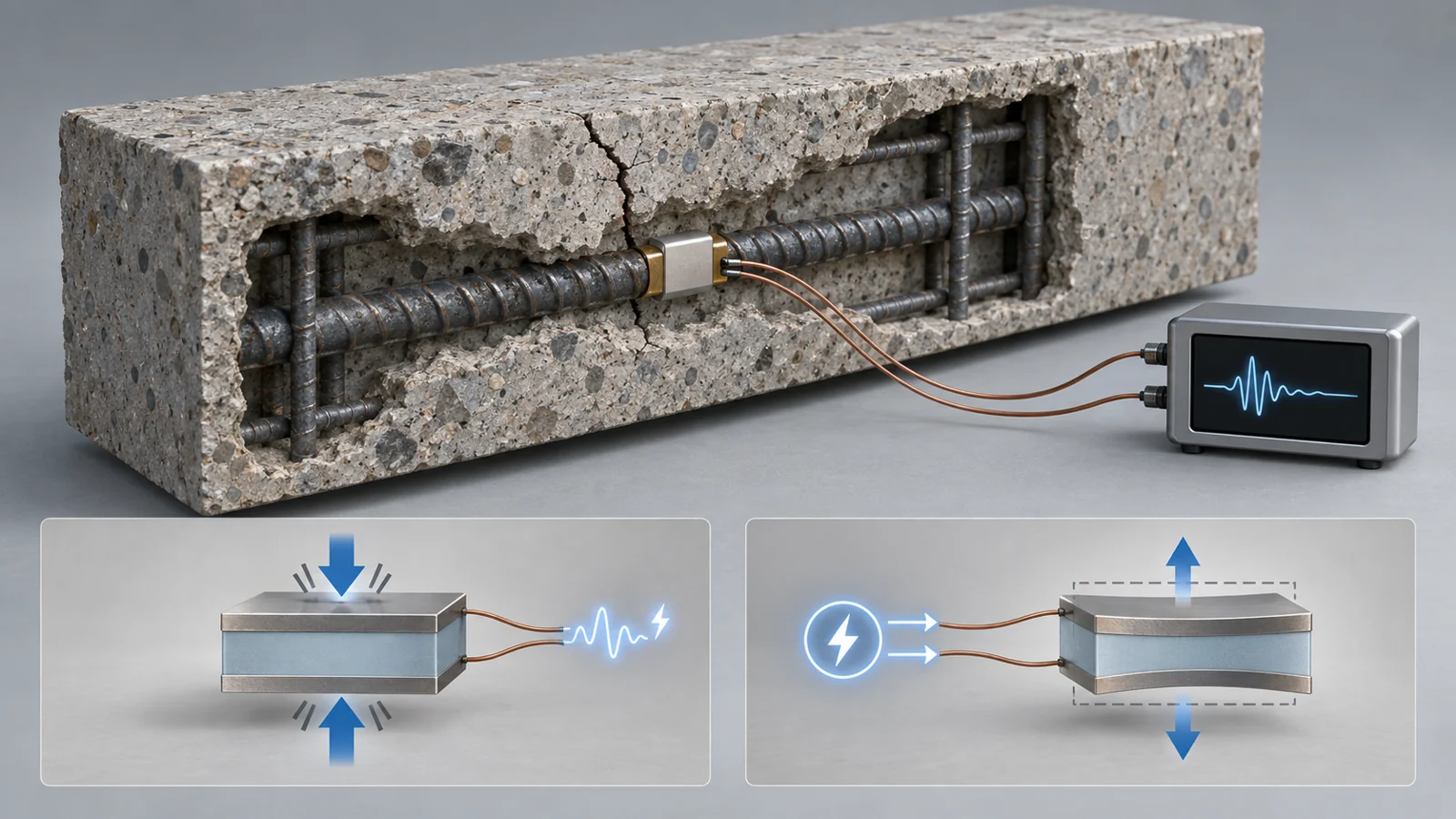
A concrete beam bends under load. A small sensor attached to its steel reinforcement responds electrically. As damage develops, that response can change, giving engineers another way to investigate what is happening inside the member.
The connection depends on piezoelectric materials, which produce an electrical response when mechanically stressed. They also work in reverse: applying an electric field makes them deform. Depending on how engineers connect and operate them, these materials can measure structural changes, exert a controlled force, or convert mechanical motion into electrical energy.
A review published in ACS Omega on May 19, 2023, brings together these civil engineering applications. Its examples range from experiments on concrete beams to mathematical models of vibration control and devices intended to harvest energy. The useful connection is a shared physical property. Each application then asks something different of it—information about damage, a commanded mechanical response, or enough electricity to operate a small device.
Comparing a beam with its undamaged state
A piezoelectric transducer converts between electrical and mechanical behavior. Attach one firmly to a structural member and its response becomes coupled to the material around it. That coupling allows an electrical measurement to carry information about mechanical changes.
One example described in the review used lead zirconate titanate, a piezoelectric ceramic usually shortened to PZT. Researchers attached PZT transducers to the reinforcement surfaces of two large-scale reinforced-concrete beams. They compared responses at different loading levels, including before and after the reinforcement began to yield, or undergo permanent deformation.
The approach used electromechanical impedance. In plain terms, an electrical input probes how the transducer and the attached structure respond together. Damage can alter that coupled response. Engineers first establish a reference for the undamaged condition, then compare subsequent measurements with it as loading changes.
In the beam study, the researchers used a numerical measure of deviation from that reference. The review describes differences between voltage responses from damaged and undamaged beams, including voltage drops associated with damage. The important observation is that the measurements distinguished changing conditions in those tested members.
This is a comparison process, not a direct electrical ruler for cracks. A particular voltage change does not automatically translate into a universal crack width, remaining load capacity, or decision about whether a building is safe to occupy. Interpretation depends on the tested structure, the transducer’s attachment, and the relationship established between loading, damage, and electrical response.
The undamaged reference therefore does real work. It gives a later measurement something meaningful to differ from. The sensor provides evidence of a change; engineering interpretation connects that evidence to the condition of the member.
Supplying electricity to control motion
The reverse piezoelectric effect allows a material to act as an actuator—a component that produces movement or force. Here, electricity enters the device and drives a mechanical response.
In an active vibration-control system, measurements feed a controller, which commands the actuator through an applied voltage. The actuator’s deformation produces a control force that changes the motion of the connected system. The review describes applications involving beams and plates, with performance depending on the controller, the piezoelectric element’s dimensions, its placement, and the supplied voltage.
This direction of energy flow matters. The control force comes from electrically driven actuation. Sensing the vibration and opposing it are distinct jobs, even when piezoelectric elements participate in both.
The review also shows how researchers investigate control at different levels. In one cited study, a mathematical model of a bar and piezoelectric transducer was checked experimentally using excitation at a single frequency. Another study calculated the seismic response of concrete frames incorporating piezoelectric layers, examining factors such as layer thickness and boundary conditions.
The component experiment tests whether a model captures a particular physical response. The frame calculation explores how a proposed structural arrangement might behave under modeled earthquake loading. Those results contribute different kinds of knowledge; a calculated frame response and a measured response in a laboratory component should remain distinguishable.
When the electrical output must do useful work
For sensing, a measurable electrical change can carry useful information. Energy harvesting adds another requirement: the output must supply an actual electrical load.
The review identifies wireless transmitters and sensor nodes as potential users of harvested energy. That makes the practical question specific. Could a device attached to a vibrating structural member collect enough energy, under the motion available there, to support its intended monitoring task?
Voltage alone cannot answer that question. A reported voltage amplitude describes part of an electrical response; delivered power also depends on current and the connected load. For a monitoring device, the timing matters too. Energy must be available in an amount and at intervals compatible with taking measurements and transmitting them.
The review discusses motion arising from wind, traffic, and human activity, as well as larger dynamic loads. It also describes designs that combine harvesting with vibration dissipation, including piezoelectric elements associated with cantilever structures used as tuned mass dampers. These examples connect energy collection to the mechanical behavior of a particular device. Their output depends on how that device is excited.
This is where a small electrical demonstration can easily acquire an oversized interpretation. A voltage trace does not establish a usable power supply, and an individual harvester does not establish an energy budget for a building. Even a device that powers its own sensor has met a much narrower demand than one that could supply an active structural-control system.
For infrastructure monitoring, that narrower demand is still worthwhile. The relevant comparison is between the harvester’s usable output and the needs of a small local instrument, under specified operating conditions.
The material has to fit the structure
Choosing a piezoelectric material means choosing how a device will survive and connect to its surroundings, as well as how it will respond electrically.
PZT appears frequently in the review’s sensing and actuation examples because of its strong piezoelectric response. It is also brittle and contains lead. Those characteristics bring mechanical integration and environmental considerations into the design. A material suited to producing a strong response still needs an attachment and protective arrangement appropriate to its location.
The review contrasts ceramics with polyvinylidene fluoride, or PVDF, a flexible piezoelectric polymer. Flexibility and ease of forming can help when a device must accommodate a large or complex shape. The authors also discuss modifying polymer materials to improve their piezoelectric behavior. Barium titanate is another alternative considered in the review.
These choices do not produce one winner for every application. A transducer bonded to steel reinforcement, a flexible sensing layer, and an element designed to bend repeatedly in an energy harvester face different mechanical demands. The material’s electrical properties must be considered alongside its shape, processing, and integration.
Packaging is part of that integration. One embedded sensor described in the review resembles an aggregate particle and has two distinct parts: a functional phase containing a piezoelectric ceramic chip, and a packaging phase made from a composite material. The researchers tested characteristics including sensitivity and response across changing excitation frequency and amplitude.
That separation makes the design problem tangible. The chip performs the conversion, while the surrounding package must accommodate its placement within concrete and transmit the mechanical interaction needed for measurement. A useful sensing material and a useful embedded sensor are different stages of engineering.
Carrying laboratory results into infrastructure
The examples assembled in the review answer several bounded questions. Measurements on loaded concrete beams show discrimination between damage states in those specimens. Controlled harmonic excitation tests a component under a prescribed repeating input. A seismic model calculates the response of a proposed frame using specified assumptions.
Moving those results into a building or bridge requires connecting each finding to its operating conditions. A transducer’s attachment must continue to transmit the relevant mechanical response. Measurements must remain interpretable as conditions change. A harvester must encounter suitable motion, and an actuator must have an adequate electrical supply and mechanical connection.
The selected experiments and calculations do not by themselves establish long-term service performance or earthquake protection in occupied buildings. Nor do they demonstrate that sensing, harvesting, and active control have been combined into one autonomous infrastructure system. Their value lies in showing mechanisms and configurations that can be investigated and engineered further, while preserving the distinction between measured behavior and calculated response.
What this could change
If durable piezoelectric sensing can be paired with a suitable local energy supply, monitoring could become easier to sustain in parts of infrastructure where supplying power is difficult. A small device could use available motion to support measurements and, where the energy budget permits, transmit information about structural changes.
The potential beneficiaries are the operators responsible for buildings and bridges. More accessible measurements could help them identify where further inspection is warranted and follow how a known condition changes between inspections. The causal path runs from reliable mechanical coupling, through interpretable electrical measurements, to information that can support maintenance decisions.
That possibility depends on durable integration and enough local mechanical energy for the intended device. Where those conditions can be met, the practical gain would be a monitoring point that is easier to keep operating—making changes inside a structural member more accessible to the people responsible for looking after it.
Key Sources
- Primary source: Piezoelectric Materials in Civil Engineering Applications: A Review.
DOI or Journal Page · Review or Meta-Analysis · 2023-05-19
Keep exploring