
Research Signal – Source date 2023-01-01
A carefully patterned material can guide a mechanical vibration along a chosen path. Could similar patterns control the heat moving through an electronic device? Both tasks involve vibrations in matter, but success with one does not automatically establish success with the other. Guiding a selected wave and changing the combined movement of heat-carrying atomic vibrations pose different physical problems.
The 2023 review Phonon Engineering of Micro- and Nanophononic Crystals and Acoustic Metamaterials connects these problems across micro- and nanostructures. It brings together theoretical foundations, fabricated devices, experimental observations, and numerical studies. Its useful contribution is to explain how geometry can influence vibration—and why the governing physics changes as structures become smaller.
At the microscale, examples include channels that guide mechanical waves and a transducer that connects microwave and optical signals. At the nanoscale, the discussion turns to atomic interactions and thermal conductivity, a measure of how readily a material conducts heat. Following that transition reveals both the power of patterning and the limits of a simple “blocked vibrations mean blocked heat” picture.
How a repeating pattern selects vibrations
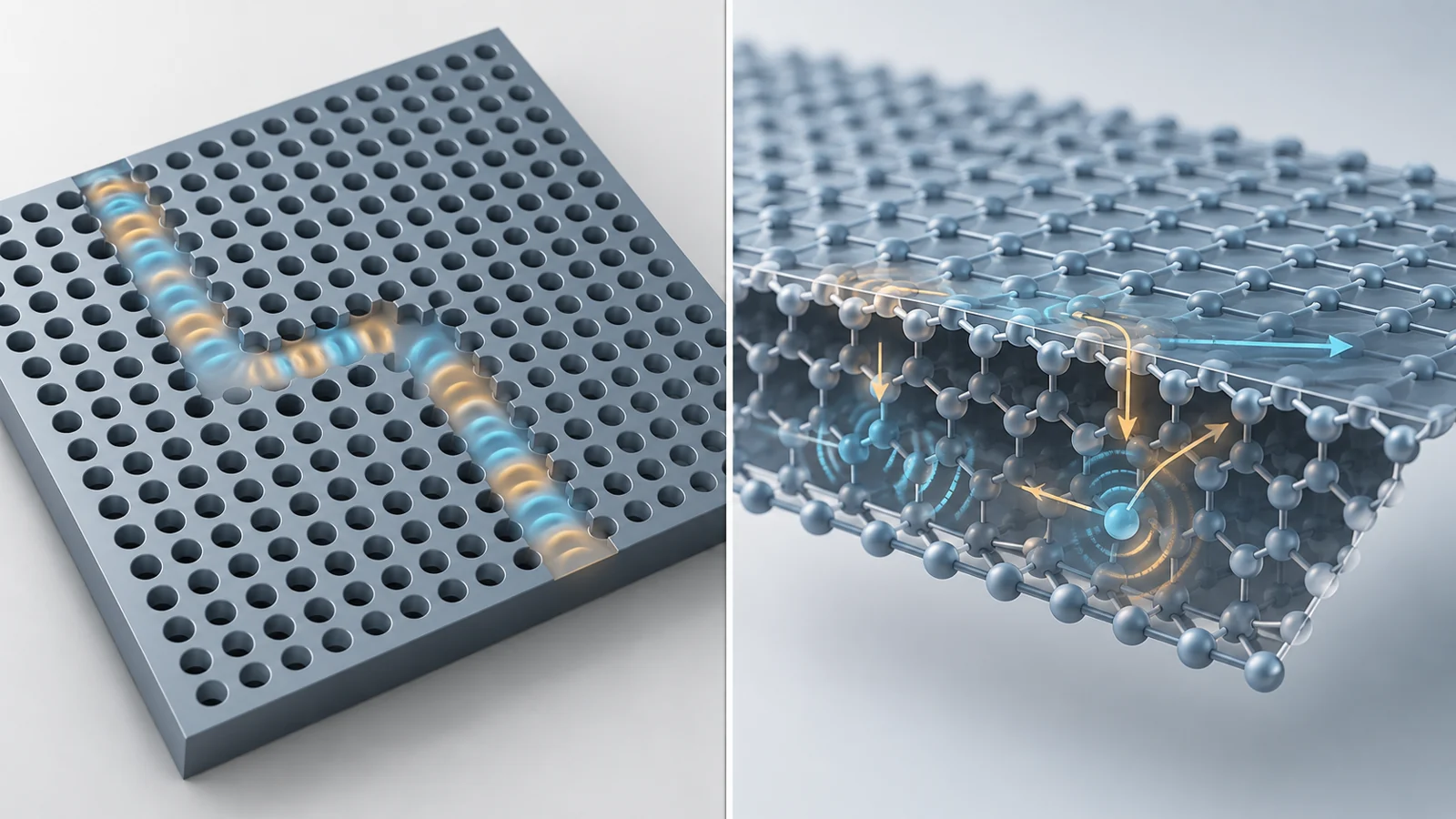
Imagine a plate with regularly spaced holes. One hole and its surrounding material form a repeating structural unit, or unit cell. Changing the cell’s shape, spacing, mass, or stiffness changes how mechanical waves travel through the whole structure.
A phononic crystal uses this repetition to control vibrations. Under the review’s naming convention, its cell spacing is comparable to the wavelength being manipulated. Acoustic metamaterials typically use features smaller than that wavelength and need not be periodic. Local resonances—the tendency of a small feature to vibrate strongly at particular frequencies—offer another way to influence propagation.
These categories can overlap. A single patterned plate may behave as a metamaterial for a long-wavelength vibration and as a phononic crystal at a higher frequency with a shorter wavelength. The distinction describes the relationship between structure and wave, rather than two completely separate families of objects.
To explain frequency selection, the authors begin with models of masses connected by springs. Repeating differences in mass or spring stiffness can create a bandgap, a frequency interval in which traveling waves cannot propagate through the modeled periodic structure. For the Bragg bandgaps discussed in the review, this behavior arises when the wavelength is comparable to the repeating distance.
That makes a bandgap selective. A structure designed around one frequency interval does not become a barrier to every vibration. Its behavior depends on which frequencies are excited and how the material and geometry shape the available patterns of motion.
Giving mechanical waves a route
A region that excludes certain waves can help define a route for them. Introduce a suitable path through a phononic crystal, and vibrations within the surrounding structure’s bandgap can travel along that path. The review describes a fabricated silicon carbide waveguide using this principle. The pattern provides confinement around a deliberately created channel.
Another reviewed experiment used annular holes of finite depth to control surface acoustic waves. Compared with the pillared structures used for comparison, the hole-based design produced stronger attenuation in the bandgap. Here the useful function was suppressing transmission over a selected frequency range. In the waveguide, the function was directing transmission along a chosen route.
Mechanical motion can also connect different kinds of signals. The authors describe an integrated, bidirectional microwave-to-optical transducer on a platform combining lithium niobate and silicon. It brought together a mechanical-wave transducer and an optomechanical crystal, which couples mechanical motion with light.
In this device, mechanical vibration serves as an intermediate step between microwave and optical signals. That is a distinct achievement from routing a wave through a channel. The review also identifies reduced material losses at cryogenic temperatures as a way to improve conversion efficiency. The operating conditions and the interfaces between components therefore matter alongside the geometry that controls the vibration.
Heat involves many vibrations at once
At atomic scales, the relevant vibrations are described in terms of phonons, the quantized excitations of a material’s atomic motion. In the nonmetallic materials discussed in the review, these excitations are major carriers of heat. Thermal transport involves a population of vibrations with different frequencies and propagation characteristics, rather than a single deliberately selected mechanical wave.
How much heat travels through a structure depends partly on how fast these excitations propagate and how far they travel before scattering. The average distance between scattering events is called the mean free path. Boundaries, impurities, defects, and interactions among phonons can all limit it.
This makes structural dimensions consequential in several ways. A boundary can interrupt transport. A repeating pattern can alter the allowed vibrations and their propagation speeds. Atomic interactions can redistribute energy among vibrations. The thermal result reflects how these effects combine across the population carrying heat.
The review’s treatment of superlattices—structures made from repeating layers—shows why reducing the repeating distance need not produce a steady reduction in thermal conductivity. When that distance is much larger than the phonon mean free path, scattering limits the influence of the repetition and weakens interference effects. With shorter repeating distances, wave behavior becomes more relevant, and the layered structure can change propagation and reduce conductivity.
Yet making the layers progressively thinner can reverse the trend. In the analyses discussed by the authors, changes in propagation speed compete with resistance to heat flow at interfaces. Calculations for some extremely short-period superlattices even predict thermal conductivity exceeding that of their constituent materials. These are calculated outcomes for particular structures, not a general rule for layered materials.
A bandgap can also have a counterintuitive role. In certain nanoscale calculations covered by the review, separating vibration bands reduces the opportunities for particular three-phonon scattering processes. Less scattering can favor heat transport, even though some frequencies are excluded. A wider gap therefore cannot, by itself, tell an engineer whether thermal conductivity will rise or fall.
This is the main break from the waveguide picture. A successful channel demonstrates control over the waves used to test it. Explaining heat flow requires accounting for the broader collection of vibrations and their interactions.
Temperature changes which effects survive
Wave interference depends on coherence: vibrations retaining a sufficiently well-defined relationship in phase. Many nanoscale experiments discussed in the review used low temperatures, where long-wavelength vibrations could interact coherently with patterns that researchers were able to fabricate.
As temperature rises, higher-frequency vibrations become more active and phonon scattering becomes more consequential. Transport can shift toward behavior that is better described through repeated scattering than through coherent interference. A pattern that strongly affects heat transport under cold experimental conditions may therefore have a different influence at an electronic device’s operating temperature.
The change is not an abrupt disappearance of all coherence. The authors cite observations indicating that some coherent, long-wavelength phonons persist at room temperature. The relevant question is how much those vibrations contribute in a particular material and structure, alongside the other carriers of heat.
The review also discusses numerical work on silicon membranes patterned with voids or resonators. Those calculations associate reduced thermal conductivity with slower propagation, reached through different mechanisms in the two designs. They illustrate why temperature-sensitive models must consider more than the presence of a gap: changes throughout the vibration spectrum can affect the thermal outcome.
Making the model match the material
Fabrication accuracy becomes a physical constraint at small scales. Repeated cells must have sufficiently consistent dimensions, and their thin or delicate constituents must retain the required strength. Variations in geometry can change the behavior that a calculation predicts for an ideal structure.
At the nanoscale, the model itself also has to earn confidence. The authors emphasize the need for appropriate descriptions of atomic interactions, sufficiently large simulated systems, and enough simulation time to obtain reliable averages. A convenient approximation can miss interactions that determine how energy actually moves, especially when temperature makes nonlinear behavior more important.
Measurements must then distinguish the proposed mechanism from other explanations. A reduction in thermal conductivity, for example, can involve boundary scattering, altered propagation speeds, or several effects together. Characterizing the vibrations helps connect a measured thermal change to the physical process responsible for it. A device-level cooling benefit would additionally depend on how that material fits into the device’s overall heat path.
Topological designs offer another approach to controlling waves, with behavior that can withstand certain small perturbations or disorder. The review presents this as an attractive direction, while identifying a substantial modeling gap at the nanoscale. The studies it discusses there rely on highly simplified models; realistic atomic networks and strong nonlinear interactions remain difficult to handle. Robustness to a specified disturbance is a useful property, but it does not establish immunity to every defect or source of loss.
What this could change
Reliable control of mechanical waves could give chip designers additional ways to move signals between components. A patterned channel could deliver a vibration to a selected location, while an efficient transducer could connect that motion to microwave or optical signals. If fabrication fidelity, propagation losses, and conversion performance become sufficient, these functions could support more closely integrated sensing and signal-processing systems.
Thermal engineering offers a separate design opportunity. Understanding how patterns change scattering and propagation could help engineers choose structures that conduct heat more readily or restrict it where thermal isolation is useful. That would make geometry an additional tool for managing heat, with the desired direction determined by the component’s role.
The authors extend their outlook to quantum information, where phonons could serve as a medium for transfer and distribution. If mechanical transport and its interfaces can preserve the required information while connecting different components, patterned structures could contribute to links between quantum sensors or processors. The reviewed waveguides and conversion devices supply relevant physical ingredients; realizing that larger capability would require those ingredients to work together under the necessary operating conditions.
Key Sources
- Primary source: Phonon Engineering of Micro- and Nanophononic Crystals and Acoustic Metamaterials: A Review.
DOI or Journal Page · Review or Meta-Analysis · 2023-01-01
Keep exploring