
Research Signal – Source date 2022-02-15
Phototherapy can be aimed at a tumor in one place. The larger question is whether destroying that tumor could also help the immune system respond to cancer elsewhere in the body. A 2022 review examines how researchers are designing peptide-based agents to bring those two aims together—and why the hoped-for effect beyond the treated site remains a research goal.
Small structures with several design jobs
Peptides are short chains of amino acids. In the approaches covered by the review, researchers design them to assemble into small structures, called supramolecular nanoagents, that can be used in photoimmunotherapy: treatment that combines light-based tumor destruction with an effort to stimulate an immune response.
The review identifies three properties that make peptide self-assembly attractive for this work. Stability concerns whether an agent can maintain its structure; targeting capability concerns where it may go; and flexibility concerns how its design can be adapted. These are design interests, not evidence that every agent achieves them or that a particular design performs better. The abstract does not specify individual peptide structures or report results for comparing them.
Pairing tumor destruction with immune stimulation
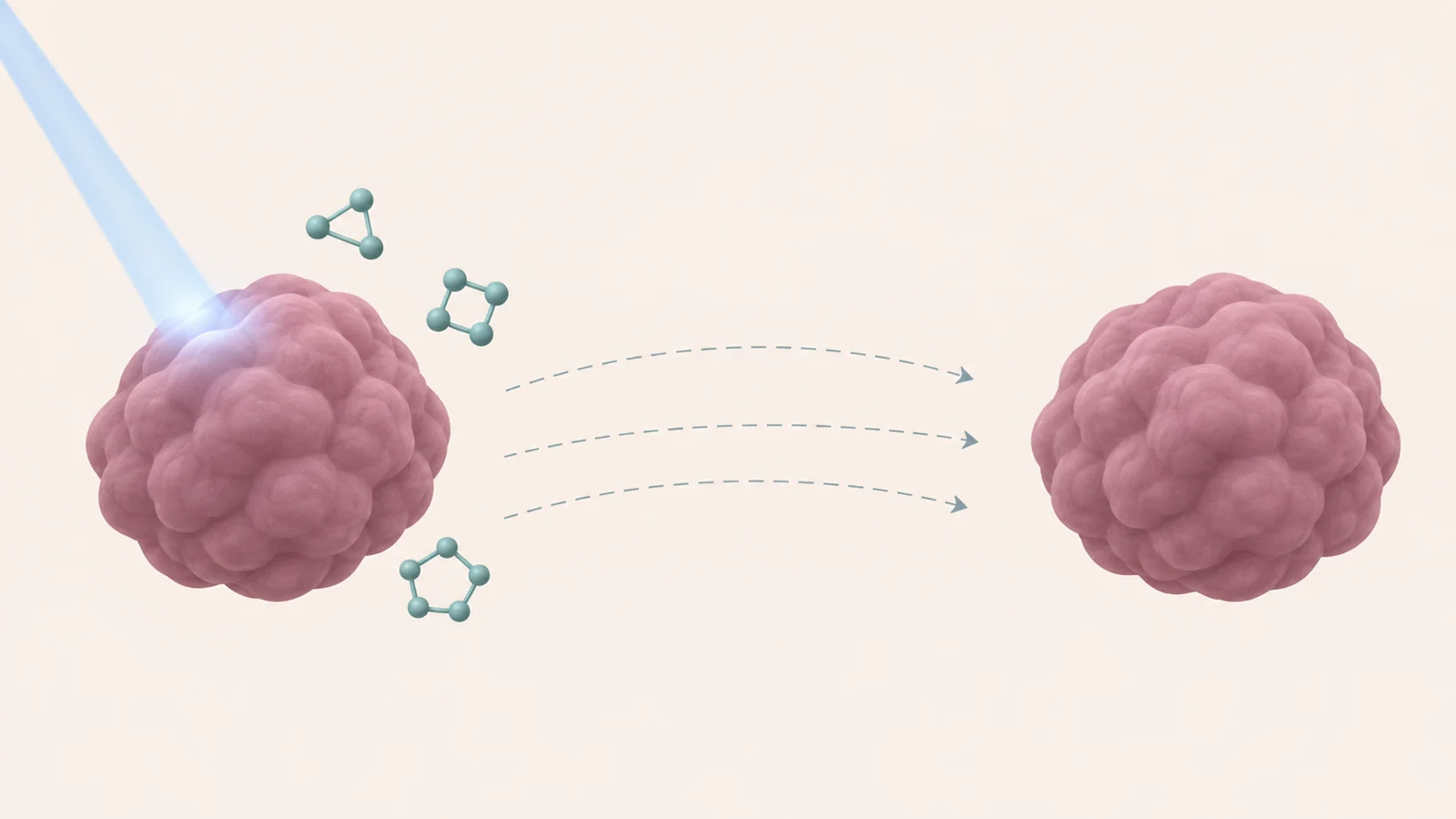
The proposed strategy starts with local treatment. Phototherapy is intended to ablate the primary tumor. The review describes the resulting tumor material as a possible in situ, or locally produced, vaccine that could prompt the host’s immune system to respond. If that response also recognizes cancer beyond the illuminated area, the effect could extend to distant disease.
That second step is the central ambition, not an outcome established here. The review brings together work on bioactive peptides—peptides included for their biological activity—and on combining them with photoimmunotherapy. Its focus is how the components might work together to amplify immune effects through multiple pathways. The abstract does not name those pathways or report effects at untreated tumors for any one approach.
This combination matters because local tumor destruction and a response elsewhere are distinct outcomes. A treatment could achieve the first without reliably producing the second. Peptide-built agents are of interest because their designed properties and combination with immune-stimulating approaches may help connect the two. The abstract gives no study-level effect sizes, comparative results or patient outcomes showing that this connection has been achieved.
What this 2022 review can support
The publication is a review of peptide-based supramolecular nanoagents for phototherapy-synergized cancer immunotherapy. It organizes design approaches, work combining bioactive peptides with photoimmunotherapy, and proposed mechanisms for strengthening immune responses. It offers a way to understand why researchers are exploring these combinations, rather than a clinical test of a new treatment.
In particular, the supplied evidence does not establish reliable control of distant metastases in patients, validate a specific peptide design, or demonstrate clinical readiness. Such claims require direct comparative and clinical evidence. The useful contribution is the research question it gathers around: how can the design of an agent make a local light-based treatment more effective at engaging the immune system?
Where this research could lead
For someone with cancer in more than one place, a future treatment directed at one tumor could be valuable if it also helped the immune system address disease beyond the treated area. The review’s proposed route to that possibility is to use peptide-built agents to improve how local phototherapy and immune stimulation work together. A dependable benefit at untreated sites would require further advances and clinical validation; it is not established by this review.
A nearer milestone would be a controlled comparison of peptide-based agents that measures both effects at the treated tumor and immune or tumor responses at untreated sites. Such evidence could show whether the proposed link between local treatment and responses elsewhere holds up, and how consistently it does so.
Key Sources
- Primary source: Supramolecular cancer photoimmunotherapy based on precise peptide self-assembly design.
DOI or Journal Page · Review or Meta-Analysis · 2022-02-15
Keep exploring