
Research Signal – Source date 2022-07-29
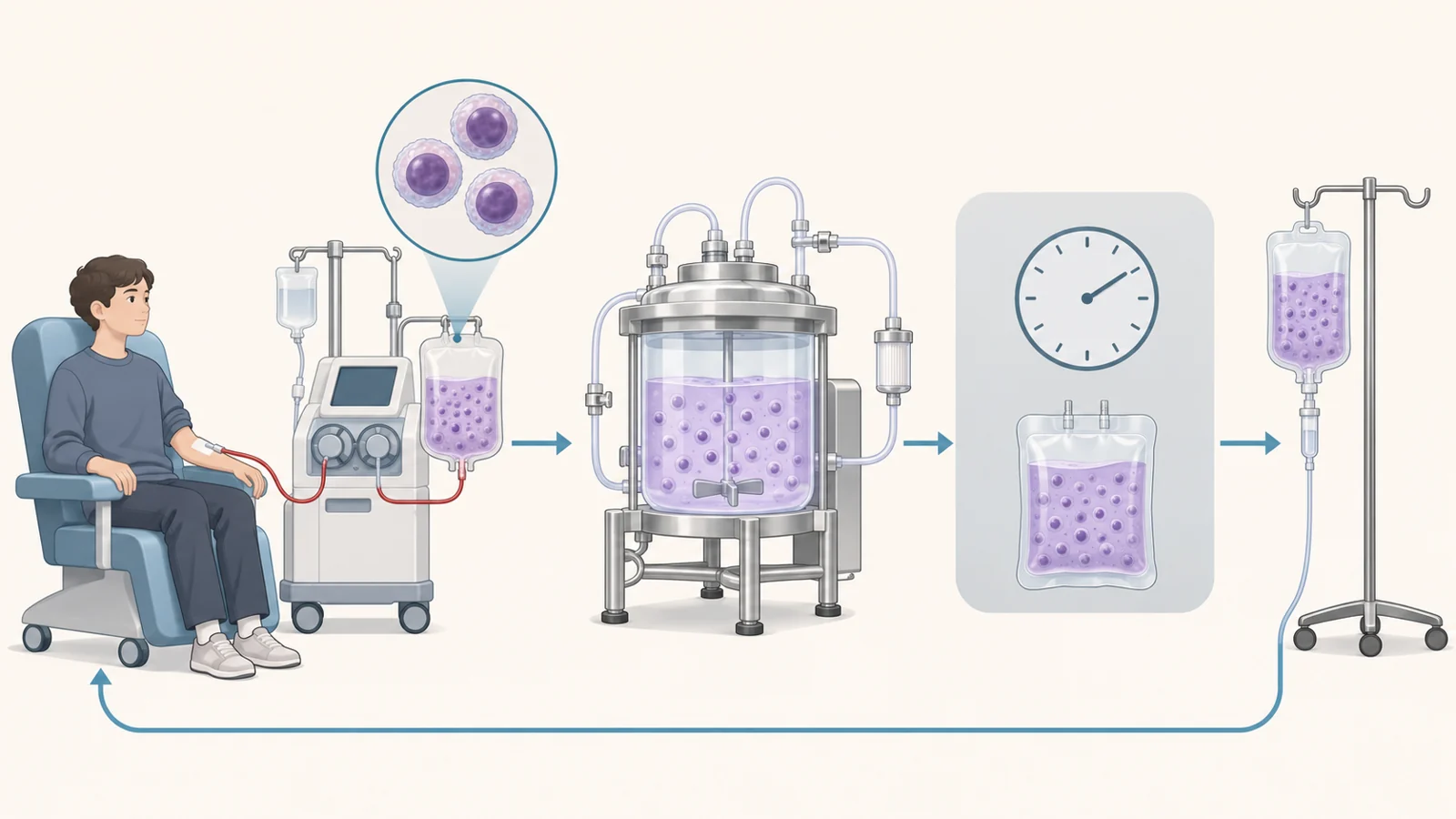
For a child with difficult-to-control leukemia, the time spent making a personalized treatment can matter. In its description of a proposed study, the research team identifies a concern: while a patient waits between T-cell collection and completion of the CAR T-cell product, the leukemia may become harder to control and the patient may grow sicker. The trial asks whether changing how those cells are made can address some of the manufacturing burden. It has not yet shown that the proposed process shortens the wait.
ClinicalTrials.gov first posted the study record on July 29, 2022. The current record lists an actual start date of September 20, 2022, says the study is recruiting, and reports no posted results. Those later status details describe the record as it stands in the supplied snapshot; they should not be read as information necessarily present when the study was first posted.
The treatment uses a patient’s own immune cells
CAR T-cell therapy begins with T cells, a type of immune cell, collected from the patient. They are engineered to carry a receptor that helps them recognize a target on cancer cells, then returned to the patient. In this study, the investigational cells are called huCART19: the engineered receptor is designed to recognize CD19, a molecule found on malignant B cells and also on normal B cells.
That target helps explain why the study plans to measure both antitumor activity and safety. The cells are intended to recognize CD19-bearing cancer cells, while the same marker is present on normal B cells. The registry describes a study for people with B-cell acute lymphoblastic leukemia (B-ALL) and B-lineage lymphoblastic lymphoma, and lists an eligibility age range from birth through 29 years.
A different route through the manufacturing step
The investigators describe first-generation CAR T-cell manufacturing as laborious, time-intensive and not automated, with substantial personnel and logistical demands. Their proposed alternative uses the CliniMACS Prodigy platform to process huCART19 cells at clinical scale in a functionally closed, sterile system. The registry presents this as a semi-automated manufacturing process intended to reduce some of those logistical burdens.
The proposed change is in production: the treatment being made remains huCART19. The study is designed to assess whether the cells can be manufactured and administered, alongside measures of safety and response. The supplied record does not give a verified comparison showing that the new route makes a ready-to-infuse product faster than the earlier process.
Patients enter the study in stages
The current registry describes a nonrandomized, sequential Phase 1 and Phase 2 study, with estimated enrollment of 115. First, a standard 3+3 dose-escalation phase is planned for participants previously treated with CD19-directed CAR T cells. Two dose increases are planned to help identify a dose considered safe for the next phase.
If at least one dose level is judged safe, the planned expansion phase can open. It has two cohorts: one for people with relapsed or refractory B-ALL who have not previously received CAR T cells, and one for people previously treated with CD19-directed CAR T cells. The groups therefore distinguish patients by prior CAR T treatment, while the expansion phase is planned to use the highest dose judged safe during escalation.
This sequence is meant to address dose and feasibility before expanding enrollment. Because the study is nonrandomized and proceeds in stages, its plan does not provide a direct randomized comparison of manufacturing routes.
Product checks and patient outcomes answer different questions
Manufacturing feasibility is one part of the evaluation. The registry plans to measure the share of manufactured products that fail release criteria, including requirements for gene-transfer efficiency, product purity, cell viability and sterility, as well as checks for tumor contamination. These measures concern whether a batch meets specified criteria for use; they are distinct from whether an infused patient responds or experiences a complication.
The study also plans to monitor adverse events and overall response. Among secondary measures are complete morphologic remission at Day 28 after infusion and, for participants with detectable disease, assessment of disease in marrow or elsewhere at one month. Other planned measures include whether huCART19 cells persist in blood and one-year event-free, relapse-free and overall survival in the two expansion cohorts.
The current registry has no posted results. Its sequential, nonrandomized design and listed measures do not supply a verified comparison showing whether the proposed manufacturing process is faster, whether more products meet release criteria, or whether treatment is safer or more effective. That is an evidence gap in the supplied record, not proof that investigators never measured manufacturing time or made other comparisons.
How this could shape the future
For a young patient whose leukemia is worsening during the wait for personalized treatment, a dependable and timely way to prepare their own engineered cells could eventually make the path to infusion less vulnerable to manufacturing delays. CAR T-cell treatment already exists; this study’s specific contribution is to test a semi-automated, functionally closed route for making huCART19 cells and to assess both product release and patient outcomes. The potential benefit depends on showing that production is timely, products reliably meet release criteria, and patient outcomes are acceptable.
A useful nearer milestone would be a reported comparison of the time from cell collection to a ready product, considered alongside release success and patient outcomes. That evidence would help show whether the manufacturing change translates into a more dependable treatment journey.
Key Sources
- Primary source: Autologous HuCART19 T Cells Manufactured Using the CliniMACS Prodigy Platform for Pediatric B-ALL (huCART19 Prodigy)
Government or Regulator · Clinical Trial · 2022-07-29
Keep exploring