
Research Signal – Source date 2022-07-08
When a checkpoint-blocking immunotherapy drug was added to chemotherapy, a 2022 analysis found higher pooled odds of cardiovascular side effects than with chemotherapy alone. Yet when researchers compared immunotherapy by itself with chemotherapy, they did not find a statistically significant increase. The answer changes with the comparison because each estimate comes from a different set of trials and asks a different question.
The analysis combined results from 50 phase III randomized trials. For combination treatment versus chemotherapy, the pooled odds of any reported cardiovascular toxicity were 1.53 times as high; for events graded severe or life-threatening (grades 3–5), the odds were 1.63 times as high. These are relative odds across trial groups, not a prediction that a particular patient’s risk rises by that amount. The analysis does not directly rank combination treatment against immunotherapy alone.
The treatment comparison shapes the answer
PD-1 and PD-L1 are parts of an interaction that can act like a brake on immune-cell activity. Some tumors use that braking signal to evade immune attack. Drugs that block PD-1 or PD-L1 loosen the brake, helping immune cells recognize and attack cancer cells. The same change in immune activity can also affect healthy organs, including the heart.
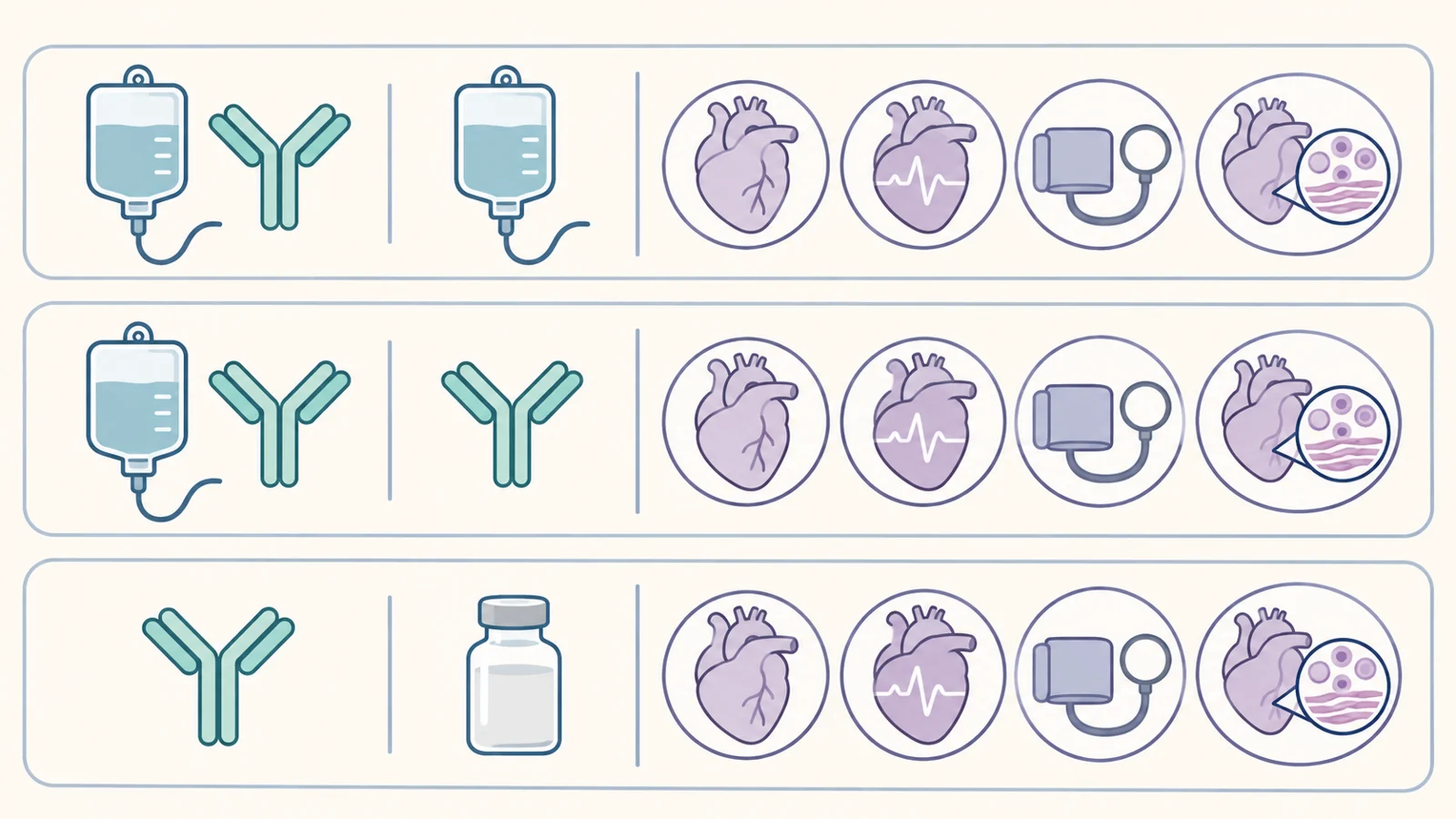
The review compared several different treatment arrangements. In one set of trials, a PD-1 or PD-L1 inhibitor was given alone and compared with placebo. In another, the inhibitor was added to chemotherapy and compared with chemotherapy alone. A separate comparison looked at single-agent immunotherapy versus chemotherapy. These groups of trials are not interchangeable: they involve different treatment regimens and trial populations.
That matters for interpreting the results. Single-agent immunotherapy had higher odds of all-grade cardiotoxicity than placebo: the odds ratio was 2.11, with a 95% confidence interval (CI) of 1.02–4.36. Its grade 3–5 result versus placebo was not statistically significant. Against chemotherapy, single-agent immunotherapy showed no statistically significant increase in either all-grade or grade 3–5 cardiotoxicity. The combination-versus-chemotherapy estimate, by contrast, showed higher pooled odds for both severity groupings.
An odds ratio compares the odds of an event between groups, and a 95% CI shows the uncertainty around that comparison. Neither tells a reader how many people will experience the event. The absolute chance depends on the underlying risk in the relevant population and treatment setting. These pooled estimates therefore cannot be translated into one universal heart-risk percentage.
Rhythm and blood-pressure events stood out
The broad cardiotoxicity category combines different kinds of reported heart and blood-vessel events. Looking at named outcomes separately gives a more specific, though still incomplete, picture.
Compared with chemotherapy alone, immunotherapy plus chemotherapy was associated with higher odds of all-grade arrhythmia, a disturbance in the heart’s rhythm (odds ratio 1.63; 95% CI 1.07–2.46). The estimate was also higher in the subgroup receiving a PD-L1 inhibitor with chemotherapy. The analysis did not find a statistically significant difference for severe arrhythmia; the number of events was too small for some severe-event comparisons to be analyzed reliably.
High blood pressure also appeared more often in the combination group. Its pooled odds were higher for all-grade hypertension (OR 1.34; 95% CI 1.02–1.77) and for grades 3–5 hypertension (OR 1.54; 95% CI 1.10–2.15). In the PD-1 inhibitor subgroup, the reported association was higher for both all-grade and severe hypertension. These are findings about the trial groups combined, not a forecast for an individual receiving a particular regimen.
Myocarditis—inflammation of the heart muscle—requires a different reading. The review did not find a statistically significant increase in myocarditis for combination treatment versus chemotherapy, but estimates were imprecise and severe cases were too sparse for some analyses. A nonsignificant result does not show that myocarditis cannot occur or that the treatments are equally safe for this rare event.
Lung-cancer trials show why context matters
The combination-versus-chemotherapy association was stronger in the non-small-cell lung cancer subgroup. The pooled odds were 1.97 for all-grade cardiotoxicity and 2.15 for grade 3–5 cardiotoxicity. The review did not find statistically significant differences in several other cancer subgroups, including breast, urothelial and small-cell lung cancer. That does not establish that those cancers or their treatments are protected from cardiovascular effects.
The authors pointed to possible reasons results could differ across cancer settings. Patients with non-small-cell lung cancer may have more cardiovascular risk factors, and chemotherapy regimens differ between cancer types. Some chemotherapy drugs can themselves affect the heart through pathways that differ from the proposed immune-related pathways. These are possible contributors discussed by the authors; the subgroup analysis did not establish why the association was stronger or isolate the effect of any one drug or patient characteristic.
The paper discusses several possible ways immune checkpoint blockade might contribute to heart injury, including immune cells reacting against heart tissue. Those explanations remain hypotheses in this analysis. Comparing reported events across treatment groups can identify an association, but it cannot show which biological process caused an event in a particular patient.
What the 50-trial synthesis can and cannot capture
The researchers searched PubMed, Embase and the Cochrane Library for randomized trials. The review was published on July 8, 2022. The team screened thousands of records and included 50 phase III randomized-trial reports with cardiovascular adverse-event data that could be extracted.
The trials’ randomized comparisons help estimate differences between the treatment groups studied. Pooling them can make uncommon outcomes easier to examine than in a single trial. But the evidence depends on what the trials recorded and reported. The review excluded trials that reported no treatment-related cardiovascular toxicity, as well as studies without extractable event data. This selection rule means the synthesis does not represent every trial of these treatments regardless of its cardiovascular reporting.
The authors identified high risk of bias in 11 trials, with incomplete reporting among the concerns. They also noted that incomplete event reporting could lead to underestimation, and that factors such as patients’ prior treatment could complicate interpretation. Trial populations and chemotherapy regimens varied, while some event categories were rare. Together, these features limit how precisely a pooled estimate can describe a specific person, cancer type or treatment plan. The available data did not let the authors examine whether results differed for men and women.
What this could make possible
If future evidence can provide dependable heart-event estimates for specific treatment regimens and patient groups, a person weighing chemotherapy plus a checkpoint drug and their cancer team could have a clearer basis for deciding which cardiac concerns deserve particular attention alongside the treatment’s cancer benefits. Blood pressure and heart rhythm are examples raised by this review’s findings; the paper did not test whether a particular monitoring strategy improves patient outcomes.
The review offers a reason to pursue that more tailored evidence: the pooled findings differed by event type, by whether immunotherapy was given alone or with chemotherapy, and in the non-small-cell lung cancer subgroup. The nearer milestone is consistent recording of cardiac events in future trials and patient-level syntheses, with absolute rates as well as relative comparisons across relevant regimens. If those results confirm which combinations and groups have meaningfully different risks, clinicians and patients could make monitoring decisions with more specific evidence than a single pooled odds ratio can provide.
Key Sources
- Primary source: Cardiovascular Toxicity With PD-1/PD-L1 Inhibitors in Cancer Patients: A Systematic Review and Meta-Analysis.
DOI or Journal Page · Review or Meta-Analysis · 2022-07-08
Keep exploring