
Research Signal – Source date 2024-01-15
A cancer treatment made from a patient’s own cells sounds highly specific, but using those cells does not guarantee that the immune response will control the tumor. Yet personalization does not make the process simple. The cells must be identified, collected, manipulated, expanded or loaded with tumor material, checked for quality, and delivered while the patient’s disease is still treatable.
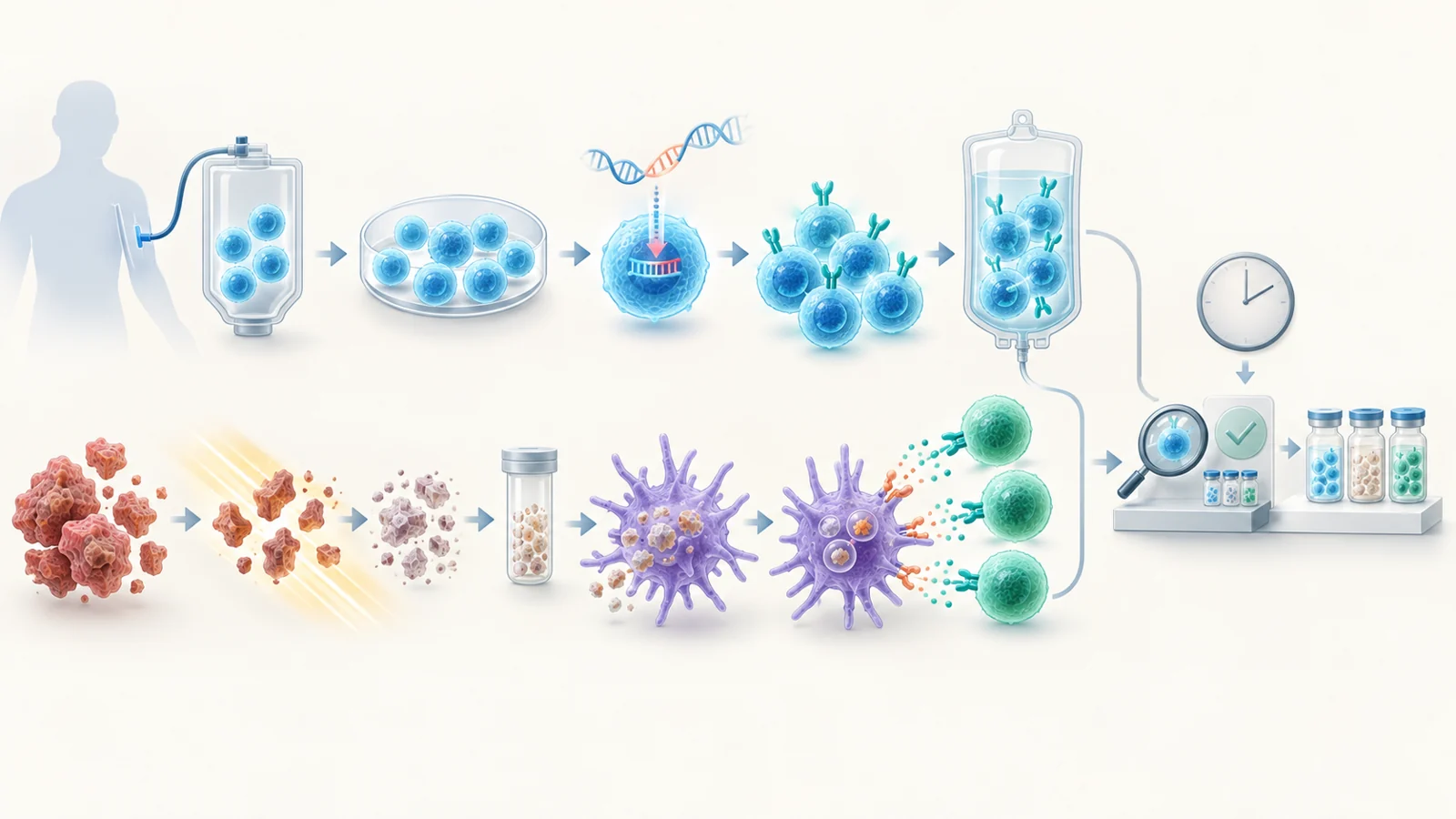
The January 15, 2024 review Engineering Challenges and Opportunities in Autologous Cellular Cancer Immunotherapy examines that engineering problem across four broad classes of therapy. Autologous means the cells come from the patient. Some approaches supply or expand tumor-attacking T cells outside the body. Others prepare tumor material or dendritic cells as a vaccine, so the patient’s immune system can activate a response after treatment. These approaches intervene at different points, and each creates its own manufacturing and safety constraints.
The treatment starts at different points in the immune response
Whole-tumor-cell vaccines use irradiated tumor cells or material from lysed tumor cells to expose the immune system to a broad collection of tumor-associated antigens. Antigens are molecular features that immune cells can recognize. In this vaccine approach, the tumor material is intended to help activate dendritic cells inside the patient, which can then prime tumor-specific T cells.
Dendritic-cell vaccines move part of that process outside the body. Dendritic cells are isolated from the patient and loaded with tumor lysate or selected tumor peptides, along with signals that help them activate T cells. The prepared cells are then returned to the patient. In this sense, the vaccine is doing more than delivering tumor material: it is trying to make the first stage of immune activation more reliable before the cells are infused.
CAR T-cell therapy and tumor-infiltrating lymphocyte therapy take a different route. Rather than asking the patient’s immune system to build the response from the beginning, they expand cytotoxic T cells outside the body. CAR T cells are genetically given a receptor aimed at a defined tumor antigen. TIL therapy expands T cells that have already entered a tumor, aiming to attack a broader, less predefined set of tumor-associated antigens.
The four classes therefore differ in what is being prepared. A vaccine prepares information and immune activation. A T-cell therapy prepares the attacking cell population itself. Neither description guarantees that the finished treatment will recognize enough cancer, remain functional, reach the right site, or be tolerated by the patient.
Recognition is more than choosing an antigen
A selected tumor antigen can make targeting precise, but precision creates a vulnerability when the tumor changes. If cancer cells reduce or lose the feature being targeted, the engineered or primed T cells may have fewer recognizable targets. The review describes antigen loss and tumor heterogeneity as reasons a response directed at an immunodominant antigen can eventually encounter resistance.
Broadening the antigen supply addresses a different problem. Whole-tumor-cell vaccines and tumor-lysate-loaded dendritic-cell vaccines can expose immune cells to the patient’s wider tumor antigenic repertoire without requiring the same prior selection of a particular neoantigen. But more antigenic information is not automatically a stronger attack. The available T-cell population may be dominated by lower-affinity clones, producing a response that is broad in principle but weak in practice.
Dendritic-cell engineering shows why recognition and activation must be considered separately. The tumor lysate may contain the relevant material, but it is not inherently immunogenic. The review describes approaches such as repeated freeze-thaw cycles, hypochlorous-acid oxidation, ultraviolet B irradiation, and heating to change how tumor material is taken up or processed by dendritic cells. These methods make the material more useful to the vaccine process; they do not by themselves demonstrate a clinical benefit.
Location matters as well. Dendritic cells need to reach places where they can activate T cells, including lymph nodes and tumor sites. Most dendritic-cell vaccines are injected intradermally, while intranodal and intratumoral delivery have also been explored. The review notes that fewer cells reach a lymph node after intradermal injection, yet intradermal and intranodal administration produced similar antigen-specific T-cell activation in the cited work. The most effective route was not settled by that comparison.
Other engineering efforts aim to improve trafficking rather than antigen loading. Researchers have induced expression of CCR7, a lymph-node-homing chemokine receptor, and have tested dendritic cells engineered to secrete CCL21 inside tumors. These examples separate several steps that are easy to blur together: obtaining tumor material, presenting it, moving the presenting cells, and activating T cells strongly enough to matter.
Time between cells and treatment is part of the problem
The interval from biopsy or collection to infusion is not just administrative waiting. It contains biological expansion, manipulation, release testing, and the patient’s changing clinical condition.
TIL therapy illustrates the pressure created by expansion. Early manufacturing processes could require six to eight weeks, during which some patients became too ill to continue; the review cites a 50% dropout rate in the first TIL trials. Later processes reduced manufacturing to roughly two to three weeks, and one design using G-Rex flasks was being tested to reduce the time to infusion from 22 to 16 days. Those figures describe particular manufacturing approaches, not a universal treatment schedule.
Whole-tumor-cell vaccine production can be biologically faster. The review describes manufacturing methods that take less than two days, but quality control may take up to three weeks. A short preparation step therefore does not mean the patient receives the product immediately. Sterility testing, release decisions, facility requirements, and the ability to complete the planned treatment all remain part of the practical timeline.
This matters because disease progression can close the treatment window before a personalized product is ready or before the patient completes the schedule. Faster manufacturing could help, but only if the shortened process still produces a product with the intended identity, function, and safety characteristics.
Production can change the cells being delivered
Cell manufacturing is a biological intervention. Expanding a population does not simply create more copies of an unchanged treatment. The conditions and duration of expansion can alter which clones survive, how differentiated they become, and how well they tolerate further stress.
TILs are a clear example. T cells in a tumor biopsy can be diverse in phenotype and function, but their composition may shift substantially during traditional expansion. More differentiated, antigen-experienced T cells may be less able to proliferate under manufacturing stress, even though they could be important for recognizing several tumor antigens. The review describes improved expansion protocols using agonistic signals against CD3 and 4-1BB alongside IL-2 to better preserve the original clonal diversity.
The idea of young TILs reflects the same tradeoff. Shorter expansion can preserve a less exhausted phenotype, while still producing a population with therapeutic activity comparable to the longer protocol in the cited work. Reducing time is therefore not merely a scheduling improvement. It can change which cells are present when the product reaches the patient.
Genetic engineering introduces another set of choices. Viral delivery has generally produced higher transduction efficiency and more stable gene expression, but it brings limits on cargo size, risks associated with random integration, and higher manufacturing cost. Nonviral methods can allow larger cargo and potentially reduce cost, but often produce lower transfection efficiency. Electroporation, the most common nonviral approach described in the review, can also alter T-cell phenotype and create toxicity concerns when large double-stranded DNA is used at high concentrations.
These tradeoffs help explain why a promising method in healthy-donor cells may not translate directly to a patient’s cells. The review describes functional CAR T cells produced in one day using T cells from healthy donors. Cancer patients may instead provide cells that are more differentiated, difficult to collect after prior treatment, or less enriched for naïve and memory phenotypes. Sorting cells before engineering may improve the starting population, but it can reduce quantity, affect function, and make manufacturing more complex.
Safety includes everything around the infusion
The infused cell product is only one part of the treatment burden. CAR T-cell therapy is associated with cytokine release syndrome and neurotoxicity, while TIL treatment can involve substantial toxicity from the preparation needed to help transferred cells expand in the body.
Engineering controls aim to make CAR T cells more manageable if they become dangerous. Suicide switches are intended to allow pharmacological depletion of the cells after an adverse event. Logic-gated CARs use more than one input signal: for example, an inhibitory signal can prevent activation when a healthy-tissue antigen is recognized, while a separate condition is needed for activation against a tumor-associated target. Spatial localization is another proposed way to limit where activity occurs. These controls address particular risks, but the review emphasizes that they are not completely effective and depend on identifying suitable combinations of tumor and healthy-tissue signals.
Lymphodepletion before adoptive cell therapy can improve expansion of the transferred cells by removing competing or suppressive immune populations and increasing access to homeostatic cytokines. It also creates its own risks. The commonly described cyclophosphamide-and-fludarabine regimen leaves patients lymphopenic and neutropenic for about seven days, with risks including neutropenic sepsis, anemia, and coagulopathy.
TIL therapy can add the burden of high-dose IL-2 after infusion. That regimen requires strict patient selection because of its toxicity. The review describes engineering efforts to reduce reliance on IL-2, including TILs designed to express membrane-bound IL-15 under the control of acetazolamide. Such approaches are attempts to change the support environment around the cells, not proof that the underlying treatment burden has been removed.
A more capable cell product could still require hazardous preparation or intensive cytokine support. Product engineering and treatment engineering must therefore be evaluated together.
Promising controls still face a translation gap
The review brings together examples from laboratory studies, animal models, and clinical work across different cancers and products. Their proximity on the same engineering map should not be mistaken for a common level of evidence or a ranking of the four therapy classes.
Healthy-donor CAR T-cell manufacturing is one useful warning. A process that rapidly produces functional cells from healthy donors may reveal what is technically possible under favorable starting conditions. It does not establish that the same speed, yield, or cell state will be achieved with T cells obtained from patients whose immune systems and prior treatments vary.
The same caution applies to attempts to edit exhausted TILs. PD-1-edited melanoma TILs improved efficacy in mouse xenograft models, but the review places their safety and efficacy in patients outside what those experiments could establish. A related clinical trial of CAR T cells edited at the PD-1 locus did not meet its prespecified median-survival criterion. Results from one setting therefore cannot be used as a shortcut to confidence in another.
Prediction models also depend on where their data come from. In CD19 CAR T-cell indications, machine-learning models using single-cell transcriptomic information identified a pre-infusion signature associated with clinical response. Monitoring after infusion has also linked changing CAR T-cell populations with disease progression, neurotoxicity, persistence, and exhaustion. Much of this work, however, has involved blood cancers. More evidence from solid tumors is needed before those models can be assumed to transfer to a different biological setting.
These mismatches are not reasons to discard engineering advances. They show what must travel with an advance: the relevant patient population, the actual starting material, the full treatment regimen, and the outcome being measured. Immune activation, successful manufacturing, and improved performance in a model are meaningful steps, but they are not interchangeable with demonstrated benefit for every patient.
What more reliable cell therapy could mean for patients
The practical promise of this field is not simply a more sophisticated cell product. It is the possibility that a personalized treatment could be prepared, checked, and delivered while the patient still has time to receive it and complete the regimen. Shorter production and release times could help preserve that opportunity, provided the process also maintains therapeutic function and meets safety requirements.
From the January 2024 perspective of the review, that remains a conditional prospect. If engineering approaches can reduce manufacturing delays, preserve useful cell diversity, control harmful activity, and work reliably with cells from relevant patient populations, more people eligible for personalized cell treatment could receive and complete it before disease progression closes their treatment window. That possibility does not promise wider eligibility or better survival on its own. It identifies the patient-facing value of making the entire path from cells to treatment more reliable.
Key Sources
- Primary source: Engineering Challenges and Opportunities in Autologous Cellular Cancer Immunotherapy.
DOI or Journal Page · Review or Meta-Analysis · 2024-01-15
Keep exploring