
Research Signal – Source date 2022-01-11
For people with Parkinson’s disease who already receive deep-brain stimulation (DBS), electrical stimulation delivered through implanted electrodes, sleep research is asking a more basic question than whether a new treatment works. Can the implanted system also provide a useful readout of the brain’s slow activity while sounds are played at night?
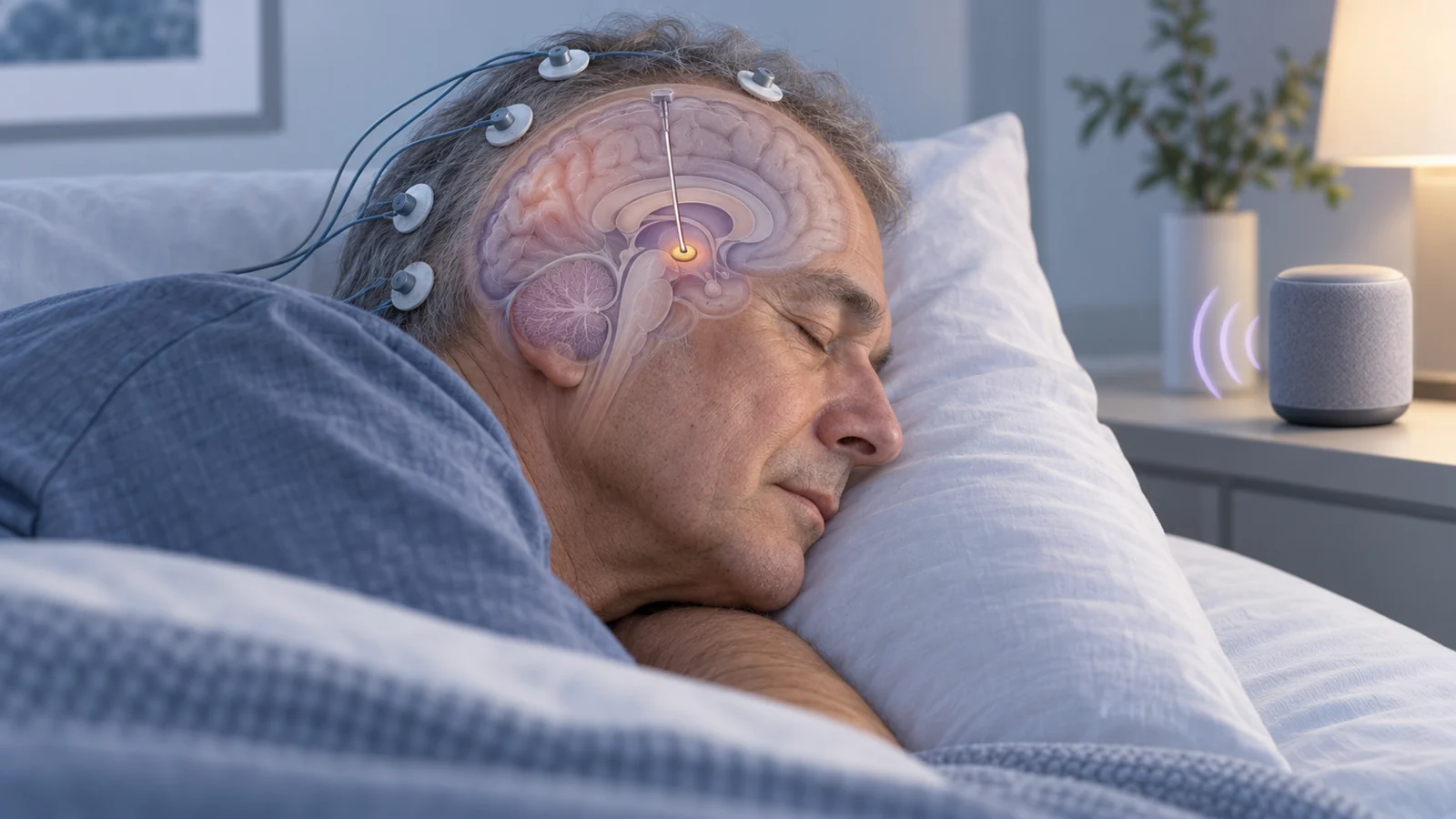
A registry entry dated January 11, 2022 describes an open-label human study designed to investigate that question. Its stated objective is to validate electrical activity in the subthalamic nucleus, or STN, for detecting slow waves during auditory stimulation. The study uses the PERCEPT DBS system and focuses on whether a deep-brain signal can be read alongside sleep activity. It is a proposed validation study, not a report of improved sleep.
Surface sensors and implanted electrodes answer different questions
The study brings together two recording locations. Surface electroencephalography, or EEG, measures electrical activity from the scalp and provides a view of cortical slow waves during sleep. The DBS electrodes sit in the STN, a deep brain region, and can record local field potentials. In plain language, local field potentials are small patterns of electrical activity detected near the implanted electrodes.
During the planned recording sessions, auditory stimulation would be timed using slow waves detected by surface EEG. The planned comparisons ask whether slow-wave activity seen at the cortex corresponds with activity recorded in the STN. Researchers would use coherence analysis to assess how closely the two signals move together. A close correspondence could support the idea that the implanted electrodes carry information relevant to sleep-related slow waves. It would not, by itself, show that sounds improve sleep or that the implant has successfully controlled sound delivery.
A screening night tests the individual response
Before the larger set of recordings, the study description includes a screening night in a sleep laboratory. Surface EEG would be recorded while auditory stimulation is applied, allowing researchers to assess whether a particular participant responds to the sounds.
The screening includes two related but different measurements. Event-related potentials, or ERPs, capture an electrical response associated with a sound. Slow-wave activity, by contrast, concerns changes in the broader pattern of slow brain activity during sleep. A participant might show a measurable response to a stimulus without that response amounting to a meaningful change in deep-sleep activity. Keeping those measurements separate helps the study ask whether the sounds are merely detected or whether they alter the sleep-related pattern the researchers are trying to influence.
The focus on people with Parkinson’s who are receiving DBS also matters. The proposed signal comes from electrodes already placed in the STN for that therapy, so the study is examining whether those recordings can carry an additional sleep-related use. The registration does not establish that every participant would respond in the same way, which is why individual susceptibility is part of the screening design.
Signal agreement is only the beginning
The study description connects several questions that should not be treated as one result. Researchers need to know whether cortical and STN slow-wave signals correspond closely enough for the implanted recording to help identify sleep activity. They also need to know whether auditory stimulation produces an electrical response or changes slow-wave activity in a given participant. A separate clinical question is whether using that information leads to better sleep in a way that matters to patients.
The registered description supports the planned measurements and comparisons. It does not establish successful validation, detection accuracy, improved sleep, or a demonstrated benefit from the proposed application. It also does not establish whether participants had enrolled or completed the procedures by January 11, 2022. Those are important differences between testing a measurement and showing that a treatment works.
What this could change
A reliable STN readout could eventually give researchers a way to time nighttime sounds using activity measured from the same implanted electrodes that support DBS. For people with Parkinson’s, that might open a route toward more individualized sound-based sleep support, with stimulation adjusted to signals recorded from the person’s own brain rather than treated as a one-size-fits-all intervention.
That possibility depends on two links holding up. The implanted signal would need to identify relevant slow-wave activity reliably, and sound stimulation guided by that information would still need to produce a meaningful improvement in sleep. The January 2022 registration describes the work needed to examine the first link; it does not provide evidence for the second.
Key Sources
- Primary source: Integration of Auditory, and Deep Brain Stimulation to Enhance Deep Sleep in Parkinson's Disease
Government or Regulator · Clinical Trial · 2022-01-11
Keep exploring