
Research Signal – Source date 2022-05-25
A drug can release the brakes on immune cells and still have little effect if those cells cannot reach the cancer. That problem helps explain why immune checkpoint treatments, which can benefit some cancers, have often struggled in pancreatic ductal adenocarcinoma. A different opening appears when a tumor has a specific weakness in DNA repair: in some patients, that weakness can make a drug that blocks another repair route more useful.
A review published May 25, 2022, examines both challenges alongside other experimental approaches. Its evidence ranges from biological studies to clinical trials of different sizes and designs. The examples point to distinct possibilities, not one treatment strategy for every pancreatic tumor.
The immune cells are often held at the edges
Pancreatic ductal adenocarcinoma, or PDAC, is the most common cancer of the pancreas. The review notes that PDAC accounts for more than 90% of pancreatic cancers. The review reports that only about 20% of PDAC cases are diagnosed early enough to be potentially resectable and that about half are metastatic at diagnosis. Even after surgery, systemic recurrence was reported in as many as 80–90% of cases. For advanced disease, chemotherapy remained the standard approach, yet median overall survival for metastatic PDAC was under a year in the evidence the review discussed. These are population figures, not predictions for any one person.
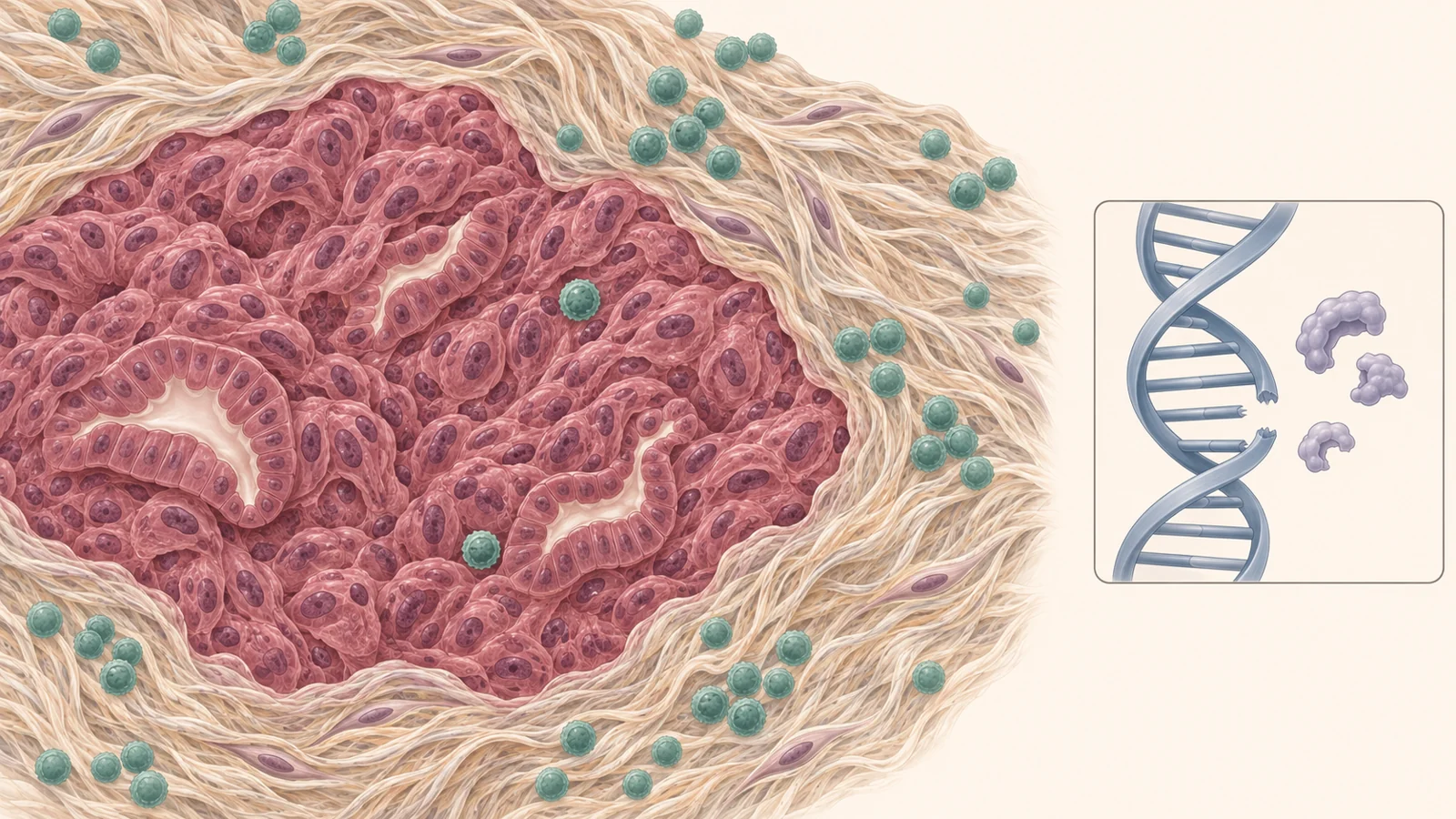
One reason the disease has resisted many immune therapies is its tumor microenvironment: the cells and surrounding material around a tumor that can shape how it grows and how immune cells behave. In PDAC, this environment often includes dense stroma, a network of supportive cells and proteins around the cancer. Pancreatic stellate cells and activated fibroblasts help build that network. They can release the chemical signal CXCL12, which attracts CD8-positive T cells but may leave them gathered in the stroma instead of next to cancer cells.
That placement matters. CD8-positive T cells can recognize and attack abnormal cells, but many PDAC tumors have few of them inside the tumor itself. The review describes this pattern as a “cold tumor.” Cancer cells can also reduce MHC I, a molecule that helps immune cells recognize them. Meanwhile, regulatory T cells and other suppressive immune cells can weaken the attack, and prolonged exposure to cancer can leave T cells less functional.
Checkpoint treatment blocks inhibitory signals that can restrain T cells. It can help those cells act, but it does not automatically solve the problem of getting enough functional T cells into a tumor. In the KEYNOTE-158 study cited by the review, 18.2% of 22 patients with PDAC had a recorded tumor response to pembrolizumab. The review also notes that only around 1–2% of PDAC cases are microsatellite-instability high, a feature associated with greater responsiveness to this treatment. That small subgroup does not describe most pancreatic cancers.
Getting immune cells inside is a different challenge from stimulating them
Some approaches try to change immune access. The review describes CXCR4, a receptor involved in signaling that can limit immune-cell movement in preclinical models. A phase II study combined the CXCR4 antagonist BL-8040 with pembrolizumab and chemotherapy for metastatic PDAC after prior treatment. A measurable tumor response was reported in 32% of the combination group; among responders, the median duration was 7.8 months. Those results looked favorable against earlier second-line treatment data, but that comparison cannot by itself show that the combination caused better outcomes; the review says larger trials were needed. They are an early response signal, not proof that changing immune access extends survival.
Vaccines take a different route: they aim to prime the immune system to recognize tumor material. Trials of GVAX, a whole-cell vaccine designed to help immune cells recognize tumor material, and other vaccine approaches had mixed results. Some studies showed immune responses or T-cell infiltration into tumors. Yet the review describes larger trials in which vaccine combinations did not improve overall survival over chemotherapy alone. For example, GVAX and CRS-207 with chemotherapy did not outperform chemotherapy alone, and a phase III trial of the peptide vaccine GV1001 with chemotherapy also did not improve overall survival.
The distinction is useful because an immune response is not the same outcome as a patient living longer. A vaccine may stimulate T cells, while dense stroma and other features still limit where those cells go or how effectively they work. The review points to combinations of vaccines and checkpoint blockade as one way researchers were trying to address that gap, but the reported immune activity had not yet become dependable survival benefit in the examples discussed.
A repair defect can create a narrower treatment opening
Some tumors have trouble repairing breaks in their DNA. Homologous recombination repair, or HRR, is one way cells accurately fix double-strand breaks. Genes such as BRCA1, BRCA2, and PALB2 help coordinate this repair. When HRR is impaired, a tumor may become more vulnerable to platinum chemotherapy, which causes DNA damage.
That vulnerability can also make a second repair-blocking approach useful. PARP inhibitors block a different DNA-repair pathway. When a cancer cell already has a weakness in HRR, disrupting another repair route can leave it unable to cope with accumulated damage. This interaction is called synthetic lethality: two weaknesses together can be fatal to the cell, although either one alone might be manageable.
The POLO phase III trial tested maintenance olaparib after platinum-based chemotherapy in people with metastatic PDAC and germline BRCA1 or BRCA2 mutations. Median progression-free survival—the time before cancer worsened—was 7.4 months with olaparib and 3.8 months with placebo. Overall survival was similar: 18.9 versus 18.1 months. The result supports a specific maintenance opportunity for a selected group, while the survival comparison remains an important part of the picture.
A repair-related mutation by itself does not guarantee that a tumor will respond. The review discusses a broader set of genes linked to HRR deficiency, but their roles in predicting benefit were less established than those of BRCA1 and BRCA2. Treatment combinations also raise practical concerns: some PARP inhibitor and chemotherapy combinations caused substantial blood-cell toxicity in early studies, while olaparib alone in POLO did not show increased toxicity compared with placebo. The mutation, treatment context, and regimen all matter.
A drug-binding pocket changed the KRAS question
KRAS is a cancer-driving gene altered in more than 90% of PDAC tumors. That high frequency can make it sound as if one KRAS drug should address most pancreatic cancers, but the drug-binding advance discussed in the review concerned a particular version, KRAS G12C.
KRAS had been difficult to target directly because its surface seemed to lack a suitable pocket for a drug to bind. New structural and measurement techniques helped identify a pocket in the G12C version, enabling small molecules to bind it. In lung cancer, a phase II study of the G12C inhibitor sotorasib reported a 37.1% response rate. Those results belong to lung cancer and cannot be transferred to pancreatic cancer as though the cancers or variants were interchangeable.
In an early study spanning several solid tumors, interim results for 10 people with PDAC and KRAS G12C showed partial tumor responses in five; all 10 had either a response or stable disease, a measure called disease control. This is a small pancreatic-cancer group, so it offers an initial indication of activity rather than a broad answer for PDAC. The review also describes resistance to first-generation G12C inhibitors, including changes that can interfere with drug binding. Other common pancreatic KRAS variants, such as G12D, required their own targeting advances.
A metabolic idea met a harder clinical test
Cancer cells can depend on nutrients in ways that differ from healthy cells. The review discusses asparagine, an amino acid that some PDAC cells may not make in sufficient quantities. Eryaspase, an enzyme treatment designed to reduce asparagine, was tested with chemotherapy as a way to exploit that potential dependency.
In a phase II study for advanced PDAC after prior treatment, eryaspase plus chemotherapy was associated with median overall survival of 6.0 months, compared with 4.4 months for chemotherapy alone. A subsequent phase III study did not meet its primary overall-survival endpoint: median survival was 7.5 months with eryaspase and 6.7 months without it. A trend in one irinotecan-based subgroup did not change the overall trial result. The contrast shows why a plausible metabolic weakness and an encouraging smaller study need confirmation in a larger controlled trial.
What this could make possible
A future patient whose pancreatic tumor keeps immune cells outside it could have a treatment option that reliably helps those cells enter before checkpoint treatment acts. That would turn immune access from a barrier into a solvable part of care, but it depends on developing and testing a combination that delivers dependable benefit for appropriately selected patients. The 2022 review supports the access problem and describes an early combination response signal; it does not establish that this future capability has been achieved.
One meaningful milestone would be a randomized pancreatic-cancer study in which an immune-access combination produces both greater immune-cell presence inside tumors and longer overall survival against an appropriate treatment backbone. Seeing both would connect the proposed mechanism to a benefit patients can feel. The separate DNA-repair route also shows why progress may arrive for defined groups first: a tumor’s particular weakness can open a treatment opportunity even when a broader approach stalls.
Key Sources
- Primary source: The Next Frontier in Pancreatic Cancer: Targeting the Tumor Immune Milieu and Molecular Pathways.
DOI or Journal Page · Review or Meta-Analysis · 2022-05-25
Keep exploring