
Research Signal – Source date 2025-07-10
A carbon-capture material can lose much of its ability to bind carbon dioxide while its porous support still looks largely intact. In laboratory tests reported on July 10, 2025, oxygen damaged the small molecules attached inside several metal-organic frameworks (MOFs)—porous scaffolds built from metal sites linked by organic molecules—more readily than it damaged the scaffolds themselves.
The difference matters because the attached molecules do the chemical catching. In a reference material, exposure to dry air at about 25 °C for 60 days reduced measured CO2 uptake by roughly 15%. A separate, harsher test—dry oxygen at atmospheric pressure and 100 °C for five days—caused a substantially larger loss. Heating the material at 100 °C under argon for ten days produced only minor changes to its CO2 uptake profile. These were different laboratory schedules, so they do not form a direct, like-for-like rate comparison. The argon result does, however, point to oxygen as the main factor behind the loss under the accelerated conditions.
Why the attached molecules do the catching
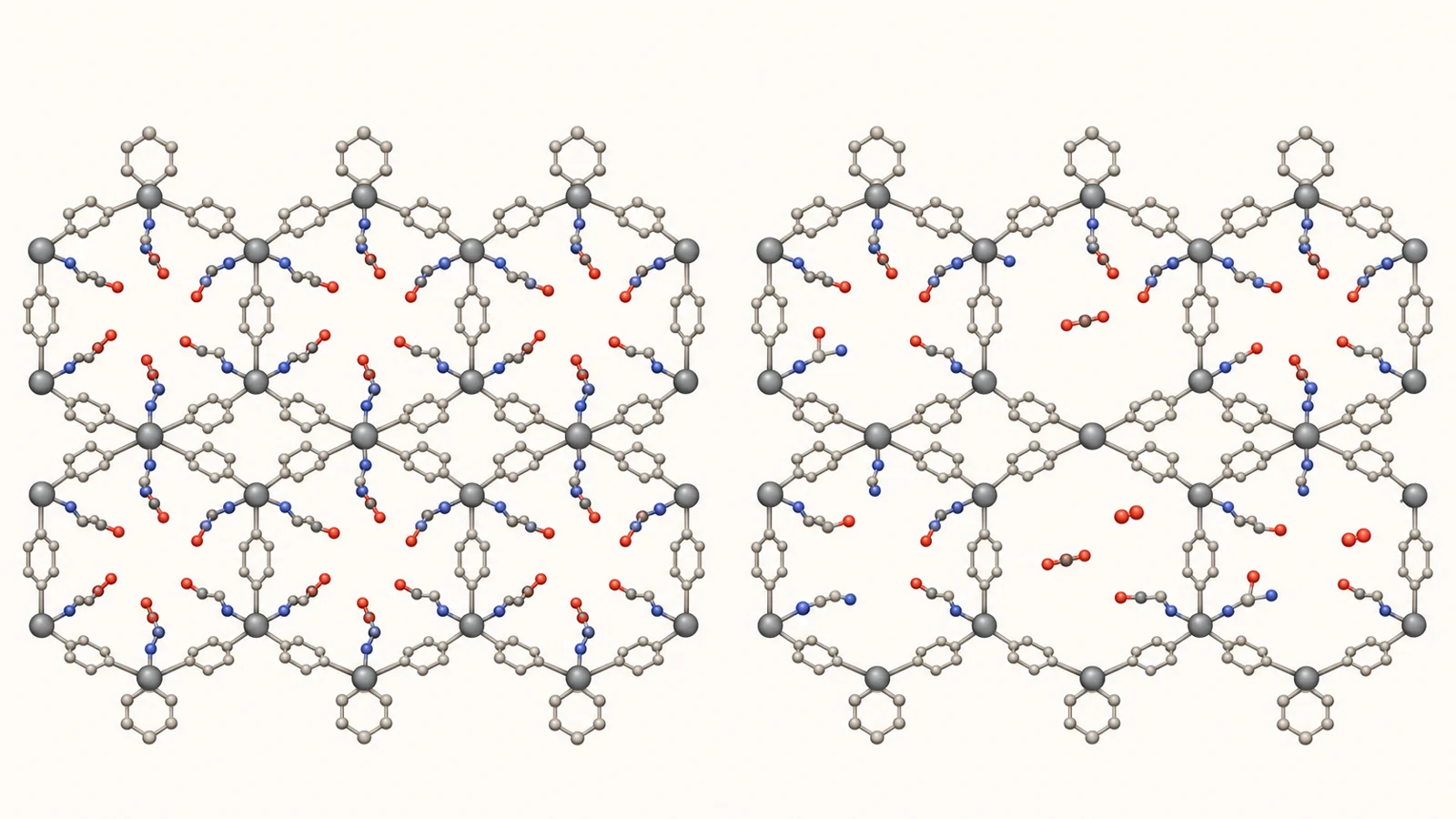
The study focused on diamine-appended MOFs. A diamine is a molecule with two nitrogen-containing amine groups; in these materials, diamines attach to metal sites lining the framework’s pores. When CO2 binds at one site, it can help neighboring diamines bind more CO2 in sequence. This cooperative process produces a sharp rise in uptake over a narrow range of temperature or pressure, and can bring the material close to one CO2 molecule per diamine.
The cooperative binding depends on the diamines remaining chemically available. Researchers found that oxygen-exposed samples could still physically hold some CO2 in their pores, but they lost much of the signal associated with CO2 chemically bound to the diamines. In the reference material, solid-state carbon-13 NMR—a way to distinguish carbon in different chemical environments—showed a strong signal for chemically bound CO2 before exposure. After 15 days in oxygen at 100 °C, that signal had largely disappeared; the main remaining signal came from CO2 held physically in the pores. The pores could still hold gas, but the cooperative chemical binding had largely been disrupted.
The scaffold held up better than its cargo
The researchers compared seven diamine-appended materials and used several measurements to locate the damage. In the reference e-2–Mg2(dobpdc), analysis of acid-digested samples found less of the attached diamine relative to the framework’s organic linker after oxygen exposure. New signals appeared in the diamine-related region, while the signals associated with the linker changed little. The CO2 uptake step also weakened and broadened.
Other structural measurements told a similar story about the support. After 15 days in oxygen at 100 °C, the reference material’s powder X-ray diffraction pattern remained nearly identical to that of the pristine sample, and its measured surface area was similar. Across the tested materials, the linker signals, porosity observations, diffraction patterns and microscopy were consistent with frameworks that remained substantially intact under these exposures. The measurements do not establish that every pore or framework feature was unchanged; they show that the attached amines were the more vulnerable component in the tests.
That diagnosis suggests a different way to think about material loss. A capture solid may lose performance because the molecules responsible for binding CO2 have changed, even if its supporting lattice remains usable. Whether that distinction can support practical maintenance depends on restoring the capture behavior reliably, not only on keeping the scaffold’s structure.
The diamine structure changed the outcome
Oxygen did not affect every attached diamine equally. After five days at 100 °C, materials carrying en or e-2 diamines retained roughly half their original CO2 uptake, with their sharp adsorption steps becoming shallow. The mm-2 versions changed less; after 15 days, they still showed a distinctive uptake step and evidence of chemically bound CO2. The diamine’s molecular structure therefore influenced how well capture behavior survived oxygen exposure.
A more substituted diamine called tmen showed strong retention in accelerated tests. Its loading in two tested frameworks remained largely unchanged after ten days in oxygen at 100 °C. The result supports the idea that changing a diamine’s structure can hinder degradation, though it does not by itself make tmen the best capture molecule. A design that resists oxidation still has to bind CO2 cooperatively, fit within the pores and provide useful overall capture performance. The study identifies a tradeoff to resolve, rather than a single winning structure.
Traces of broken bonds point toward radicals
The team looked for products to understand what happened to e-2 during oxygen exposure. Solid-state NMR supported the presence of ethylamine among the products left in the framework, while gas-phase measurements and oxygen-isotope tracing supported the formation of acetaldehyde and carbon dioxide among volatile products. The study also identified water and other aldehyde- and imine-containing species. These observations are consistent with cleavage of carbon–nitrogen bonds in the diamine, but they do not identify every product or establish one complete reaction route.
Calculations were used to examine how such cleavage might begin and spread. The proposed sequence starts with a highly reactive hydroxyl radical, which could remove a hydrogen atom from an amine. Fast transfers of hydrogen atoms could then create carbon-centered radicals—reactive sites on the diamine’s carbon atoms. Those radicals can react with oxygen, and the modeled reactions suggest routes to further bond breaking. In the calculations, breaking an oxygen–oxygen bond appears likely to be a slow step that affects the overall reaction rate.
Several observations help test parts of this account. Adding iron to the reference framework accelerated diamine loss: after five days at 100 °C in oxygen, the share of metal sites carrying e-2 fell from 90% to 22%, compared with a drop from 100% to 52% without added iron. This controlled comparison is consistent with trace transition metals helping generate reactive oxygen species, but it does not prove that iron is the only initiator in other materials or conditions. Exposing the reference material to oxygen in darkness produced only a marginally higher CO2 uptake than the regular exposure, suggesting that light was not a major factor in these tests.
A radical formed on one diamine could also affect its neighbors. The proposed propagation chemistry includes steps in which reactive intermediates transfer hydrogen atoms among nearby amines, multiplying reactive sites. The calculations suggest that molecular spacing and diamine shape could influence how readily this happens. But the chain-reaction account remains a mechanistic proposal: the researchers note that confinement within pores, interactions with the metal sites and processes involving several amines can change reaction behavior. Simple molecular models cannot capture every effect inside the framework.
The experiments establish neither a service lifetime nor performance through repeated cycles in an industrial gas stream. They also do not show that the degradation-resistant structures retain all the capture advantages needed in a working system. The evidence is strongest for a localized diagnosis under the reported exposures: the diamines degraded, CO2 chemisorption weakened, and the supporting frameworks remained substantially intact.
Where this research could lead
If that weak point can be managed through realistic operating cycles, an operator might eventually restore a capture bed by renewing its attached CO2-binding molecules while keeping the porous scaffold in service. The study includes a preliminary replacement demonstration: after damaged diamines were replaced in two materials, their CO2 adsorption profiles resembled those of pristine samples. That is a useful bridge from diagnosis to a possible maintenance approach, though one demonstration does not show that replacement can be repeated at operating scale.
A practical version would need to retain the sharp CO2 uptake response through mixed-gas adsorption and regeneration, and show that molecular replacement works more than once. Those tests would establish whether the scaffold-and-renewable-molecule approach survives the conditions a capture bed must face. Commercial capture with aqueous amines already exists; this solid-material strategy remains experimental. If its cooperative binding can be preserved while damaged diamines are renewed, the payoff could be a bed whose useful structure lasts beyond the molecules that first occupied it.
Key Sources
- Primary source: Mechanistic Studies of Oxidative Degradation in Diamine-Appended Metal-Organic Frameworks Exhibiting Cooperative CO 2 Capture.
DOI or Journal Page · Peer-Reviewed Paper · 2025-07-10
Keep exploring