
Research Signal – Source date 2021-04-20
A vaccine can bring tumor-targeting immune cells into action and still leave an ovarian tumor growing. In a mouse study published on April 20, 2021, researchers tested two ways to address that gap: strengthen a signal that helps activate T cells, and reduce a group of immune cells that may suppress them. Each approach added something to vaccination, but neither erased the limits of the model or established a treatment for patients.
The question matters in ovarian cancer because the paper describes objective responses to single-agent PD-1 or PD-L1 checkpoint blockade as limited. These drugs block immune “brakes” that can restrain T cells. If checkpoint treatment alone often fails to produce tumor regression, combinations need to address other obstacles to a sustained immune attack.
A vaccine built to mobilize tumor-specific T cells
The team used an aggressive ovarian cancer model in mice. The tumor cells were engineered to express ovalbumin, a protein used here as a model tumor antigen. That gave researchers a defined target for measuring tumor-specific CD8-positive T cells, a type of immune cell that can recognize and attack cells carrying that antigen.
The vaccine came in two steps. First, mice received MIS416 combined with ovalbumin. The booster was an oncolytic Maraba virus engineered to carry ovalbumin. The researchers called this prime/boost vaccination MIS/MRB. In earlier work with this model, the group had reported that the vaccine delayed tumor progression, prolonged survival, and worked better with PD-1 blockade. In the current study, the authors used the vaccine as a strong starting point for testing other additions.
Tumors were implanted in the abdominal cavity, where disease could spread through the peritoneum. Researchers tracked progression partly through increasing abdominal circumference as fluid accumulated, a measure they said tracked with tumor burden in their previous imaging work. These are outcomes in a specific engineered mouse model; they do not tell us whether the same treatments help people with ovarian cancer.
CD27 added a boost, with a measured ceiling
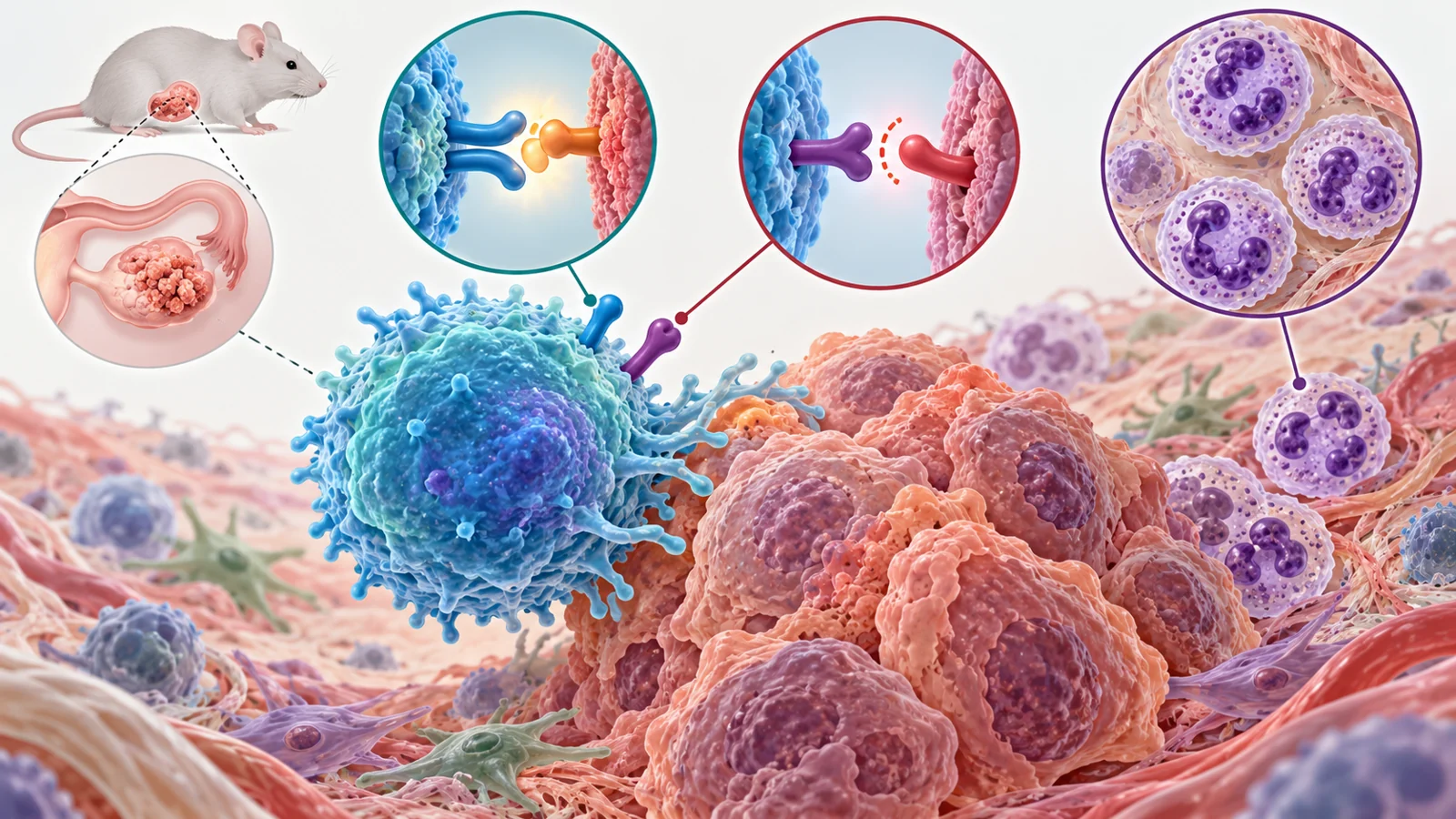
The first candidate was CD27, a receptor that provides T cells with a costimulatory signal: an additional cue that can support their activation. The researchers focused on it because their tumor gene-expression data showed that CD27 was present in the vaccine-associated T-cell signature, while its partner CD70 was generally low and did not rise after vaccination. They reasoned that supplying a stronger CD27 signal might improve the response.
In mice, an antibody that stimulated CD27, given alongside MIS/MRB, delayed tumor progression and improved survival compared with vaccination alone. The effect was accompanied by a temporary increase in ovalbumin-specific CD8-positive T cells circulating in the blood.
But at a later measurement, CD27 stimulation had not clearly increased the number of tumor-specific T cells in the tumor or improved their measured function there. The T cells remained abundant in the tumor environment, yet the added signal had not overcome their dysfunction. Adding anti-PD-1 further improved tumor control in the treatment group, but the three-part regimen was not significantly better than vaccination plus anti-PD-1 alone in the reported comparison. The mouse results therefore point to a gain from CD27 stimulation over vaccination, while leaving its added value alongside checkpoint blockade unresolved in this experiment.
A human tissue clue pointed toward granulocytic cells
The second approach focused on myeloid cells, a broad family of immune cells that can influence T-cell activity. In surgical specimens from six people with ovarian cancer, the researchers measured several immune-cell populations. CD15-positive granulocytic cells were more frequent where CD3-positive tumor-infiltrating T cells were less frequent. CD14-positive monocytic cells showed the opposite correlation, tracking positively with CD3-positive T cells.
That small tissue analysis is an association. It cannot show that granulocytic cells caused T cells to be scarce, nor does it establish a marker for selecting treatment. It did, however, give the researchers a reason to test whether reducing granulocytic cells changed the vaccine response in mice.
Depletion worked best alongside PD-1 blockade
The researchers used an antibody that targets Ly6G and Ly6C to reduce granulocytic cells in vaccinated mice. The antibody reduced measured circulating granulocytic cells and lowered CD11b-positive myeloid cells in the tumors, but adding it to vaccination did not significantly improve survival or reverse tumor-specific T-cell dysfunction. It also did not act exclusively on granulocytic cells: the authors said they could not rule out effects on other Ly6G-positive or Ly6C-positive cells.
The combination results differed from depletion alone. Adding anti-PD-1 to vaccination and the depletion antibody improved vaccine efficacy compared with either antibody treatment added separately, according to the paper. The remaining myeloid cells in tumors had more PD-L1, an immune-brake molecule, than myeloid cells in blood and spleen; the study did not establish that this caused the combination’s greater tumor control. The experiment supports a combination worth further testing in this model, not a demonstrated benefit in patients.
There was also a safety cost in the mice: 2 of 25 receiving the vaccine and depletion treatment developed toxicity, including weight loss and poor body condition, and required euthanasia. The finding underscores that changing immune-cell populations can have effects beyond the intended target, especially when the antibody’s cell specificity is imperfect.
Tumors can adapt beyond the vaccine target
The engineered ovalbumin target made it possible to track a defined T-cell response, but it also limits how closely the model represents the range of targets in human ovarian tumors. A tumor that loses the recognized antigen could escape those T cells even if treatment initially mobilizes them.
The authors discuss antigen-loss variants among relapsing tumors in earlier work with this model. They also mention an unpublished observation of antigen loss in tumors that relapsed after a vaccine, anti-PD-1, and anti-CD27 combination. That observation was not a published result of the current experiments, so it cannot establish how often antigen loss occurs or how it affected the treatment comparisons reported here. It does highlight a problem the paper raises: durable control may depend on more than strengthening the response to one target.
A path to better-matched ovarian cancer immunotherapy
A more durable immune attack could become possible if treatment combinations are matched to the obstacles present in a particular tumor: weak T-cell costimulation, suppressive granulocytic cells, or checkpoint signals that restrain the cells vaccination mobilizes. This mouse study offers distinct clues about those mechanisms, including a CD27-related gain with a ceiling and a depletion strategy whose strongest reported effect came alongside PD-1 blockade. Whether such matching can improve outcomes for patients whose tumors respond poorly to checkpoint treatment alone depends on confirmation in more representative models and clinical testing.
Key Sources
- Primary source: A prime/boost vaccine platform efficiently identifies CD27 agonism and depletion of myeloid-derived suppressor cells as therapies that rationally combine with checkpoint blockade in ovarian cancer.
DOI or Journal Page · Peer-Reviewed Paper · 2021-04-20
Keep exploring