
Research Signal – Source date 2022-01-01
Osteosarcoma treatment has to deal with two problems at once: a tumor growing in bone and the possibility that cancer has spread beyond what scans show. A limb-preserving operation is one part of a combined approach. Chemotherapy can address disease beyond the visible tumor; surgery must remove the tumor adequately; reconstruction aims to restore useful movement. A 2022 review describes how these parts fit together and where newer approaches were still being explored.
Chemotherapy treats more than the visible mass
The review presents chemotherapy around surgery as an established part of osteosarcoma care. Given before an operation, it is intended to treat the primary tumor and early disease that may have spread. The approach also gives the team a way to examine how the tumor responded: after removal, specialists can measure how much of it has died, or undergone necrosis, and use that finding to inform the chemotherapy that follows.
That measurement comes from the removed specimen, so it answers a question about the tumor after treatment and surgery. Before surgery, clinicians would need a different tool to estimate response without removing the tumor. The review describes symptoms, tumor size, imaging features, and blood-test changes as factors considered in assessing treatment, while identifying a noninvasive measure of tumor necrosis before surgery as a valuable future capability. Such an assessment could help with planning, but the review does not establish that one is validated or improves decisions.
A preserved limb still needs a sound operation
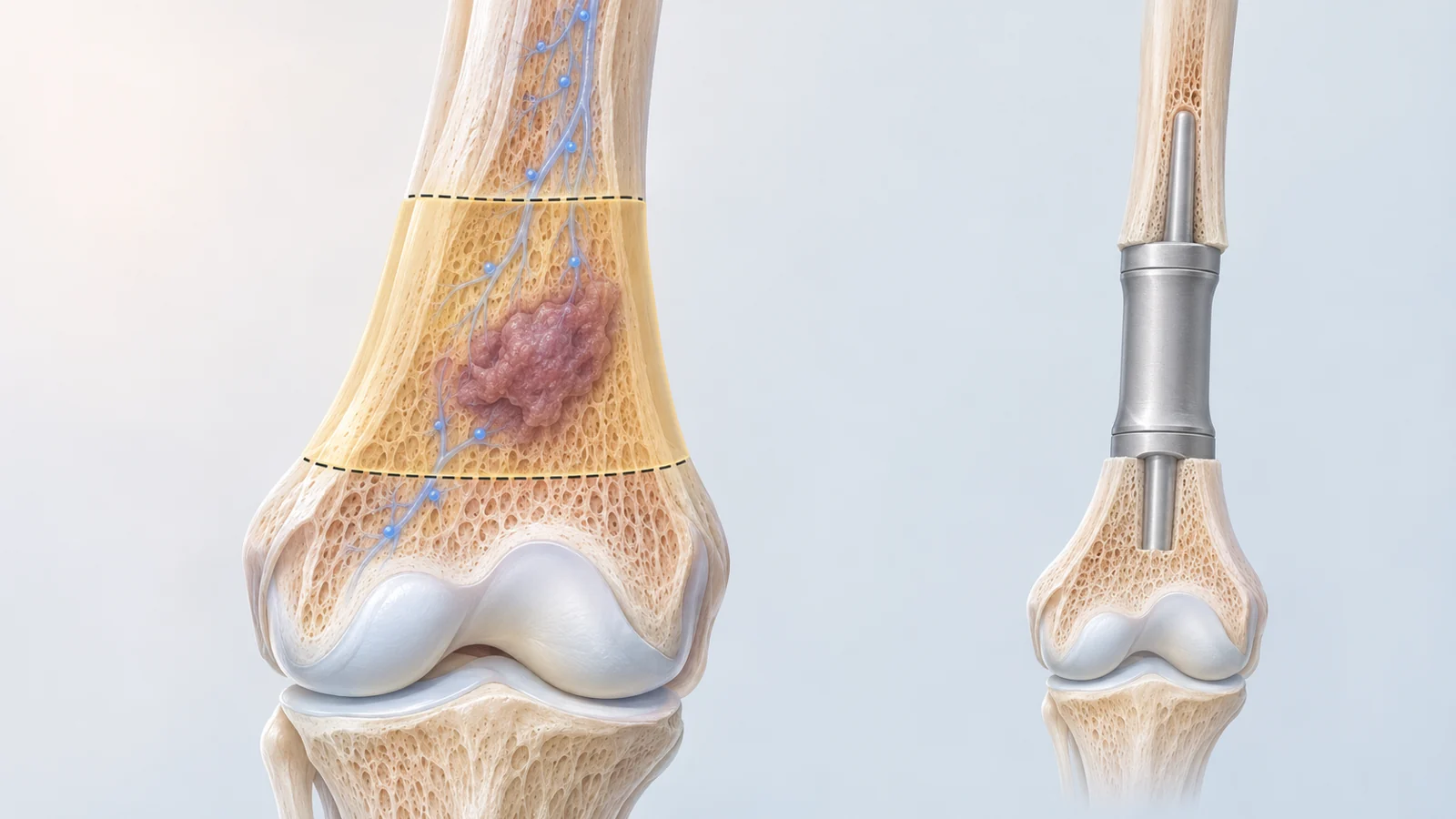
Preserving the limb still requires removing the tumor with an adequate margin of surrounding tissue. The review says the planned removal should encompass the tumor, its surrounding reaction zone, and nearby normal tissue. It describes this margin as difficult to achieve in many malignant bone tumors, with resections often made closer to one centimeter beyond the reaction zone. The goal is adequate tumor removal, even when that means taking substantial bone and soft tissue.
The remaining bone then has to be reconstructed so the limb can function. Computer-aided planning and image-guided bone cuts can help surgeons translate a three-dimensional plan into the operation, particularly in complex cases. For a young person, a tumor prosthesis also has to support stability and early activity after a large tissue defect. The practical question is therefore whether the reconstructed limb is likely to work better for that person than a prosthesis after amputation—not simply whether the limb can be retained.
The review cites no statistically significant difference in postoperative survival between patients who had limb-salvage surgery and those who had radical surgery. That comparison addresses survival across the cited surgical groups. It does not show that the operations produce equal outcomes for every patient, nor does it decide which option offers better function in an individual case.
New drugs face a difficult target-selection problem
The review describes two different ways researchers were trying to add to standard treatment. Targeted drugs aim at growth signals used by tumor cells. It discusses regorafenib and pazopanib, drugs designed to block several growth-related enzymes; combining such drugs with chemotherapy before surgery was still being explored in clinical trials. Choosing a useful target is difficult because osteosarcoma is uncommon and its tumors vary widely, so the same drug may not fit every tumor.
Immune checkpoint drugs take another route. Proteins such as PD-1 and PD-L1 can restrain immune responses, and blocking them was being investigated as a way to help immune cells attack tumors. The review cites a mouse osteosarcoma model in which antibodies against PD-1 or PD-L1 inhibited tumor-cell growth and invasion. That animal finding offers a reason to investigate the approach; it is not evidence that checkpoint treatment improves survival in people with osteosarcoma.
A local procedure can serve a different purpose
Some treatments discussed in the review address a specific site or symptom rather than replacing chemotherapy’s role across the body. Arterial embolization cuts off blood flow to a tumor. In one cited series, 19 people with advanced osteosarcoma received the procedure; all had pain relief three days later, and five had continuing relief after repeat embolization. Those results describe pain response in that small group, not control of osteosarcoma throughout the body.
The review also describes procedures for specific sites of spread. It cites radiofrequency ablation in 10 patients under 25 whose osteosarcoma had spread to the lungs and reports no metastasis at the treated site. It also describes cryoablation for spread to bone. These site-specific examples cannot establish control of cancer elsewhere or longer survival.
Survival figures depend on the setting
The review places several figures from different contexts side by side. Its introduction says five-year survival had been about 20% under earlier treatment limitations, and that limb salvage had reached more than 65% as chemotherapy and surgery developed. It also reports five-year survival of 60% to 70% at various bone-tumor centers in China using surgery with chemotherapy before and after the operation. That center-specific figure describes those centers and their combined treatment approach; it is not a universal forecast for every patient or setting.
The cited comparison between limb-salvage and radical surgery asks a separate question: whether postoperative survival differed statistically between those surgical groups. A center’s overall survival figure and a comparison of operations have different populations and purposes. Neither alone tells an individual what treatment will achieve, and the review’s figures do not establish one treatment effect for all osteosarcoma patients.
What this could change
A dependable way to assess tumor response before surgery could give a young person and their care team an earlier indication of whether the primary tumor is responding to chemotherapy, before the removed specimen becomes available. That information might help them plan the next steps of treatment, but the review does not establish a validated test or show that acting on its result improves decisions or outcomes.
A meaningful nearer milestone would be a prospective study showing that a noninvasive preoperative assessment agrees with the necrosis measured in the removed tumor and can inform treatment decisions. Agreement with the specimen would connect the new measurement to the response already used to guide care. Only after that bridge is established could studies test whether using the information makes surgical planning more dependable, without assuming better survival or function in advance.
Key Sources
- Primary source: Current Status and Prospects of Clinical Treatment of Osteosarcoma.
DOI or Journal Page · Review or Meta-Analysis · 2022-01-01
Keep exploring