
Research Signal – Source date 2026-04-22
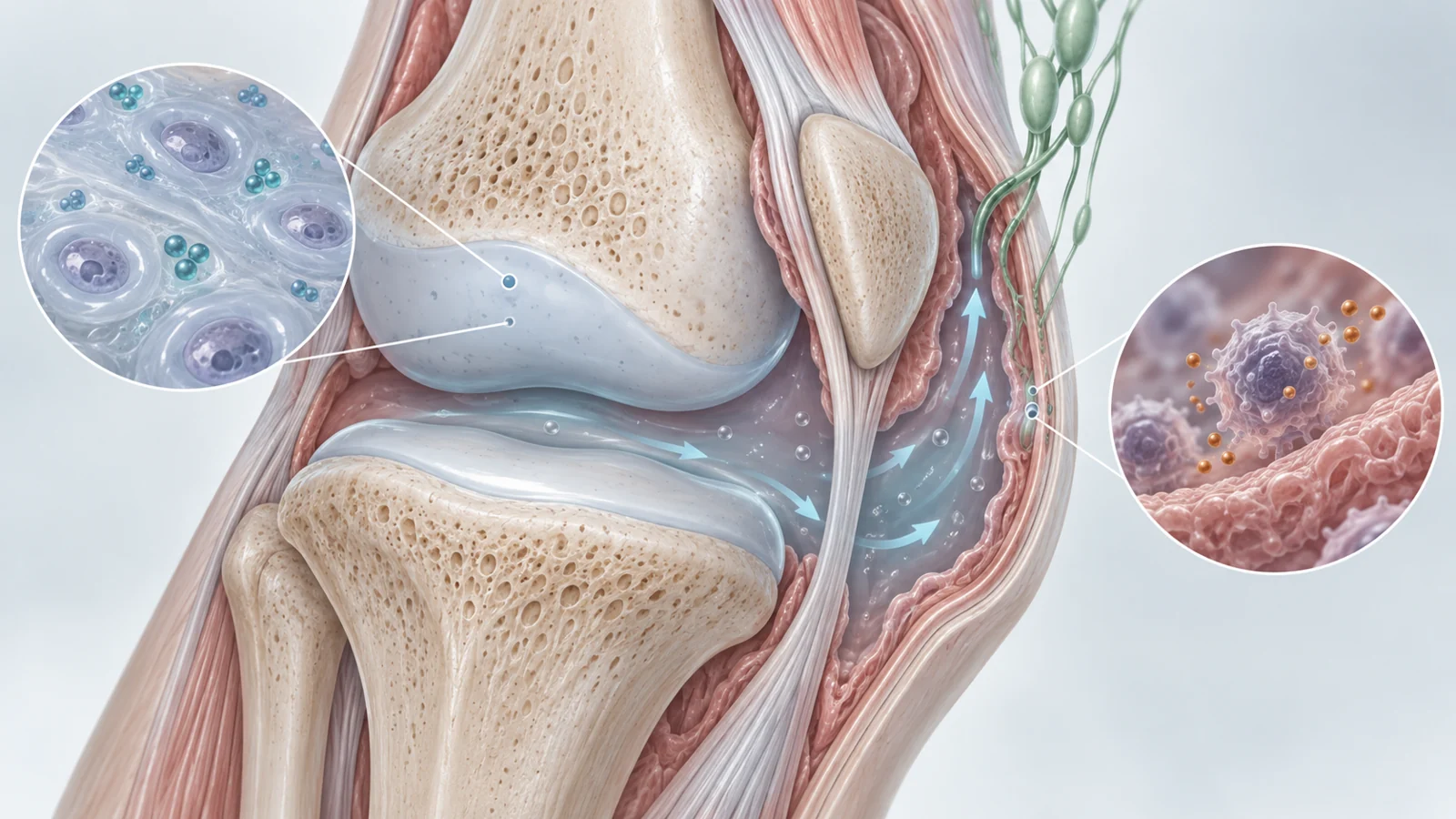
Osteoarthritis is often described as a joint disease involving cartilage damage and inflammation. But the condition also involves changes in the cells that maintain cartilage, the bone beneath it, and the synovial tissue lining the joint. A review published on April 22, 2026, examines whether engineered particles could reach these tissues and influence processes linked to aging, metabolic stress, and inflammation.
The idea goes beyond carrying a pain-relieving drug to a joint. Some designs aim to release a treatment in response to local conditions or to interact with particular cells. The review gathers examples from laboratory and animal research; it does not show that these approaches preserve movement or slow disease in people.
Pain relief leaves the joint biology in motion
Exercise tailored to a person’s needs, weight management, physiotherapy, and pain medicines can help manage osteoarthritis symptoms. The review describes current care as largely symptomatic: it does not reverse the underlying changes that can affect cartilage, subchondral bone, and synovial tissue together. Joint replacement may be considered when damage becomes severe, but it is a substantial intervention.
Cartilage depends on living chondrocytes to maintain its extracellular matrix, the material that gives it structure and mechanical function. With aging and osteoarthritis, matrix components can degrade and cartilage becomes more vulnerable to damage. Changes in the underlying bone and inflammation in the synovium are also part of the joint environment discussed in the review. A treatment that reaches only one place or acts for too little time may have limited opportunity to affect this connected problem.
Reaching cartilage is a design problem
A drug injected into a joint faces two practical barriers described in the review. Cartilage is dense and negatively charged, making it difficult for many substances to penetrate. Meanwhile, synovial fluid turnover and lymphatic clearance can remove locally delivered treatments from the joint.
Nanomaterials offer ways to tune a carrier’s surface, size, and release behavior. These features have different jobs. Surface chemistry can help a material bind to tissue; dimensions can influence how far it penetrates; and a responsive design can release its cargo when it encounters a particular local condition. Longer retention could increase the time available for a treatment to act, though each formulation has to be assessed on its own.
The review’s examples are not interchangeable versions of one therapy. Some are designed to carry drugs, while others are intended to interact with cells or the surrounding tissue. Their reported effects also come from different experiments, so they cannot be ranked as if they had been tested side by side.
Targeting aging cells while supporting repair
Cellular senescence is one aging-related process discussed in the review. Senescent chondrocytes can contribute to a local environment associated with tissue damage. Removing such cells is one proposed route, but a delivery system also has to reach the affected cartilage and avoid treating healthy cells as the target.
One example used aldehyde- and methacrylic-anhydride-modified hyaluronic acid microspheres. The particles were designed to anchor to collagen-II fragments at degraded cartilage surfaces. They released liposomes carrying ABT263, which promotes senescent-cell apoptosis, alongside PDGF-BB, a signal intended to recruit surrounding mesenchymal stem cells. In a porcine cartilage explant model of osteoarthritis, the reported sequence included nearby macrophages clearing dying cells, a shift toward a pro-resolving phenotype, lower p16INK4a abundance, and restored glycosaminoglycan content.
Other cited work tested different approaches in animals. The review describes selective senescent-cell clearance in mouse models alongside lower histologic disease severity, improved pain behavior, and reduced MMP-13 expression. A separate copper sulfide nanoparticle formulation targeting beta-2-microglobulin was reported to eliminate senescent chondrocytes and increase cartilage matrix measures in a mouse model. The review also flags copper accumulation in the liver and kidney as a concern for that formulation.
These results illustrate why delivery and biological action are linked: a carrier may be designed to localize treatment, while its cargo or material properties determine what happens around the target cells. They remain results from particular tissue and animal settings, not evidence of benefit for patients.
Oxidative stress offers another target
Osteoarthritis-related metabolic changes include altered energy use and mitochondrial function. The review describes higher lactate production and extracellular acidification, alongside lower mitochondrial respiration and ATP production in osteoarthritis chondrocytes compared with healthy cells. It also connects reactive oxygen species, or ROS, with increased tissue breakdown and reduced cartilage-building activity.
One strategy combines an injectable, self-healing hydrogel with drug-loaded nanoparticles. The material is designed to respond to ROS and acidity: the hydrogel can scavenge ROS, while ROS-triggered release makes the drug available under those conditions. In a rat model induced with monosodium iodoacetate, the formulation was reported to reduce cartilage degeneration, suppress inflammatory signals, and preserve cartilage matrix measures. The table also notes rapid degradation and the need for repeated injections.
A different design aims to distribute oxidative-stress control across more of the joint. In an anterior cruciate ligament transection mouse model, permeable micro- and nanoscale hydrogel microspheres were reported to clear ROS from macrophage mitochondria, inhibit osteoclast activity, and limit early chondrocyte apoptosis. The study also reported less cartilage degeneration and suppressed subchondral bone remodeling. This is a broader set of reported tissue effects, but it comes from a different material and animal model; it does not establish a general advantage over the drug-releasing hydrogel.
Macrophages can shape the inflammatory environment
Macrophages in the synovium help coordinate inflammatory and tissue-repair activity. The review describes strategies designed to shift macrophage activity away from an inflammatory state and toward a more reparative one. That shift could influence signals that affect cartilage, but the effect depends on the formulation and experimental setting.
For example, a micro- and nanoscale delivery system called GelMA@FPPD carried dexamethasone and was designed to target M1 macrophages. In a rat model induced with monosodium iodoacetate, the review reports increased apoptosis of M1 macrophages, lower inflammatory cytokines, protection of cartilage, and relief of osteoarthritis-related effects. The table identifies unanswered questions about dosing, long-term cumulative toxicity, mechanisms, and performance in other disease models.
A local formulation may help concentrate an intervention near the tissue of interest, yet a joint contains several interacting cell types and structures. The examples that address aging, oxidative stress, and macrophage activity are separate approaches. Their combined success as a single treatment has not been demonstrated by the evidence summarized here.
Animal results leave translation questions open
The studies span cartilage explants and different mouse and rat models, each with its own disease induction, material, target, and measured outcomes. Some report molecular or matrix changes; others include pain-related behavior or tissue inflammation. These endpoints do not amount to a shared test of whether a treatment slows osteoarthritis or preserves everyday mobility.
The delivery systems also face practical constraints. Several approaches require repeated injections, and the review highlights limited long-term assessment, a lack of large-animal validation for some designs, and concerns about material distribution or accumulation. The copper finding in liver and kidney tissue is one concrete example of why a material’s fate matters alongside its intended effect in a joint. Short or model-specific observations cannot establish durable benefit or long-term safety in people.
Could treatment preserve a damaged joint?
A therapy that stays in the joint, reaches cartilage or synovial cells, and moderates damaging activity could one day help preserve cartilage and slow deterioration. For people with osteoarthritis, that might mean retaining mobility for longer. The review’s examples make this a research possibility, not a demonstrated patient benefit: durable effects and safety would need to be shown in people.
Key Sources
- Primary source: Nanotherapeutic Strategies for Osteoarthritis: Targeting Aging, Metabolism and Inflammation.
DOI or Journal Page · Review or Meta-Analysis · 2026-04-22
Keep exploring