
Research Signal – Source date 2023-01-23
Quercetin is a plant compound found in many vegetables and other plant foods. In those foods, it usually appears as a glycoside: quercetin with one or more sugar groups attached. That chemical detail matters because the body does not receive an onion, a tablet, and a molecule of isolated quercetin in quite the same way.
A review published on January 23, 2023, examined whether quercetin glycosides could contribute to cardiovascular health, particularly by influencing processes involved in atherosclerosis. Its evidence spans food composition, digestion, human absorption comparisons, laboratory experiments, animal models, and human population studies. The practical question is narrower than “Is quercetin good for the heart?” A more useful question is what kind of exposure reaches the body after eating a food, taking a supplement, or doing both—and what that exposure can actually tell us about artery protection.
Food and supplement names hide different molecules
Onions and shallots are notable food sources of quercetin glycosides. Characteristic glucose-bound forms include quercetin 4′-O-glucoside and quercetin 3,4′-O-diglucoside. Other vegetables contain related forms, while foods such as lettuce, broccoli, asparagus, and apples can supply different sugar attachments.
A supplement tablet may instead provide quercetin aglycone, the form without an attached sugar. It may also present the compound in a different physical structure from the one embedded in plant tissue. Those differences affect how readily quercetin dissolves, is transformed, and becomes available for measurement in the body. The amount printed on a label is therefore an intake quantity, not a direct reading of the amount that reaches blood, tissues, or a vessel wall.
The surrounding food can matter as well. In one comparison discussed by the review, equal quercetin amounts delivered in enriched cereal bars produced higher plasma levels of quercetin metabolites than quercetin powder in capsules. Another comparison found higher measured exposure after onion-skin extract than after pure quercetin dihydrate. These findings do not make a food automatically superior to a supplement. They show why chemical form and food matrix belong in the same conversation as dose.
Digestion changes the substance that circulates
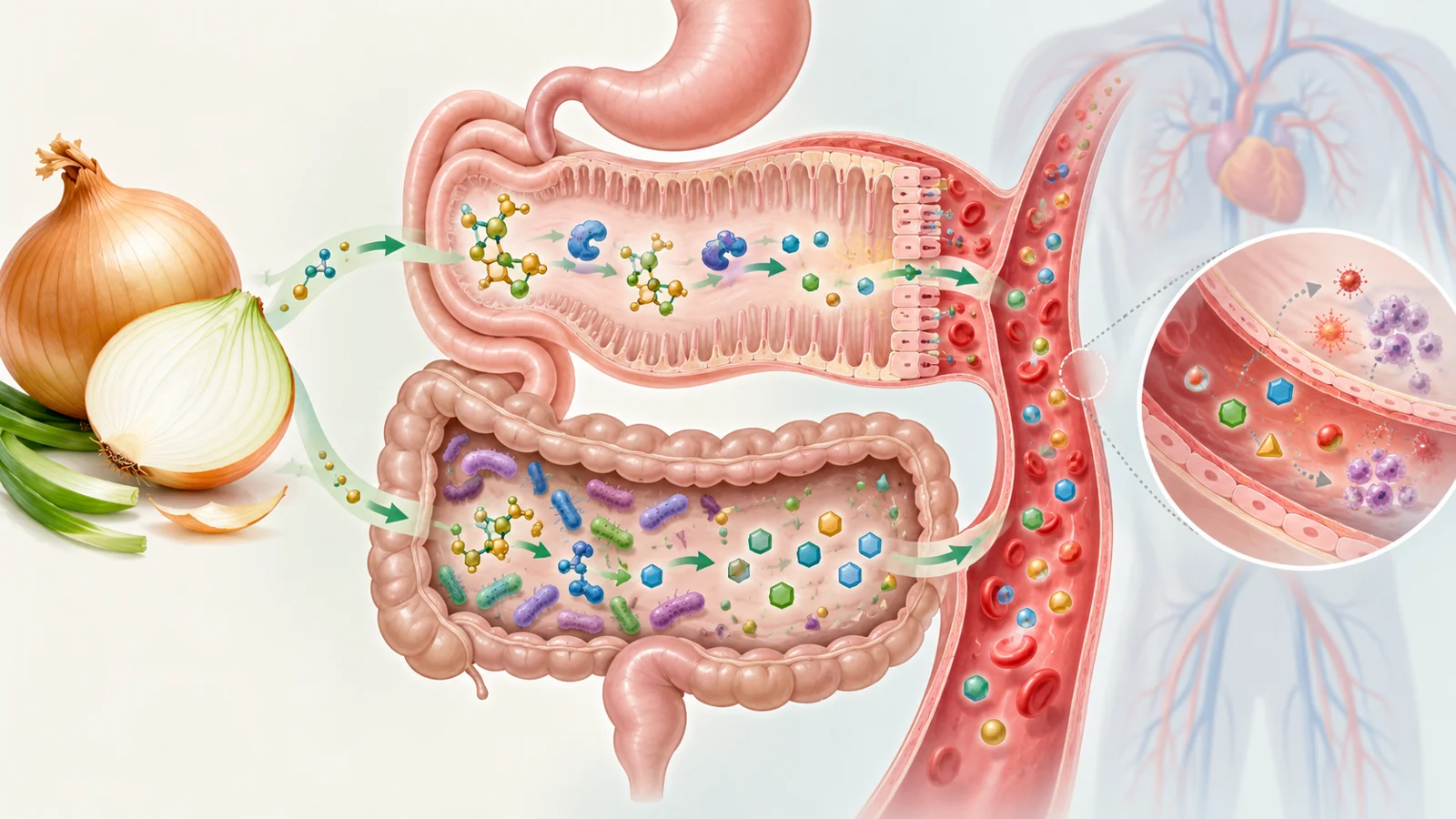
Some glucose-bound quercetin glycosides can be partly broken down and absorbed in the small intestine. Intestinal cells then attach chemical groups such as glucuronide or sulfate to the absorbed material. The liver can modify it further before the resulting conjugated metabolites enter circulation, undergo additional processing, or return through enterohepatic circulation. Much of this material is eventually excreted in urine over the following days.
Other glycosides, including forms attached to sugars besides glucose, travel farther through the digestive tract. In the large intestine, gut microbes remove sugar groups and break the quercetin structure into smaller compounds. Rutin, for example, can be converted into hydroxyphenyl acid derivatives, including 3-hydroxyphenylacetic acid and other related products. The precise mixture depends partly on the person’s intestinal microbiota, so two people can receive the same food and generate different circulating metabolites.
That process explains why a blood sample after onion consumption does not simply show the same quercetin molecule listed in a food table. In a human study summarized by the review, researchers identified 23 conjugated metabolites in plasma one to four hours after red-onion intake. These included several quercetin glucuronides and sulfates, as well as an isorhamnetin glucuronide. Some products formed in the large intestine may also be absorbed after microbial breakdown.
The biological question is consequently not only whether quercetin entered the body. It is which forms entered, at what concentrations, for how long, and whether those forms can affect vascular processes at realistic human exposure levels.
A dose swallowed is not the same as exposure
A crossover comparison makes the problem concrete. Participants consumed fresh red onion providing 47 milligrams of quercetin expressed as aglycone equivalent, or a quercetin supplement tablet providing 544 milligrams of aglycone equivalent. The measured endpoint was total quercetin recovered in urine over 24 hours. The values were 1.69 ± 0.79 micromoles after onion and 1.17 ± 0.44 micromoles after the supplement, with no statistically significant difference between them.
That result is interesting because the swallowed amounts were very different, but it is easy to overread. Urinary excretion is a recovery measurement; it is not a direct measurement of artery-wall exposure, plaque change, or cardiovascular events. A nonsignificant difference in that endpoint does not establish that onion and supplement exposure are identical, that they produce the same clinical effects, or that the doses can be exchanged.
The comparison does, however, challenge a simple assumption that a much larger tablet dose must create proportionally more useful exposure. The review links the result to the food matrix and to the poor solubility of pure quercetin aglycone. In the digestive tract, a compound’s physical form and its surrounding food components can influence how much becomes available for absorption. A smaller amount in a food may therefore produce a different measured profile from a larger amount in a capsule.
Measured exposure is also individual. Microbial composition, intestinal transformation, conjugation, and clearance all vary. The same label quantity can become a different set of circulating compounds in different people, which is one reason the authors call for better biomarkers of actual quercetin exposure rather than relying only on food-frequency estimates.
Why vascular researchers are interested
Atherosclerosis develops in artery walls through interacting processes that include injury or dysfunction of the endothelium, the cell layer lining blood vessels, along with lipid accumulation, oxidative stress, and inflammation. Quercetin-related compounds have attracted interest because experiments suggest that they can influence more than one of these processes.
The review describes direct radical-scavenging chemistry, but it also emphasizes indirect antioxidant activity. Quercetin compounds may alter the activity or expression of enzymes involved in oxidative balance and inflammation. This matters because the circulating forms are often conjugated metabolites rather than the unconjugated molecule used in many laboratory experiments.
The effects can differ by molecule. In experimental work summarized by the review, quercetin 3′-O-sulfate retained inhibitory activity against lipoxygenase, while quercetin 3-O-glucuronide did not show the same activity against that enzyme. The glucuronide did show activity against myeloperoxidase, an inflammatory enzyme released by activated immune cells. In another experiment, quercetin metabolites inhibited COX-2 messenger RNA in human lymphocytes outside the body, whereas a single high intake of onion-derived quercetin glycosides did not change COX-2 messenger RNA in living participants. These contrasts show why “quercetin” is too broad a label for interpreting every result.
Animal models provide a different kind of evidence. In mice lacking apolipoprotein E and fed a high-fat diet, quercetin aglycone administered for 12 weeks was associated with less plaque formation, lower levels of PCSK9, TNF-α, and IL-6, and higher expression of ABCA1 and LXR-α. This is a specified experimental model with a specified exposure, not a demonstration that eating onions reverses human plaque. Cell and animal studies also frequently use concentrations that are higher than ordinary human dietary exposure, leaving the human contribution of the proposed mechanisms unresolved.
Human evidence has a narrower meaning
Population studies provide a reason to keep studying quercetin-rich foods. A case-control study summarized in the review associated eating one or more portions of onion per week with a lower risk of non-fatal acute myocardial infarction. An Iranian cohort study also associated higher habitual intake of allium vegetables, including onion and garlic, with lower cardiovascular risk during follow-up.
These findings concern foods and dietary patterns, not isolated quercetin exposure. Onion contains sulfur compounds and other constituents, and people who eat more allium vegetables may differ from other participants in ways that are difficult to capture. Dietary recall can also misstate how much quercetin a person actually consumed. An association involving onion or garlic therefore cannot identify quercetin as the causal protective ingredient.
Intervention studies point in a similar direction but remain suggestive. The review describes short-term trials involving onion intake and cardiometabolic or vascular measurements, while noting substantial differences in food form, individual bioavailability, and study design. The authors call for larger, longer interventions that connect realistic quercetin-glycoside exposure with meaningful cardiovascular outcomes. Until that link is demonstrated, the evidence supports a plausible research direction rather than a preventive dose, a supplement recommendation, or a replacement for established treatment.
What this could change
Familiar foods such as onions could become a more precisely supported part of cardiovascular prevention, giving people at risk a food-based option whose contribution is understood rather than inferred from a molecule’s reputation or a label dose. That benefit would depend on larger, longer human studies showing that the metabolites produced by realistic dietary exposure are linked to meaningful cardiovascular protection. A clearer connection between food form, individual metabolism, and outcomes could also help researchers distinguish useful dietary patterns from claims built only on high-dose laboratory experiments.
Key Sources
- Primary source: Potential Role of Quercetin Glycosides as Anti-Atherosclerotic Food-Derived Factors for Human Health.
DOI or Journal Page · Review or Meta-Analysis · 2023-01-23
Keep exploring