
Research Signal – Source date 2021-02-10
A stiffer material can still be easier to damage
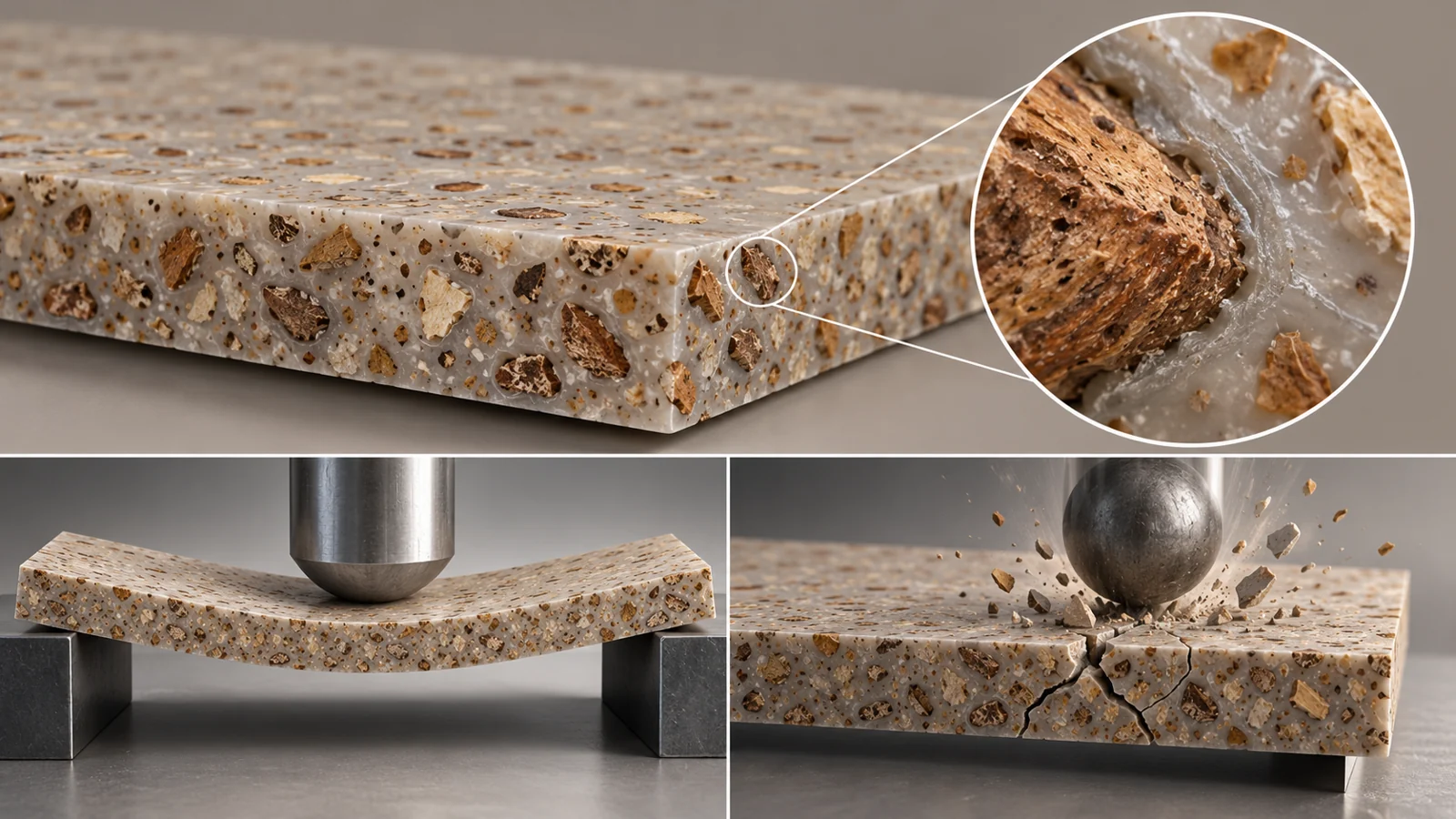
In one polypropylene composite covered by the review, adding olive-pit flour raised the plastic’s stiffness in a pulling test but reduced its ability to withstand a sudden blow. At 40% filler by weight, its tensile modulus—a measure of how much a material resists stretching—was 18% higher than that of unfilled polypropylene. Yet its tensile strength fell by about 13.8%, its elongation at break by 90.5%, and its Izod impact strength by about 82.5%.
Those measurements describe different kinds of performance. Modulus is about stiffness: how much a material deforms under a given load. Tensile strength describes how much pulling force it can take before breaking. Elongation at break measures how far it can stretch before it snaps. Impact strength concerns its ability to absorb a sudden blow. A rise in stiffness does not mean the material has become tougher in all these ways.
The same formulation also became harder as the olive-pit content rose. Hardness can be useful for some surfaces, but it does not cancel out the much lower impact strength. The result is a tradeoff, not a simple upgrade: this olive-pit-filled plastic became stiffer under a pulling load but less resistant to a sharp hit.
A waste material with useful structure
Olive stones are the hard inner part of the fruit, made up of the seed and its woody shell. They are among the residues left by olive-oil production, and the table-olive industry also produces them. The review describes them as lignocellulosic material, meaning their plant structure is built mainly from cellulose, hemicellulose, and lignin. These components form the cell walls that give plants structure.
Recovering those components separately can require difficult, costly processing with environmental drawbacks. Grinding the residue and using it as a filler offers a more direct way to put some of that biomass to use. In a composite, small particles are mixed into a polymer matrix—the plastic or resin that holds them together. Researchers have tested olive-stone fillers in several thermoplastics, resins, and rubber blends, with properties and possible uses varying by material.
The idea is appealing, but the particles do not automatically reinforce every property. Their effect depends in part on how evenly they spread through the polymer and how firmly they connect to it. At high loading, olive-pit particles in polypropylene can clump or disperse poorly. Weak contact between particles and polymer can leave gaps and cavities. Under stress, those poorly bonded regions can become places where cracks begin or grow.
Moisture creates another concern. Olive stone is hydrophilic, meaning it tends to take up water. Water can move through pores and gaps around the filler, and the review links higher filler content with greater water uptake in the studies it discusses. That matters because a composite’s behavior in a dry test may not describe how it performs in a humid or wet setting.
Surface treatment can improve the fit
Researchers have tried treating olive-stone particles to improve their contact with a polymer. In one unsaturated-polyester example, flexural strength—a measure of resistance to breaking when bent—reached about 48 megapascals with 40% untreated olive filler by weight, compared with about 42 megapascals for unfilled resin. With treated filler, flexural strength reached about 51 megapascals at 30% filler by weight. These are the reported maxima at different loadings, so they do not establish a direct same-loading comparison. The review attributes the improvement with treatment to better adhesion between the filler and resin.
The treatment also changed the reported water absorption. For composites with 40% filler by weight, maximum water absorption fell from around 9% with untreated olive filler to about 5% with treated filler. Better wetting and stronger contact with the resin, along with a reduction in the filler’s hydrophilic character, were offered as explanations in the review.
Treatment did not remove every tradeoff. In the polyester example, impact strength declined as filler content increased, and the treatment did not reverse that pattern. A surface treatment that helps one property or one polymer may not work the same way in another. The review emphasizes that the suitable treatment depends on the chemistry and interactions of each polymer matrix.
Panels have a different job from load-bearing parts
A material for a shelf, door, or other non-structural panel does not face the same demands as a beam or other load-bearing component. Higher stiffness or hardness may be useful for some panel applications, even when tensile or impact performance declines. The review describes olive-stone particleboards made with unsaturated polyester resin, including a composition containing 80% olive stone and 20% resin by weight. The reported physical and mechanical results were largely in line with standards cited by the review for particleboards.
That example makes panels a concrete area of interest, but it is not proof that any olive-stone mixture is ready for routine use. A panel has to meet the requirements of its intended setting, including how it handles impacts, moisture, and ongoing use. A promising result in a particular test or composition does not establish performance across different sizes, production conditions, or service environments.
The broader evidence also calls for caution in comparing materials. The 2021 paper is a review of earlier studies, not a newly fabricated composite. Its authors describe an English-language Scopus search using terms for olive stones or olive pits and composites, and focus on studies reporting mechanical performance or enough information to estimate it. The cited experiments vary in polymer type, filler amount, preparation, surface treatment, and test. Their results cannot be combined into one best loading or one performance prediction for every plastic.
The review’s overall pattern helps explain why the polypropylene example is not contradictory: olive-stone filler often raises elastic modulus, while strength, stretch, or impact performance can decline. Interfaces between the plant particles and polymer are central to that balance. More filler means more particle–polymer contact, and if that contact is weak, it can create more places for damage to start. Moisture can further affect behavior where pores and gaps provide paths into the material.
What olive stones could change for everyday panels
Olive-processing residues could become a useful filler in non-structural panels and similar components, giving manufacturers another material input and a use for some of the residue. That prospect depends on finding formulations that keep the impact resistance, moisture behavior, and service-life performance a panel needs, while remaining workable to produce at reasonable cost. The studies summarized in 2021 point to a possible use, not an established market outcome or a demonstrated net environmental benefit.
Key Sources
- Primary source: Olive Stones as Filler for Polymer-Based Composites: A Review.
DOI or Journal Page · Review or Meta-Analysis · 2021-02-10
Keep exploring