
Research Signal – Source date 2026-06-08
An older donor liver may still be usable, while a younger one may carry substantial damage. Age matters, but it cannot tell the whole story about how well an organ might function. A review published on June 8, 2026, argues that examining the biology of a liver—and the changes it undergoes after recovery—could add useful information before transplantation.
The review focuses on cellular senescence: a state in which cells stop dividing after stress or damage. Senescence can help repair tissue and restrain the growth of damaged cells. When senescent cells accumulate over time, however, they can release inflammatory signals, affect neighboring cells, and contribute to fibrosis and weaker regeneration. The balance depends on which cells are involved and what is happening in the tissue.
That makes senescence an intriguing candidate for assessing donor organs, but not a ready-made pass-or-fail test. The review describes possible ways to measure and influence senescence during transplantation, including while a liver is preserved outside the body. The proposed opportunity is real; evidence that these approaches improve outcomes for recipients is not yet established.
A birthday is only one clue
Donor livers from people aged 65 or older are often classified as expanded-criteria grafts. These organs can carry greater risk of early dysfunction, particularly alongside factors such as fat accumulation, prolonged oxygen deprivation, or donation after circulatory death. Yet age by itself does not describe an organ’s functional reserve or capacity to recover.
Biological aging reflects accumulated changes that affect tissue maintenance, repair, and metabolism. It tends to increase with chronological age, but illness, genetics, and environmental exposures can shape its pace. The review notes that a younger donor with fibrosis, metabolic dysfunction, an alcohol use disorder, or drug-related injury could have a more aged biological profile than an older donor whose liver is healthier.
Senescence is one possible part of that picture. A brief, localized senescence response may help contain damage or coordinate repair. With chronic accumulation, senescent cells can produce a mix of signals known as the senescence-associated secretory phenotype, or SASP. These signals may promote inflammation and encourage nearby cells to enter a similar state. If that burden grows beyond what immune surveillance can clear, tissue function and regenerative capacity may decline.
A useful assessment would therefore need to say more than whether a marker is present. It would have to capture the amount and location of senescent cells, the cell types involved, and whether their activity is helping repair or adding to dysfunction. A single clinically validated senescence marker is not available, the authors say. The review points to gene-expression profiles, single-cell sequencing, spatial analysis, and machine-learning analysis of tissue images as research approaches that may help characterize this variation. None is yet a dependable standalone verdict on whether a particular liver should be transplanted.
Preservation changes the biology being assessed
After recovery, a donor liver is separated from both donor and recipient. That period creates a controlled window for observing the organ and, in principle, treating it before implantation. It is also a time when preservation itself can affect cells.
During static cold storage, prolonged ischemia—the interruption of normal blood supply—can affect liver cell types differently. The review describes evidence that hepatocytes predominantly undergo cell death, while bile duct cells, or cholangiocytes, can enter senescence. Changes in these cells have been linked to disrupted bile-duct structure and impaired regeneration. Prolonged ischemia is also associated with shortened cilia on cholangiocytes; these structures help the cells sense bile flow.
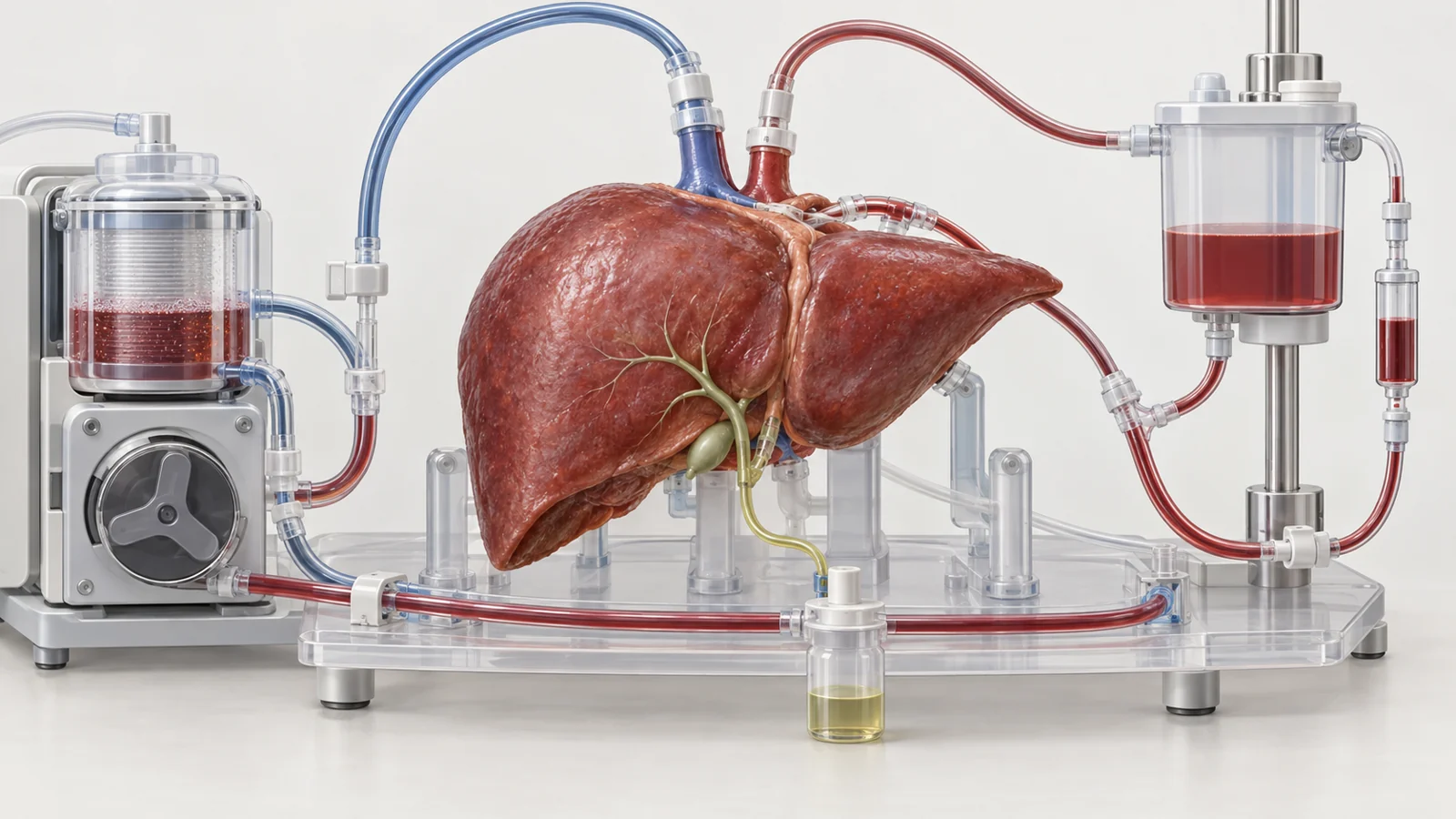
Machine perfusion keeps an organ supplied with a circulating preservation solution under controlled conditions. Researchers can sample the liver before and after an intervention, including through tissue, perfusate, or bile. Because treatment would be delivered to an isolated graft, this setup could also allow a time-limited, localized exposure without initially exposing the recipient to the drug. The review presents perfusion as a way to study senescence and possible reconditioning, not as proof that a treated organ will function better after transplant.
Early findings point to bile-duct repair
Some of the evidence summarized in the review comes from human liver tissue outside the body and some from animal models. Those settings offer ways to investigate possible effects, but they are several steps removed from showing a benefit in transplant recipients.
In human liver explants, studies discussed by the review found that dasatinib, a drug that can target senescent cells, was associated with improved biliary regeneration. Related findings in human liver grafts included preservation of cilia structure and biliary regeneration. Animal studies also reported improved bile-duct regeneration after cold storage. These observations make bile-duct cells a relevant focus, because injury to the biliary system can affect graft function.
The review also summarizes experiments with ABT-737, which targets proteins that help some senescent cells resist cell death. In mouse models, it was associated with preserved cilia structure and biliary regeneration in the setting of cholangiocyte senescence. These are preclinical findings, not evidence that the drug is safe or effective for reconditioning a donor liver destined for a patient.
The experiments differ in their models, interventions, and measured outcomes. Results involving explanted tissue or animals cannot establish that a senescence-targeted treatment improves graft survival or other recipient outcomes. Nor do results for a drug used in another disease establish that it can safely prepare a donor liver for transplantation.
Removing cells and quieting signals carry different risks
Senolytics are intended to remove senescent cells by interfering with the pathways that help them survive. Dasatinib and quercetin, for example, target different survival mechanisms and have been studied in combination. The logic is to reduce the cells that may be sustaining harmful signals. But senescent cells are not all harmful: they can support wound healing, tissue remodeling, and tumor suppression. Removing them at the wrong time or from the wrong cell population could disrupt those roles.
Senomorphics take a different approach. Rather than killing senescent cells, they aim to dampen harmful signals while leaving the cells in place. That may preserve useful functions, but it is difficult to suppress damaging signals without also affecting normal immune or repair responses. Senescent cells can also differ in their signaling and survival pathways, even within the same liver.
These differences matter in transplantation. An intervention that helps bile-duct cells could have another effect on hepatocytes, stellate cells, or liver sinusoidal endothelial cells. The review highlights evidence that endothelial-cell senescence in the liver may have a protective role in clearing toxins during aging. Broadly removing senescent cells could therefore disturb tissue balance rather than uniformly improve it.
Timing and drug interactions add further complications. Signals from senescent cells can help close wounds, so treatment around surgery could interfere with wound healing or the integrity of surgical connections. After transplant, senotherapeutics may interact with immunosuppressive medicines. The review discusses possible interactions that could increase immune suppression, with risks such as infection or malignancy, as well as the possibility that existing drugs with senescence-modulating effects might be relevant. These possibilities call for careful testing; they do not establish a safe dosing strategy for donor-liver treatment.
How liver reconditioning could expand the donor pool
If researchers can develop reliable ways to measure senescence and safely recondition selected grafts during perfusion, transplant teams could eventually have more information for judging organs that are now difficult to evaluate by age and conventional risk factors alone. In turn, some marginal livers might become usable, potentially easing organ scarcity for people awaiting transplantation. That benefit depends on showing that a treatment preserves or improves whole-organ function and helps recipients, not simply that a laboratory marker changes.
The review identifies substantial work ahead: better markers, an understanding of how different liver cell populations respond, and trials designed to assess both safety and clinical benefit. Machine perfusion also adds cost; the authors cite an internal estimate from one center of about €10,000 per liver perfusion. Collaborative studies at centers with established perfusion programs could help build evidence while sharing the practical burden.
For now, the central idea is a research opportunity: preservation may provide time to inspect and possibly influence a donor liver’s biology. Whether that window can safely expand the donor pool remains an open clinical question.
Key Sources
- Primary source: Integrating senotherapeutics into transplantation: liver reconditioning in an aging donor pool.
DOI or Journal Page · Review or Meta-Analysis · 2026-06-08
Keep exploring