
Research Signal – Source date 2024-07-20
Fat tissue does more than hold excess energy. Its ability to accommodate that energy helps determine where fat accumulates elsewhere in the body. When this storage function falters, the consequences can reach organs such as the liver and muscles. Understanding metabolic risk therefore means looking at the condition and location of fat tissue alongside its quantity.
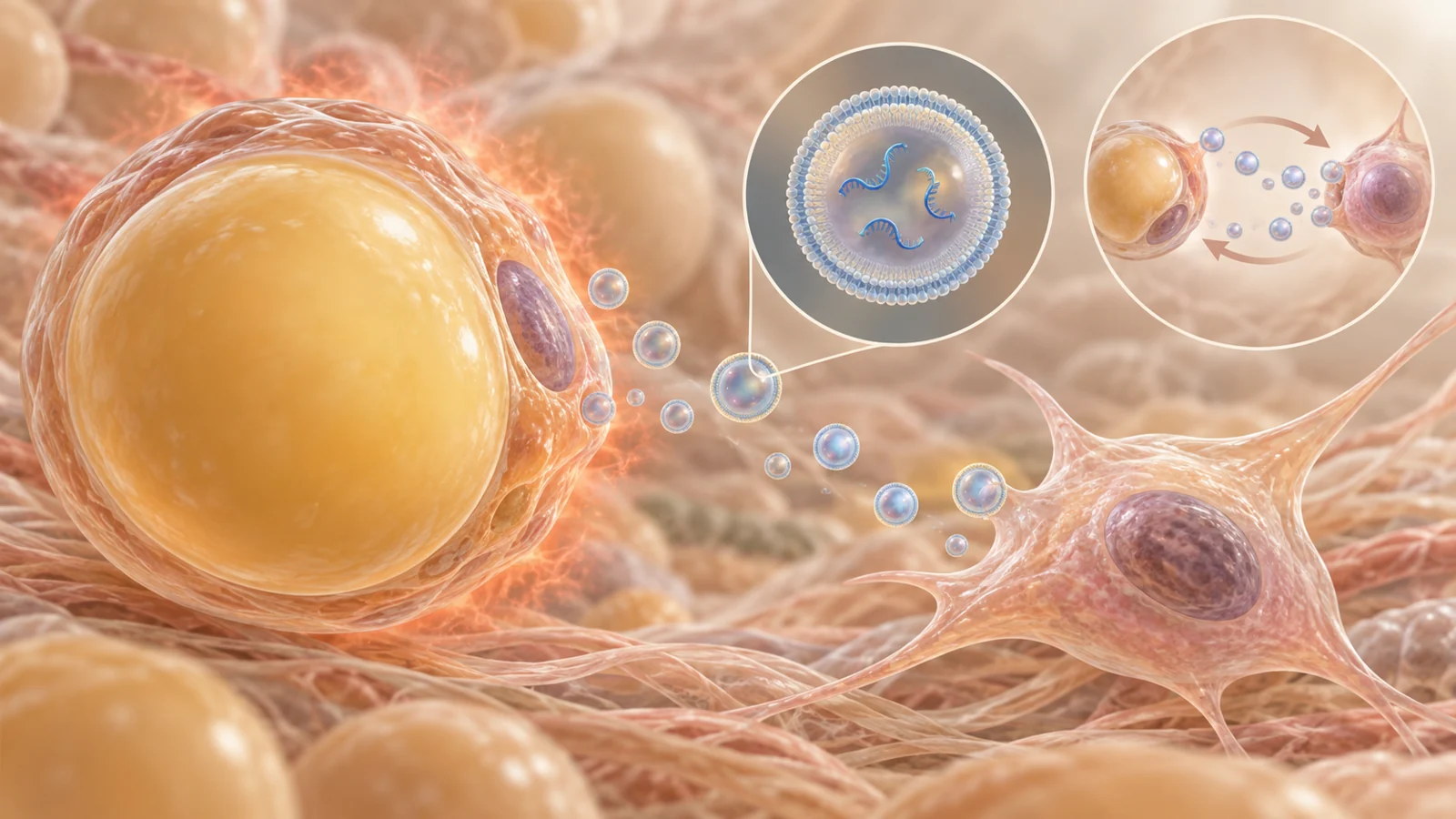
A narrative review published on July 20, 2024, proposes a connection between impaired storage and communication among cells. It brings together evidence on cellular senescence—a persistent stress state in living cells—and extracellular vesicles, tiny membrane packages that cells release. One experiment described in the review links vesicles from enlarged mouse fat cells to changes in neighboring cells that can develop into new fat cells.
That connection offers a possible treatment target. Whether it can become a useful treatment depends on how much the mechanism matters in people and whether harmful communication can be interrupted selectively.
When fat tissue struggles to make room
White fat tissue normally stores excess energy in the form of triglycerides. It also releases hormones and other substances that help regulate metabolism. Its capacity to accommodate more fat depends partly on existing fat cells enlarging and partly on precursors developing into additional fat cells.
The authors describe how persistent nutrient excess can strain this system. Enlarged fat cells can experience inadequate oxygen supply, impaired mitochondrial function and oxidative stress. The endoplasmic reticulum, which helps process proteins, can also become stressed. Responses that ordinarily help a cell cope may become inadequate when these pressures persist.
Cellular senescence is one possible outcome. In cells capable of dividing, it involves a lasting stop to cell division. The cells remain alive and metabolically active, distinguishing senescence from apoptosis, a form of programmed cell death. Mature fat cells and their precursors have different roles here: the renewal problem concerns precursors that would otherwise help produce additional fat cells. It does not require mature fat cells to be routinely dividing.
If precursor function deteriorates while existing cells approach their capacity to enlarge, fat tissue becomes less able to accommodate additional energy. The review connects this loss of buffering capacity with increased circulating fatty acids and fat deposition in tissues such as the liver and skeletal muscle. Harm associated with excess lipid accumulation in these locations is called lipotoxicity.
The proposed sequence explains why simply counting or weighing fat misses part of its biology. A tissue can contain abundant stored energy while struggling to provide further storage. The authors present this as part of a unifying hypothesis for metabolic dysfunction, rather than a complete explanation of obesity.
Tiny packages with effects inside other cells
Senescent cells release a mixture of substances, including inflammatory proteins, growth factors and extracellular vesicles. Together, these secretions are known as the senescence-associated secretory phenotype. Vesicles are one component of that mixture, with a particular ability to carry cargo between cells.
Exosomes are a subtype of extracellular vesicle formed inside a cell and then released. Other vesicles bud from the cell surface. Their membrane enclosure can protect cargo such as RNA from breakdown outside the cell, allowing it to reach a recipient.
Some of that cargo consists of microRNAs, small RNA molecules that regulate protein production. A microRNA can bind to a target messenger RNA—the instructions used to make a protein—and reduce production from those instructions. This gives vesicles a route to altering a recipient cell’s behavior without changing its DNA sequence.
The significance is more specific than two neighboring cells both being under stress. A package released by one cell can carry material that influences molecular activity inside another. The mouse-derived experiment summarized in the review tests whether vesicle release contributes to such an effect.
What the mouse cell experiment tested
Researchers brought together enlarged fat cells from beneath the skin of male mice with diet-induced obesity and adipose-derived stem cells, which can develop into fat cells. Growing different cell types together in this way is called co-culture. It lets researchers examine their interactions under controlled laboratory conditions.
The recipient stem cells developed several changes. Markers of endoplasmic reticulum stress increased, as did the senescence-associated proteins p16 and p21. The cells took longer to double in number, and their capacity to differentiate into fat cells declined. The review also describes shorter telomeres and an increase in a commonly used senescence-associated enzyme marker.
These measurements address different aspects of the response. Stress markers describe changes inside the cells; slower population growth concerns their ability to expand; reduced differentiation concerns their potential contribution to fat storage. The finding is therefore relevant to the renewal of fat tissue, beyond the presence of an isolated molecular warning sign.
The researchers then used GW4869, an inhibitor of an enzyme involved in exosome production. According to the review, inhibiting exosome production prevented the reported effects in the recipient cells. This intervention adds information that measuring stress markers alone cannot provide: reducing vesicle production changed the response, supporting a functional contribution from that route in the experimental system.
It does not, by itself, identify the responsible cargo or establish that the inhibitor acts exclusively through the proposed pathway. Nor is preventing these changes in a mouse-derived cell culture equivalent to improving metabolic health in a person. The experiment supports a mechanism at the cellular level; its clinical importance remains a separate question.
Why the location of fat matters
Human tissue observations add an anatomical dimension. The review describes samples obtained from people with obesity undergoing bariatric surgery. Visceral fat from the omentum and mesentery—tissues within the abdomen—released more small extracellular vesicles per gram than fat from beneath the skin.
The comparison per gram matters because it concerns secretion relative to tissue mass, rather than simply reflecting the presence of a larger fat depot. It suggests that different fat locations can make different contributions to vesicle release. It does not establish that every vesicle released from visceral fat has harmful cargo.
Location also influences exposure. Blood from some abdominal visceral fat drains through the portal vein toward the liver. The liver can therefore receive fatty acids and other substances released by these depots directly. This provides a plausible connection between the properties of a particular fat depot and its effects on another organ.
The review also describes associations between higher circulating vesicle levels and insulin resistance, in which tissues respond less effectively to insulin. Those observations answer a different question from the co-culture experiment. Surgical tissue measurements compare secretion from fat depots; blood measurements relate circulating levels to metabolic features. Neither alone demonstrates that vesicles cause insulin resistance in patients or tells us how much of the circulating material reaches a particular target cell.
A treatment would need to preserve useful communication
Vesicle release is also part of normal physiology. Cells use these packages in responses to nutrient availability and changing tissue conditions. The review describes microRNAs released by adipose-derived stem cells that promote blood-vessel formation in response to fat-tissue enlargement and inadequate oxygen supply. Such functions make indiscriminate suppression a problematic therapeutic assumption.
A useful intervention would need to distinguish harmful signaling from communication that supports tissue function. That might depend on which cells release the vesicles, what they carry or how recipient cells respond. Simply lowering the total vesicle count would not establish that this balance had improved.
The evidence assembled here also needs to be read at its own level. The authors report an English-language search of PubMed, MEDLINE and the Cochrane Library through June 30, 2024, supplemented by examination of reference lists. That search date is distinct from the July 20 publication date. Their narrative synthesis connects cell experiments, animal findings, human tissue observations and associations; these approaches provide different kinds of support for the proposed biology.
The mechanistic findings discussed here do not establish a safe, effective human regimen for blocking vesicle release or clearing senescent cells in obesity. The review’s broader discussion of treatments does not turn this particular chain of evidence into a demonstrated therapy. Its contribution is to connect a plausible cellular process with a specific loss of tissue function that treatment development could try to address.
What this could change
If harmful vesicle signaling proves clinically consequential and can be selectively interrupted, treatment might help preserve the ability of fat-cell precursors to develop into functioning fat cells. That could help tissue accommodate excess energy, reducing the amount of lipid deposited in organs less suited to storing it. For people with obesity, the potential benefit would be less metabolic harm from impaired storage, provided useful cellular communication remains intact.
This possibility gives fat-tissue function a concrete place in treatment thinking alongside fat quantity. The desired outcome would be tissue that retains its capacity to renew and buffer energy, with downstream improvements in organ exposure and metabolic health. As of July 2024, that is a conditional therapeutic prospect arising from the biology, not an established clinical result.
Key Sources
- Primary source: Cellular Senescence and Extracellular Vesicles in the Pathogenesis and Treatment of Obesity-A Narrative Review.
DOI or Journal Page · Review or Meta-Analysis · 2024-07-20
Keep exploring