
Research Signal – Source date 2025-06-06
A walnut-shell treatment raised the cellulose content of the remaining dry material from 27.4 to 87.9 grams per 100 grams. That sounds like nearly all the shell’s original plant fiber was saved. It does not show that by itself.
The 87.9 figure is a share of the material left after processing. To know how much cellulose survived the process, readers also need the solid yield: how much treated material remained compared with the amount that went in. A cleaner, more cellulose-rich remainder can still represent a loss of some original cellulose along the way.
A review published on June 6, 2025, compares conventional and newer approaches to isolating cellulose from nut shells. Its examples show why a large final percentage is only one part of judging an extraction method. The shell’s starting composition, the sequence of treatments, and the amount of material retained all affect what a result means.
The number describes the treated material
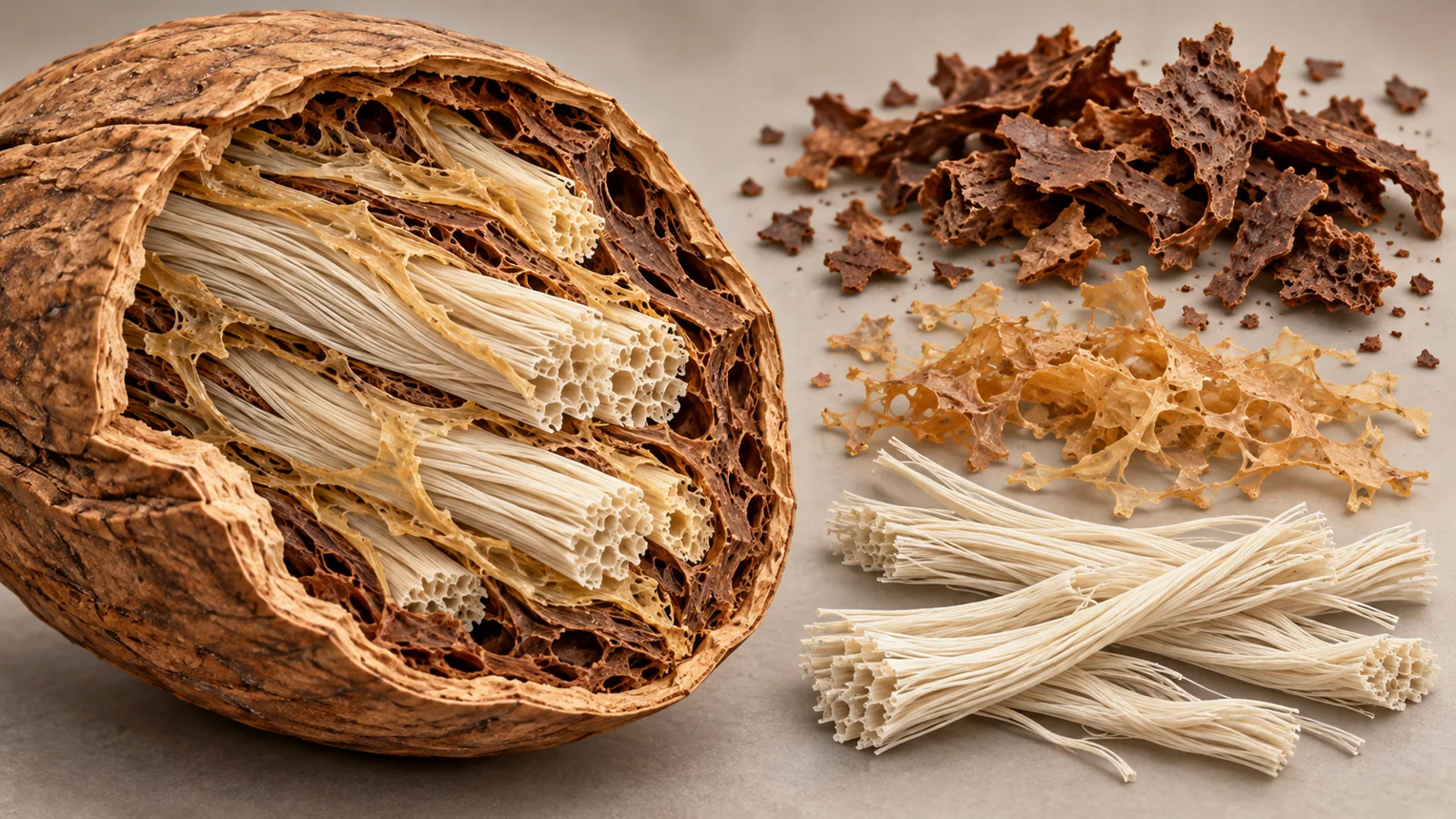
Cellulose is the structural plant fiber that gives many plant materials strength. In a nut shell, it is not sitting in a clean, separate layer. Long cellulose chains gather into tiny bundles, or microfibrils, with ordered crystalline regions and less ordered amorphous regions. These bundles are embedded in a matrix that includes hemicellulose and lignin. Lignin is especially difficult to remove and can shield the cellulose from treatment.
Washing and grinding help prepare shells, but they do not separate those components. Reducing particle size exposes more surface to treatment, while chemical or hot-water steps loosen or remove parts of the surrounding matrix. The challenge is to remove enough material to make the cellulose accessible without sacrificing too much of the cellulose itself.
The walnut example makes the measurement issue concrete. The shells began with 27.4 grams of cellulose per 100 grams of dry material. Four cycles in a 2% sodium hydroxide solution at 100 °C raised the cellulose content to 56.6 grams per 100 grams of dry material. The process removed hemicellulose selectively, but lignin remained. A subsequent bleaching step raised the cellulose content to 87.9 grams per 100 grams of dry material.
Those figures describe composition at different stages. They show that cellulose made up a larger fraction of the treated solids; they do not, on their own, reveal the fraction of the original cellulose recovered. If processing also removes substantial mass, the percentage can rise even as some cellulose is lost. A fair comparison therefore needs both composition and solid yield, along with a consistent basis for calculating recovery.
More lignin removed can mean less cellulose retained
A hazelnut-shell comparison illustrates a different tradeoff. Among three single treatments, alkaline treatment removed the most lignin, 49.6%. Yet its cellulose recovery was 85.4%, lower than recovery with dilute acid, at 96.7%, or hot-water treatment, at 98.0%.
The treatments were doing different jobs. Alkali removed more lignin in that comparison, but it also dissolved some of the less ordered parts of the cellulose. A process chosen to open up the shell and reduce lignin may therefore perform differently from one judged by how much cellulose remains. Neither measurement alone captures the whole result.
The comparison also shows why a treatment cannot always be judged as a single ingredient. When alkali came before hot water, reported lignin removal reached 60.7%; reversing the order produced 46.7%. The review suggests that in the reversed sequence, heat and pressure may have caused lignin to gather again in droplets, making the later alkali step less effective. Sequence changed the outcome even though the same broad treatment types were involved.
Hot-water treatment is being explored as a way to use water as the extraction solvent. At elevated temperatures, water’s properties change, and the process can break down hemicellulose while leaving cellulose stable at lower temperatures than those needed to degrade it. As hemicellulose breaks down, it releases acids that can help break down more hemicellulose; lignin can also split into smaller compounds that are easier to remove in a later step. These effects make hot water a candidate in a treatment sequence, rather than a guarantee of a finished, purified material on its own.
Other approaches also carry tradeoffs. Physical methods such as microwaves and ultrasonication can require high energy input. Chemical treatments can remove lignin effectively but may form by-products that interfere with later use. The review describes deep eutectic solvents as an area of growing interest, while emphasizing that extraction severity must be balanced: overly aggressive conditions can degrade cellulose, and mild conditions can leave lignin behind.
The feedstock changes the calculation
“Nut shell” is not one uniform raw material. Cellulose, hemicellulose and lignin proportions vary between species and can also shift with growing conditions and maturity. Studies may use different analytical methods, which can further complicate comparisons. A treatment that works well on one shell should not be assumed to work equally well on another.
The starting material can also have other valuable components. The review notes that pecan and Brazil nut shells have attracted attention for compounds studied for antioxidant and antimicrobial properties. Cashew shells contain cashew nut shell liquid, an oil used in bio-based resins and coatings. For those feedstocks, cellulose extraction is only one possible use of the material. The value of a route depends partly on what it leaves available, not just on the purity of the cellulose fraction.
This variability is one reason a high laboratory figure cannot settle which route is best for all shells. Useful comparisons need to identify the shell type and report results on a common basis. Composition, solid yield and cellulose recovery answer related but distinct questions. Process sequence matters too, as the hazelnut results show.
From a promising treatment to a usable process
A cellulose-rich sample is an early measure of separation, not a demonstration of a reliable industrial supply. Moving from laboratory experiments to practical use requires testing under realistic operating conditions. A processor and a material maker would need to know whether a chosen shell stream can be handled consistently, what the process consumes, and whether the recovered material meets the quality needed for its intended use.
That assessment includes more than the amount of reagent used. Energy demand, material losses, process costs and environmental effects all matter. The review calls for work on scalability, cost-efficiency and environmental impact; the evidence summarized here does not establish that a particular route has a net environmental advantage. Nor does it validate a commercial supply chain based on nut-shell cellulose.
A particularly useful next comparison would report cellulose purity and recovery together, using a shared mass basis, and account for energy and reagent inputs. That would help distinguish a route that produces a high-percentage cellulose solid from one that recovers more of the starting fiber at manageable operating demands.
Where this research could lead
If a repeatable, shell-specific recovery process can deliver cellulose with suitable material quality at practical operating demands, a nut processor could supply a defined stream of shells to a materials maker for a tested cellulose-based packaging ingredient instead of discarding that stream. Cellulose and packaging research already exist; the unproven step is whether a particular shell type can provide a consistent ingredient through a workable recovery route.
The review’s results point to why that route would need to be tailored: shells start with different proportions of cellulose, lignin and hemicellulose, and treatment order can change how much lignin is removed and cellulose retained. A nearer milestone would be a pilot-scale run on walnut shells that reports cellulose purity and recovery on the same mass basis, alongside energy use and reagent inputs. Material testing and further process development would still be needed before that result could support a dependable supply for packaging.
Key Sources
- Primary source: Conventional and Novel Strategies for Cellulose Isolation from Nut Shells: A Review.
DOI or Journal Page · Review or Meta-Analysis · 2025-06-06
Keep exploring