
Research Signal – Source date 2022-01-25
More than 90% of neuroblastomas are diagnosed before age 10. This cancer is rare in older people, leaving less evidence to guide expectations for teenagers and adults. In a study combining five hospital cases with 137 cases from published literature, adolescents had better reported outcomes than adults. The findings point to age and cancer spread as important clues, but they describe an assembled group of patients rather than a population-wide forecast.
The researchers defined adolescents as ages 14 to 18 and adults as older than 18. They assessed clinical and tumor features, along with treatments, across all 142 cases. Within this group, adolescents had better outcomes than adults, a difference the authors reported as statistically significant (p=0.012). The comparison identifies a pattern in these cases; it does not show that age itself caused the difference.
Age was one part of the picture
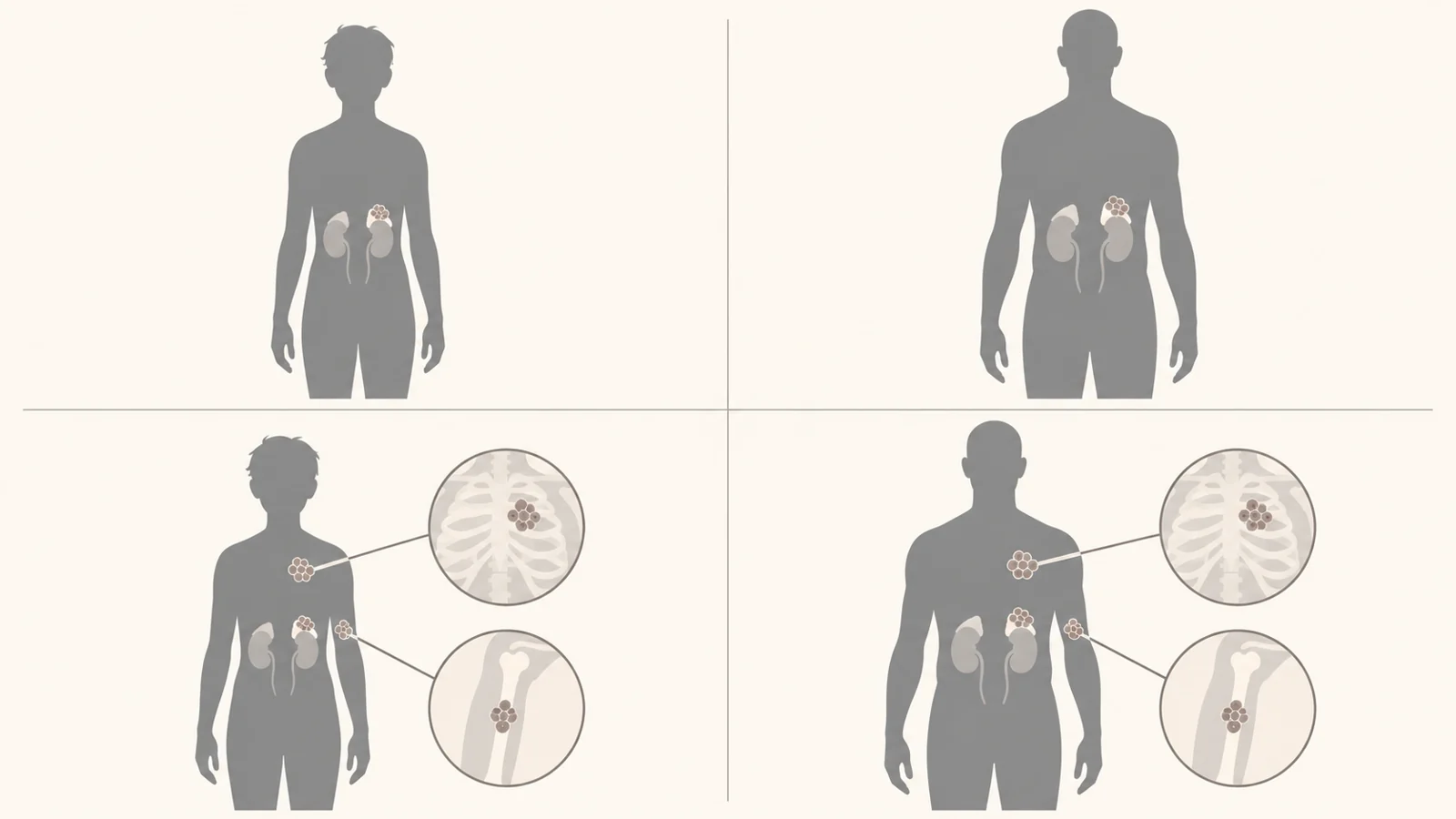
The older patients did not all share the same outlook. The authors also found poorer outcomes among patients diagnosed with neuroblastoma or nodular ganglioneuroblastoma, a related tumor type, and among those whose cancer had spread to distant parts of the body. The tumor-diagnosis association and the finding about spread are separate observations; the paper identifies distant metastasis as an independent adverse factor for overall survival.
Overall survival refers to how long patients live after diagnosis or treatment begins. Calling metastasis an independent adverse factor means its association with poorer overall survival remained when the researchers considered other factors in their analysis. It does not provide a personal prediction for a teenager or adult with the disease.
What the treatment comparisons did and did not show
Complete surgical removal of the tumor was associated with better survival in the assembled cases. That association does not establish that surgery alone produced the difference: patients whose tumors could be completely removed may have differed in important ways from those whose tumors could not.
The chemotherapy comparison depended on whether the cancer had spread. Among patients with distant metastasis, those who received chemotherapy had longer progression-free survival, the time patients lived without their disease worsening. The authors did not find a chemotherapy advantage in the localized-disease group. These comparisons may help frame questions about treatment in older patients, but the assembled cases cannot show that chemotherapy caused the reported difference or establish a regimen for future patients.
A rare cancer, gathered from different records
Because neuroblastoma in adolescents and adults is uncommon, the researchers combined five patients treated at their hospital with 137 cases described in earlier publications. That approach made it possible to examine more older patients than the hospital series alone contained. It also means the results reflect a collection of cases assembled from different sources, not a single study that followed a defined group under one shared plan.
This matters when interpreting both prognosis and treatment. Case reports and hospital records can differ in which details they include and which patients become part of the published record. The study therefore offers useful associations to investigate, not reliable population-wide survival estimates or proof that a particular treatment improves outcomes. The authors called for chemotherapy regimens and doses to be better adapted to older patients. They also raised anti-GD2 immunotherapy as a possible approach; this study did not demonstrate a benefit from it in these 142 patients.
What this could make possible
A teenager or adult diagnosed with this usually childhood cancer could eventually have a prognosis discussion grounded in evidence tested specifically in older patients. That discussion could account for whether the cancer has spread, rather than relying chiefly on experience with young children. The bridge is the study’s age and metastasis associations; dependable estimates and treatment guidance will require stronger, independently assembled evidence.
One meaningful milestone would be a larger cohort of adolescent and adult patients assembled separately, with clearly reported survival outcomes. If it reproduces the age and metastasis patterns, clinicians and researchers would have a firmer basis for developing and testing guidance for this older group.
Key Sources
- Primary source: Exploring the prognosis of neuroblastoma in adolescents and adults: a case series and literature review.
DOI or Journal Page · Review or Meta-Analysis · 2022-01-25
Keep exploring