
Research Signal – Source date 2025-01-14
An important question in sleep and cognitive care is whether treating obstructive sleep apnea (OSA) can improve thinking for people already showing mild cognitive impairment (MCI). A ClinicalTrials.gov record dated January 14, 2025 describes a planned randomized controlled trial of continuous positive airway pressure (CPAP), an air-pressure treatment for sleep apnea, in adults with MCI and previously untreated OSA.
The study is testing a possibility, not reporting an established benefit. Its central question is whether starting CPAP earlier produces better cognitive results than waiting four months while both groups receive web-based sleep education. The supplied record lists the study as not yet recruiting, with an estimated enrollment of 206 participants and no posted results.
Why the timing is the point
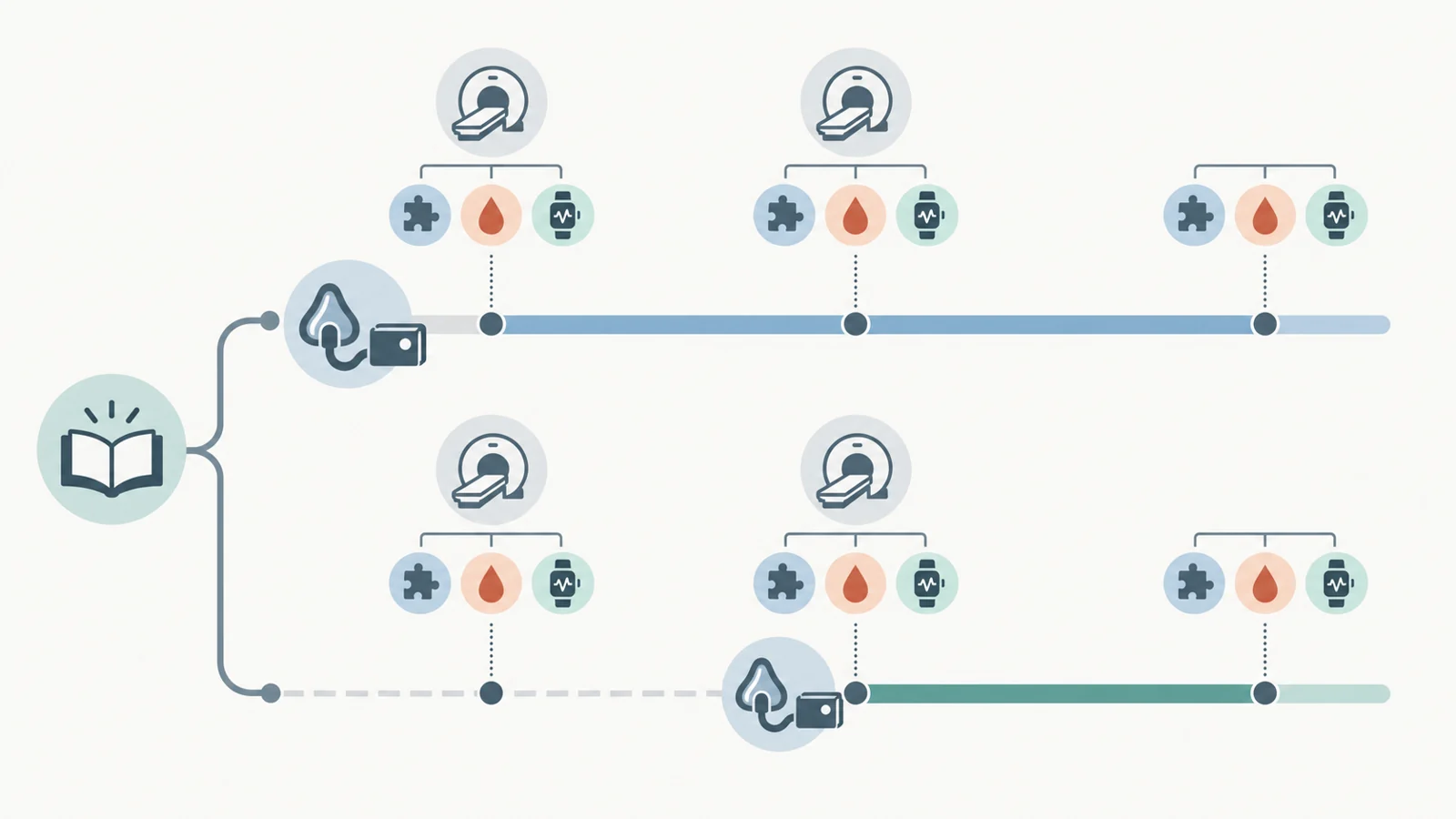
The trial is designed around the timing of treatment. Participants will be assigned to one of two parallel groups. The Early CPAP group will begin CPAP and sleep education at enrollment and continue both for eight months. The Later CPAP group will receive the same sleep education for the first four months, then add CPAP for the remaining four months.
During the first four months, the comparison is relatively direct: both groups receive the educational program, but only the early group is assigned CPAP. By month eight, however, both groups have received CPAP. The later comparison therefore concerns different treatment histories rather than a continuing treated-versus-untreated split. One group will have had eight months of CPAP, while the other will have had four months.
The sleep education comes through the sleep modules of the Brain Health Pro platform. The supplied record describes material on sleep physiology, healthy sleep habits, and sleep disorders such as sleep apnea. This shared component matters because it gives both groups an educational intervention while the timing of CPAP is changed.
The record describes a single-blinded randomized parallel study and gives a minimum eligibility age of 55. It does not establish that the estimated enrollment was achieved. It also lists an estimated February 2025 start, estimated primary completion in September 2027, and estimated completion in January 2028. Those dates are registry estimates, not verified milestones. January 14, 2025 is the publication date supplied for this study identity; it should not be read as proof that every listed field appeared in exactly that historical registry revision.
Treatment assignment is not the same as nightly use
The study’s CPAP arm includes more than handing participants a machine. The record says participants will receive a study-provided auto-titrating CPAP device, with settings set by a study sleep medicine physician according to current clinical practice parameters. They will have an in-person mask fitting and support from a sleep technologist by telephone or video. Masks, tubing, chin straps, and other equipment intended to help optimize use will also be provided.
Participants will be asked to use CPAP nightly, and device downloads will be used to monitor adherence. That distinction is important when the results are eventually interpreted. Random assignment answers which treatment schedule a participant was offered. Device records can help describe how much of the assigned treatment was actually used. A cognitive result associated with an assigned CPAP strategy and a result associated with sustained nightly exposure are related questions, but they are not identical ones.
The later group is also meant to receive the same type of support after its four-month education period. This makes the timing of treatment, rather than an intentionally different support package, the central feature of the comparison. The supplied evidence does not establish how many participants will start treatment, how consistently they will use it, or whether the planned schedule will be completed.
Thinking comes first in the outcome hierarchy
The primary cognitive outcome is change in the Symbol Digit Modalities Test, or SDMT, over the registry’s Week 0 to Week 32 window. The test measures speeded executive function. It is one outcome measure, not a complete measure of memory, independence, or dementia risk.
Additional cognitive tests will cover attention and executive function through Trail Making Test A and B, working memory through Digit Span and Letter-Number Sequencing, verbal learning and memory through the Hopkins Verbal Learning Test, and overall cognitive impairment through the Alzheimer’s Disease Assessment Scale Cognitive Subscale. These measures broaden the picture, but they do not turn a change on any one test into proof that dementia has been prevented.
The study also plans supporting measurements. Blood samples will be used to measure plasma pTau181 and GFAP. MRI will quantify features including perivascular spaces and white matter hyperintensities. Wearable and at-home measurements will capture sleep and physiology, including oxygen-related measures, sleep staging, total sleep time, and sleep fragmentation. These data may help show whether biological or sleep-related changes accompany a cognitive result and may help researchers investigate possible pathways between CPAP and thinking.
The schedules are not all the same. Cognitive assessments, blood samples, and wearable measurements are planned at baseline, four months, and eight months. MRI is planned at baseline and four months only. The registry gives the primary cognitive outcome a Week 0 to Week 32 window and the MRI outcome a Week 0 to Week 16 window. Calendar months and registry weeks should therefore be kept as separate descriptions rather than treated as interchangeable.
What this registry record can answer later
The record identifies a testable hypothesis: in adults with MCI and previously untreated OSA, adding CPAP to sleep education may improve cognitive function, and earlier treatment may be more beneficial than later treatment. It also lays out a way to compare different exposure durations and to examine whether sleep physiology or biological measurements change alongside cognitive performance.
It cannot, in the evidence supplied here, tell readers whether CPAP improved cognition in this trial. There are no reported effect estimates or participant outcomes in the supplied package, and achieved enrollment, actual treatment exposure, and completed study milestones have not been established. The record’s not-yet-recruiting status and estimated dates describe the registry entry; they do not verify what happened afterward.
The possible findings also represent different kinds of claims. A higher score on the SDMT would concern performance on a speeded executive-function test. A change in pTau181 or GFAP would concern a blood measurement. A change in MRI or sleep physiology would concern a biological or physiological measure. None of those measurements is interchangeable with a demonstrated reduction in dementia incidence.
The intended population matters as well. The evidence concerns people aged 55 or older who have MCI and untreated OSA, as described in the eligibility and study summary. It does not establish applicability to every older adult, to people without sleep apnea, or to people with diagnosed Alzheimer’s dementia. The supplied record describes the study as single-blinded but does not establish which party is blinded. It also does not provide a verified numerical threshold for clinically meaningful change or authorize a detailed account of the analysis plan.
What earlier sleep-apnea treatment could mean for cognitive care
Earlier supported CPAP could become a more deliberate part of cognitive care for older adults who have both MCI and untreated OSA, but only if this trial establishes a clinically meaningful advantage and the treatment proves usable in practice. A reliable benefit from starting treatment sooner could give clinicians an additional reason to prioritize timely CPAP access, careful fitting, adherence support, and sustained use for this specific population.
That possibility is what the trial is structured to examine. The supplied registry record offers a defined comparison and a set of planned measurements, not evidence that the hoped-for cognitive benefit has already occurred.
Key Sources
- Primary source: CPAP Randomized Controlled Trial
Government or Regulator · Clinical Trial · 2025-01-14
Keep exploring