
Evidence date · 2022-11-01 · 1 of 1 – Track starter note
See current Track status →
Making an object harder to detect with electromagnetic waves is not only a question of shaping its surface. The materials around it must also respond to those waves in carefully controlled ways. In a November 2022 study, researchers used evolutionary optimization to explore whether cloaking designs could account for the imperfect materials available in practice.
Here, electromagnetic cloaking means making an object less detectable to incoming electromagnetic waves. The authors describe earlier transformation-optics and artificial-metamaterial approaches as difficult to realize because they can require materials with carefully varying and direction-dependent properties. They also frame earlier invisibility designs as limited to narrow frequency regimes and strongly affected by material losses.
Two routes inside a compact structure
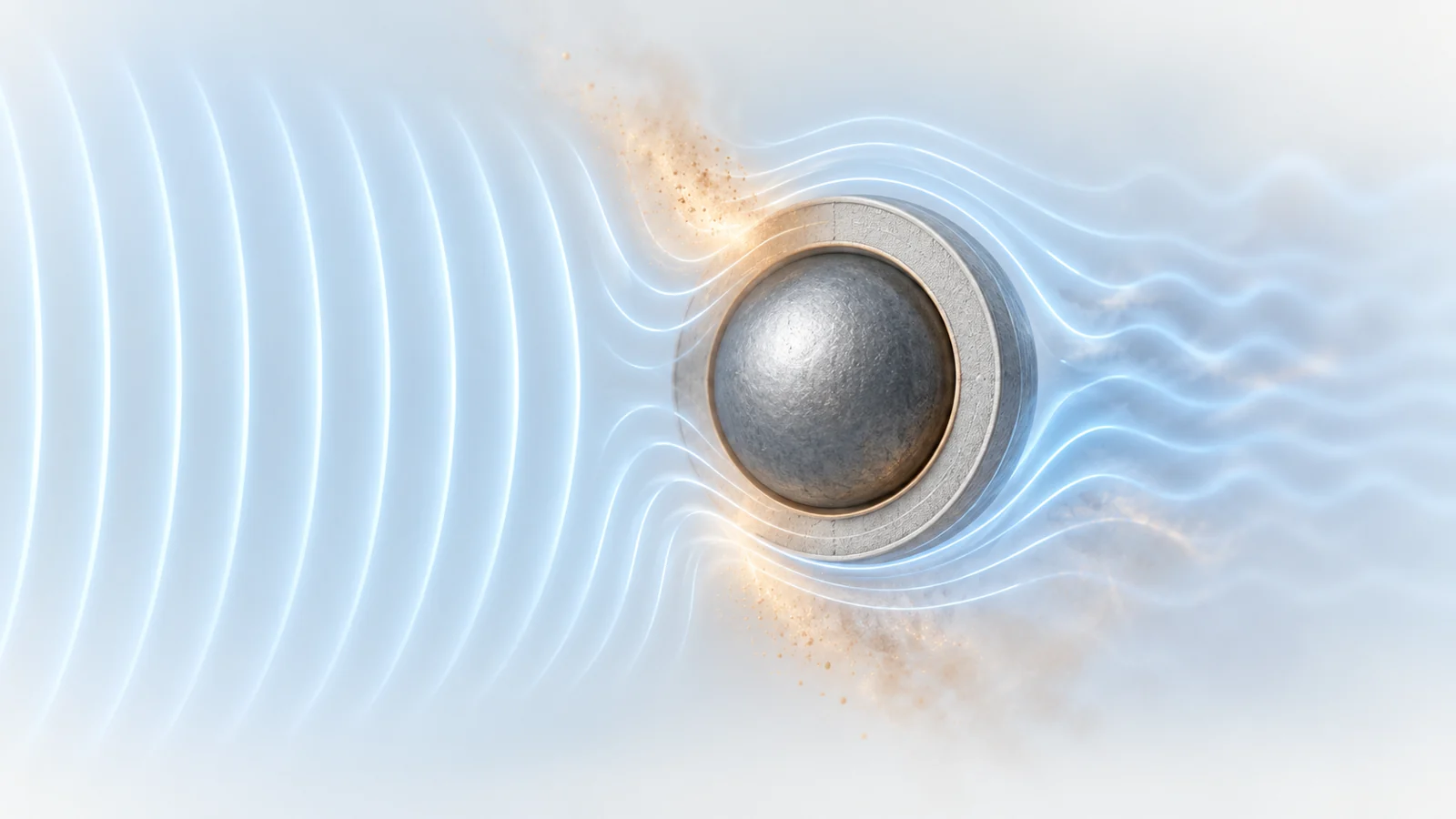
The proposed designs use a two-layer core-shell configuration: an inner core surrounded by an outer shell. This gives the concept a comparatively simple structural form, while the material response of the layers is selected through optimization.
The paper presents two related but distinct routes. One involves multifrequency isotropic invisible devices, using realistic material choices such as microwave materials. The other involves natural hyperbolic invisible devices, including van der Waals materials. These labels describe different material-response strategies; the study does not treat them as interchangeable versions of the same device.
The point of the arrangement is not to claim that a finished cloak has been built. It is to show how a compact design can be matched to material properties that exist outside an ideal mathematical model.
Designing with losses in the calculation
Real materials absorb or otherwise lose part of the energy carried by an electromagnetic wave. The researchers included these inherent losses in the optimization process rather than treating the materials as perfectly lossless inputs.
That choice matters because accounting for losses is different from removing them. The optimization can search for designs that remain useful under lossy conditions, but it does not make the losses disappear or guarantee the same behavior across every operating condition. In this study, the material-aware calculation is the bridge between an ideal cloaking concept and a more realistic design problem.
What the reported checks establish
The authors evaluated the proposed devices in two ways: with full-wave numerical simulations and with analytical calculations. They report excellent invisibility performance from both forms of evaluation, describing the results as evidence that the method is stable.
Those findings establish a computational and mathematical result for the proposed designs. The supplied study evidence does not provide numerical details about operating frequencies, bandwidth, dimensions, scattering reduction, material parameters or fabrication tolerances. Multifrequency operation should therefore not be read as continuous broadband invisibility, and the result does not establish invisibility across visible light.
The supplied evidence leaves open whether physically fabricated devices would preserve the predicted performance, even though realistic material choices and their inherent losses are already included in the optimization. What is established here is a design strategy supported by numerical simulations and analytical calculations; the supplied evidence does not establish a fabricated or experimentally demonstrated device.
What this could change
If these material-aware designs continue to perform well when physically fabricated, the two-layer core-shell approach could make electromagnetic cloaking easier and less expensive to build. Realistic microwave or van der Waals materials, combined with a simpler structure, could give device engineers a more accessible starting point for future low-cost invisible-device implementations. That possibility remains conditional on fabrication and real-material tests preserving the useful behavior predicted by the calculations.
Key Sources
- Primary source: Invisible devices with natural materials designed by evolutionary optimization.
DOI or Journal Page · Peer-Reviewed Paper · 2022-11-01