
Research Signal – Source date 2021-02-26
Natural killer cells already have a useful cancer-fighting ability. They can recognize and lyse some abnormal cells without the prior sensitization required by certain other immune responses, and they do not depend on the same human leukocyte antigen matching used by some cell therapies. The practical question is harder: what must change for that broad ability to become a dependable treatment that can find the right tumor, survive manufacturing and remain active after infusion?
A review published on February 26, 2021, examined several ways of using natural killer cells against cancer, including cells expanded with cytokines, antibody-assisted approaches and genetically modified products. Its particular focus was receptor engineering. Adding a tumor-directed receptor could give an NK cell a more specific way to recognize cancer, but recognition is only one part of a treatment. The cell must also receive the right activating signals, be produced in sufficient numbers, retain its function and work safely in a patient.
Natural killer cells start with a flexible defense
Natural killer cells are a population of immune cells found among the lymphocytes in peripheral blood. Unlike T and B cells, they do not build antigen-specific receptors through receptor rearrangement. Instead, their behavior is governed by germline-encoded activating and inhibitory receptors. This gives them a form of rapid surveillance rather than a single predetermined target list.
The review describes two broad NK-cell populations in blood. Most are CD56dim cells that express high levels of CD16, a receptor that can help them respond to antibody-coated targets. A smaller CD56bright population is more associated with cytokine production. Both groups can participate in immune defense, but their properties matter when researchers try to expand, activate or genetically modify cells for treatment.
NK cells can recognize malignant cells through several receptors at once. Their response reflects the balance of signals rather than one universal cancer switch. Activating receptors include natural cytotoxicity receptors and NKG2D. Inhibitory receptors include KIRs and NKG2A. A healthy cell’s major histocompatibility complex class I molecules can engage inhibitory pathways, while changes on a stressed or malignant cell may alter that balance. This biology helps explain why NK cells can attack some tumors naturally, but also why natural activity does not automatically provide precise, reliable tumor selection.
The cell’s decision depends on competing signals
The patient’s own NK cells offer a concrete example of the problem. In autologous therapy, the cells are collected from the same person who will receive them. The review summarizes evidence that inhibitory receptors on those NK cells can recognize self MHC class I molecules displayed by cancer cells and restrain activation. NK cells taken from people with cancer may also be in an immunosuppressed or functionally impaired state, making it harder for them to show strong antitumor activity after collection and expansion.
Adding stimulation can change how active a cell is, but activation and target selection are separate design problems. Cytokines such as interleukin-2 or interleukin-15 may support expansion or activation in particular approaches, yet the resulting cells still need a way to distinguish a tumor from surrounding tissue. The review also describes approach-specific toxicity concerns. High levels of interleukin-2 were associated with vascular leak syndrome in one treatment strategy, while very high interleukin-15 exposure was associated with cytokine release syndrome or dose-limiting toxicity in other settings. These observations belong to the particular cytokine-based approaches described, not to every NK-cell treatment.
Three ways to direct recognition
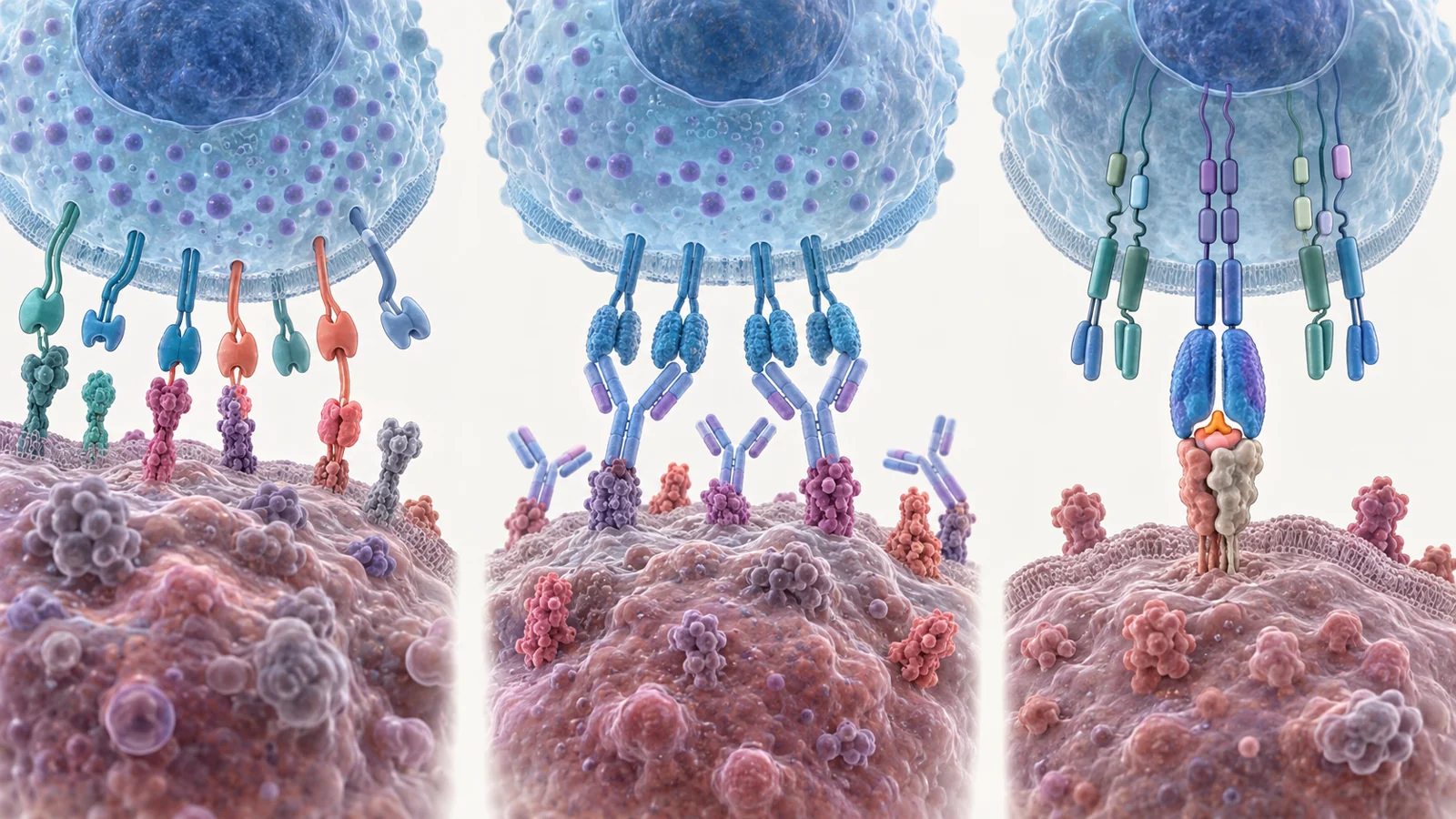
The review presents antibody-based therapy as one way to help NK cells identify a target from outside the cell. When an antibody coats a tumor cell, the antibody’s constant region can engage CD16 on an NK cell. That contact can trigger antibody-dependent cellular cytotoxicity, or ADCC, leading the NK cell to attack the marked target. The antibody supplies the address; the NK cell supplies the killing machinery.
A chimeric antigen receptor, or CAR, builds a related idea into the cell itself. Its antibody-derived recognition component is connected to intracellular signaling machinery, so a genetically modified NK cell can respond when that engineered receptor binds its chosen tumor-associated antigen. The approach can make recognition more directed, but the review identifies practical obstacles including limited expansion, difficult gene transfer and a shortage of suitable targets, especially for solid tumors.
A T-cell receptor provides another recognition route. It can recognize a particular peptide presented in an HLA context, but the receptor does not simply function by being placed on an NK cell in isolation. The review describes supplying NK cells with the T-cell receptor together with the CD3 components needed for its signaling complex. In this design, the engineered receptor adds antigen-specific recognition to an NK cell that still retains its innate receptor system.
What T-cell receptors added in the laboratory
The review summarizes two independent preclinical studies using NK cell lines engineered with T-cell receptors and CD3 components. In one, TCR-NK cells derived from NK-92 and YTS lines carried a receptor directed against a tyrosinase-derived melanoma peptide. Recognition was restricted by HLA-A2, and the engineered cells showed antigen-specific killing of tumor cells in laboratory experiments and in an animal model. Another study used an NK-92 line engineered with CD3 components and T-cell receptors directed at peptides from a TGF-β receptor II frameshift mutation and the melanoma-associated antigen Melan-A. Those cells also showed enhanced recognition of targets carrying the relevant antigens.
The tyrosinase example makes the added capability easier to see. Native NK recognition uses the cell’s existing mixture of activating and inhibitory receptors. The introduced T-cell receptor supplies a more narrowly defined route: a particular peptide must be presented in the relevant HLA setting for that receptor to engage. The engineered cell therefore gains a new recognition condition; it does not become universally compatible with every tumor or every patient.
These experiments established antigen-specific activity in the models summarized by the review. They did not establish patient benefit from TCR-NK treatment. Nor were they a direct clinical comparison with CAR-NK, TCR-T or another cancer therapy. The review discusses clinical experience with other NK-based approaches, including CAR-NK work, but results from those approaches cannot be assigned to the TCR-NK experiments simply because all of them use NK cells.
A promising target is only the beginning
A treatment has to be made before it can be matched to a tumor. Autologous and allogeneic NK-cell therapies can be limited by the number of functional cells available for infusion. Cell lines offer a different tradeoff. They can be expanded more extensively in culture, which could make production more consistent, but the review describes irradiation before infusion as a safety step for NK-92 cells. Irradiation can limit the cells’ ability to expand substantially in the body, potentially reducing their effectiveness. Clinical experience summarized for non-modified NK-92 cells showed safety and tolerability in early trials, but the reported clinical benefit was not sufficient in every setting, including a Phase I study in refractory or relapsed acute myeloid leukemia.
Genetic modification adds another manufacturing bottleneck. The review notes that primary NK cells can be difficult to transduce efficiently. Messenger RNA transfection may produce low efficiency in some peripheral- and cord-blood preparations, while lentiviral transfer can vary by cell source. Even when a CAR is introduced, expression from messenger RNA can decline within days. Expansion with feeder cells may increase cell numbers but raises a separate product-safety concern if feeder cells remain in the final preparation.
Preserving the cells after they are made is also part of the treatment problem. The review cites a report of severe loss of cytolytic function after cryopreservation of IL-15-activated NK cells followed by culture without IL-15. The reported reduction was specific to that preparation and handling context, but it illustrates why a product that recognizes the right target in a fresh laboratory test may still be difficult to store and deliver with the same useful activity.
The proposed TCR-NK workflow therefore involves more than choosing a receptor. A tumor-specific T-cell receptor and the CD3 components would need to be introduced into an NK line, selected cells would need to be expanded and tested, and the resulting product would need to meet manufacturing requirements before it could be banked for later use. The review presents this as a prospective strategy, not as evidence that a routine clinical supply system had already been established.
What prepared cell treatments could mean for patients
Prepared TCR-NK products could eventually offer an additional option for people whose own immune cells are too impaired or unsuitable for collection and modification. Cells that can be expanded, engineered, tested and preserved ahead of treatment might reduce reliance on making a separate product from each patient’s cells. That possibility depends on several conditions arriving together: the receptor must recognize a compatible tumor peptide and HLA context, the cells must be manufactured safely, useful activity must survive storage and infusion, and patient benefit must be demonstrated in clinical treatment.
The February 2021 review therefore points toward a potential access benefit without establishing that the benefit had been realized. Engineered recognition may solve one part of the targeting problem. A usable prepared treatment would require that recognition to remain connected to reliable cell production, preserved function and evidence that the whole process helps patients.
Key Sources
- Primary source: The Advances and Challenges of NK Cell-Based Cancer Immunotherapy.
DOI or Journal Page · Review or Meta-Analysis · 2021-02-26
Keep exploring