
Research Signal – Source date 2025-06-11
Osteoarthritis gradually damages cartilage and can inflame the tissue around a joint, making movement harder. Many current treatments focus on easing symptoms. Researchers are also exploring whether repair-focused approaches could influence the processes that damage the joint.
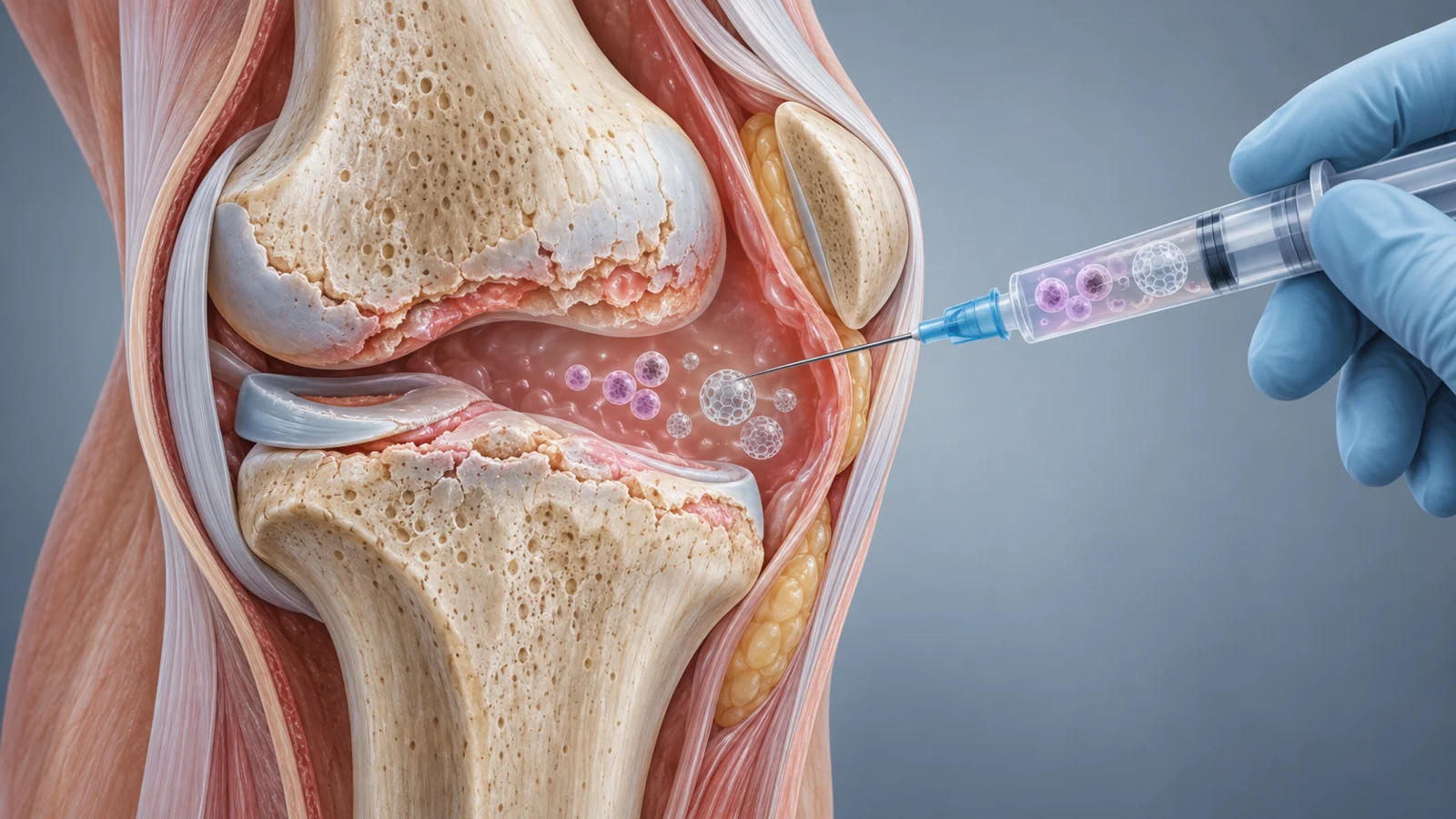
Mesenchymal stem cells (MSCs) are one such approach. These cells can release signals that affect inflammation and tissue repair, and they can develop into several cell types, including cartilage cells. But an osteoarthritic joint is a difficult place for transplanted cells to survive and function. A June 2025 narrative review considers whether natural compounds such as curcumin and resveratrol might help MSCs perform better. Its literature search focused on studies published from 2018 through 2024; the review itself did not test a treatment.
A repair strategy faces a difficult joint environment
The appeal of MSCs is not limited to replacing damaged cartilage. They also release cytokines, growth factors, and extracellular vesicles that may influence inflammation and the activity of other cells. In principle, those effects could support repair while changing the local environment that contributes to tissue damage.
Inflammatory signals such as IL-1β, IL-6, IL-17, and TNF-α can activate NF-κB and MAPK pathways. These pathways are associated with enzymes that break down the extracellular matrix, the supporting material in cartilage. Inflammation can therefore both damage the tissue and create conditions that make a cell-based treatment harder to sustain.
MSCs injected into a joint may have low survival, limited retention, or difficulty acting in that inflamed environment. Results can also vary with the cells’ tissue source and how they are isolated and cultured. The proposed combination strategy is to use selected natural compounds to support cell survival or alter relevant biological activity, rather than asking transplanted cells to work unaided.
The compounds take different routes
Curcumin, a compound from turmeric, is discussed as an anti-inflammatory and antioxidant that can inhibit NF-κB and reduce inflammatory signals including IL-6 and TNF-α. In studies described by the review, it also supported MSC survival and proliferation under oxidative stress and promoted their development toward cartilage cells. Those findings make curcumin relevant both to the cells’ ability to persist and to their potential role in cartilage repair.
Resveratrol is considered through a different set of observations. The compound is linked to SIRT1, a pathway involved in mitochondrial function and oxidative stress. Studies summarized in the review associate resveratrol with increased expression of cartilage-related markers such as collagen type II and aggrecan, as well as reduced activity of matrix-degrading enzymes and inflammatory mediators. This is a different research rationale from curcumin’s reported support for cell survival under oxidative stress.
The review also describes epigallocatechin-3-gallate (EGCG), a green tea polyphenol, in relation to collagen handling. It reports that EGCG may support MSC-mediated collagen remodeling under oxidative stress, but that it is ineffective once collagen has already undergone oxidative damage. The distinction matters: the review does not present the compounds as interchangeable supplements with a shared, established effect. Each represents a separate research approach, with results tied to particular experimental conditions.
The clearest combination example comes from models
Among the preclinical examples, the review describes curcumin-treated MSCs administered into osteoarthritis model joints. In those models, the combination reduced inflammation and promoted cartilage regeneration more effectively than MSCs alone. The review links curcumin’s effects to inhibition of NF-κB/JNK signaling and notes that delivery systems such as curcumin-loaded nanoparticles and microgels improved bioavailability and efficacy in the reported experiments.
Other model findings broaden the picture but do not make every combination equivalent. Resveratrol paired with MSCs was associated with better cell survival and proliferation in animal models, alongside changes related to oxidative stress and inflammation. Quercetin-treated bone marrow MSCs were described as producing exosomes that delivered miR-124-3p to cartilage cells and altered inflammatory signaling. EGCG findings centered on MSC protection and collagen remodeling under specific conditions.
These are encouraging results from experimental systems. They show why researchers are testing compound-and-cell combinations, but they do not establish that a specific pairing repairs cartilage or slows osteoarthritis in patients. The curcumin comparison with cells alone is one model result, not proof of a durable human treatment effect.
Human findings remain hard to interpret
The clinical literature discussed in the review includes studies of MSCs on their own, as well as combinations involving other interventions. Some MSC trials reported reduced pain or better joint function, while findings on cartilage protection and repair were less consistent. Evidence about MSCs paired with platelet-rich plasma (PRP) is a separate line of research; it cannot establish what happens when MSCs are paired with natural products.
Direct clinical evidence for MSCs combined with natural products is more limited. The review mentions interest in Radix Achyranthis Bidentatae alongside MSCs, but describes the overall evidence as early, with much of the research in preclinical models or small clinical studies. It also reports conflicting patient findings: some studies suggested symptom improvement, while others did not show significant cartilage regeneration.
Pain and function matter to patients, but they do not by themselves show that cartilage has been restored or that disease progression has changed. The review therefore presents a gap between the promise seen in models and the less uniform clinical picture. The evidence it discusses does not identify a validated dose, standardized combination, or durable benefit and safety for a particular natural product paired with MSCs.
Consistency is part of the treatment challenge
A compound that works in a model must still reach the relevant tissue in a usable form. Curcumin and resveratrol can have poor bioavailability and be rapidly metabolized, according to the review. Nanoparticles and hydrogel-based delivery systems are among the approaches discussed, but a formulation that performs in an experiment still needs to be optimized and assessed for clinical use.
The cell product also needs to be consistent enough for results to be compared. MSCs may come from bone marrow, adipose tissue, or umbilical cord blood; isolation, culture, and administration practices vary. Differences in the joint itself—including inflammation, oxygen levels, and other local conditions—may further affect cell performance. Osteoarthritis also varies between patients, so a combination that helps in one setting may not have the same effect in another.
These practical differences make it difficult to tell whether two studies tested essentially the same treatment, or to know which patients might benefit. Reliable clinical evidence will depend on a deliverable compound, clearly characterized cells, and outcomes that can be interpreted across studies and patient groups.
How a reliable combination could change osteoarthritis care
A combination that can be delivered consistently and shown to work safely over time could offer patients an option aimed at more than temporary symptom relief. By supporting cell activity while easing inflammation, it might help preserve or repair cartilage and address processes involved in joint deterioration. That possibility remains conditional: the treatment would need to demonstrate durable benefit and safety in people, not only promising effects in experimental models.
Key Sources
- Primary source: Synergistic Effects of Natural Products and Mesenchymal Stem Cells in Osteoarthritis Treatment: A Narrative Review.
DOI or Journal Page · Review or Meta-Analysis · 2025-06-11
Keep exploring