
Research Signal – Source date 2026-08-21
A silica-based repair liquid appeared to diffuse more successfully into highly porous, aged concrete from a hydraulic tube than into lower-porosity concrete from a hydropower plant. The authors of an August 21, 2026 preprint interpret the contrast as a sign that the material’s access depends on the concrete it is meant to repair. They assessed treated samples in the laboratory; they did not repair an operating hydraulic structure.
The difference matters because a treatment applied at the surface can only influence material it reaches. The reported result offers a possible way to think about repair access, while leaving open how much of the measured change came from the treatment and what it would mean for a structure’s performance.
A mixture designed to interact with concrete’s binder
The study tested Elera, a mixture the authors describe as colloidal nanosilica dispersed in potassium silicate, acrylic latex, water and fumed nanosilica. Nanosilica means extremely small silica particles. The researchers applied the mixture to aged concrete samples taken from hydraulic tubes at the Assis Chateaubriand Hydroelectric Plant, also identified as UHE Mimoso, and examined sections after treatment.
Concrete’s binding matrix includes calcium silicate hydrate, usually shortened to C-S-H. The researchers investigated whether silica in the applied mixture could participate in reactions associated with forming or recovering this matrix. That is a proposed explanation for the thermal changes they measured; the experiment does not separately establish the contribution of each ingredient.
The preprint names the acrylic latex as BS 700 in its abstract and BS 796 elsewhere in the text. The exact grade therefore remains uncertain.
Heating samples reveals changes, with limits
To assess treatment, the researchers used thermogravimetric analysis, or TGA. A small piece of concrete is heated while an instrument records how its mass changes. The team also examined derivative thermogravimetry, or DTG, which tracks how quickly mass changes across the heating curve. They tested at two rates, 10°C and 20°C per minute, with samples heated from room temperature to 880°C in nitrogen.
The curves depend partly on the test conditions. For example, the reported mass loss between 15°C and 300°C was 7.9% at the slower rate and 6.4% at the faster rate. The authors attribute this difference to limits on how quickly moisture can leave during faster heating. In the 300°C to 800°C interval, the reported losses were similar: 10.6% and 10.5%. A thermal curve is therefore a response to both the sample and how it is measured.
In treated, highly porous hydraulic-tube concrete, the authors report an increase in the mass percentage in the 450–520°C range. They associate this change with pozzolanic reactions, in which silica-related chemistry can contribute to cement-like binding products, and interpret it as evidence of C-S-H matrix recovery. This is a laboratory interpretation of the mass-loss pattern, rather than a direct measurement of repaired strength or water tightness.
Each part of the heating curve cannot be assigned to one substance with confidence. The concrete binder and calcium hydroxide, another cement compound, both change during heating. The added acrylic polymer and carbonation linked to environmental exposure can also affect the curve. Because these effects overlap, the curve alone cannot show how much new binder formed after treatment. The authors also discuss exterior and interior sections, whose exposure may differ.
Porosity may explain the diffusion contrast
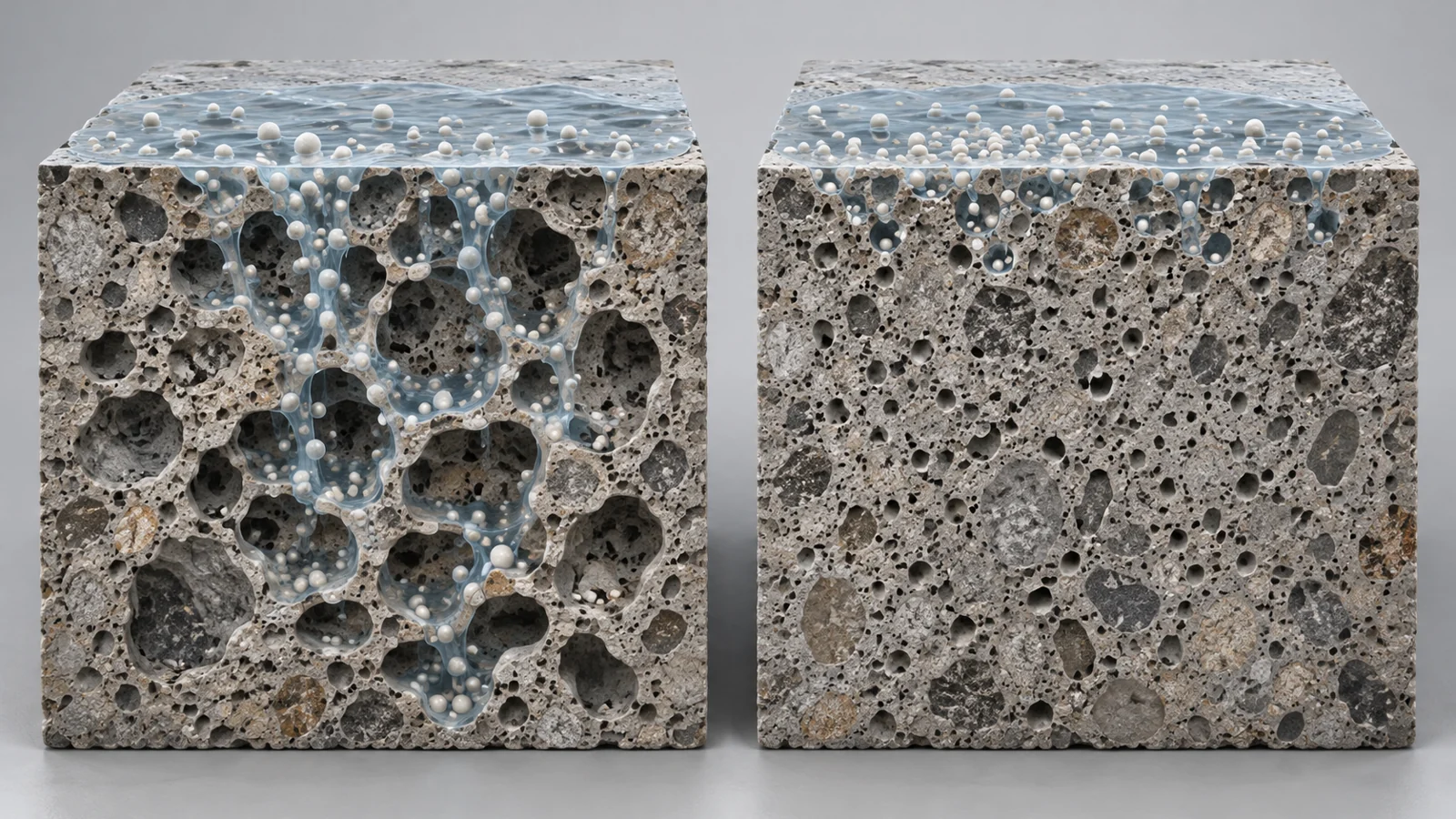
The authors report more successful diffusion in the highly porous hydraulic-tube samples and limited penetration in lower-porosity samples from the plant. They suggest that the denser material restricted movement from the treated surface. The comparison supports porosity as a plausible explanation, but it does not isolate porosity as the only difference between the sample groups.
That distinction sets the practical boundary. The preprint says field limitations prevented direct application, so its result concerns laboratory-treated samples, not the repair of an operating dam or hydraulic tube. The thermal evidence does not establish crack closure, recovered structural capacity, lasting durability or reduced maintenance. Injection is proposed as another way to deliver material into denser concrete, but this study did not demonstrate that approach.
What this could change for hydropower concrete repair
If surface-applied silica can be shown to reach and benefit aging hydraulic concrete in field conditions, repair teams could have another way to target areas where the material can penetrate. Denser sections might need a different delivery route, such as injection, if that method proves workable. A reliable approach could make maintenance more targeted and reduce its burden, but penetration, durable performance and field operation all remain to be demonstrated.
Key Sources
- Primary source: Evaluation of Colloidal Nanosilica Diffusion for the Recovery of Aged Cementitious Matrices in Hydraulic Structures: Insights from Thermogravimetric Analysis
DOI or Journal Page · Preprint · 2026-08-21
Keep exploring