
Research Signal – Source date 2021-03-24
Cancer immunotherapy can present a difficult mismatch: an immune drug reaches the body, yet a tumor may contain too few attacking immune cells for that treatment to do much there. The same body-wide exposure can affect healthy tissue. A 2021 review of nanotechnology and cancer immunotherapy describes one way researchers are trying to address both problems: package immune treatments in carriers designed to alter where, when, and how they are released.
The distinction matters because a carrier is not itself proof that a treatment works better for patients. The review brings together examples involving different materials, drugs, vaccines, and tumor models. Many of the results discussed are preclinical, and the review does not provide a common estimate of patient benefit across these approaches.
A tumor can be quiet while the rest of the body responds
Some tumors are called “cold” because relatively few T cells—the immune cells that can recognize and attack cancer—have entered them. A checkpoint inhibitor can release a brake on immune activity, but that may have little effect in a tumor with few T cells to activate. Systemic dosing, in which a drug circulates through the body, can also expose healthy tissues to immune stimulation.
Combining checkpoint inhibitors has been explored as one response to limited activity, but the review notes that such combinations can bring serious immune-related effects. It also describes challenges with personalized and cell-based approaches, including cost, labor, and variability. Nanotechnology offers another kind of intervention: changing the drug’s delivery and release, sometimes alongside other immune-stimulating cargo.
A depot can keep an antibody near the tumor
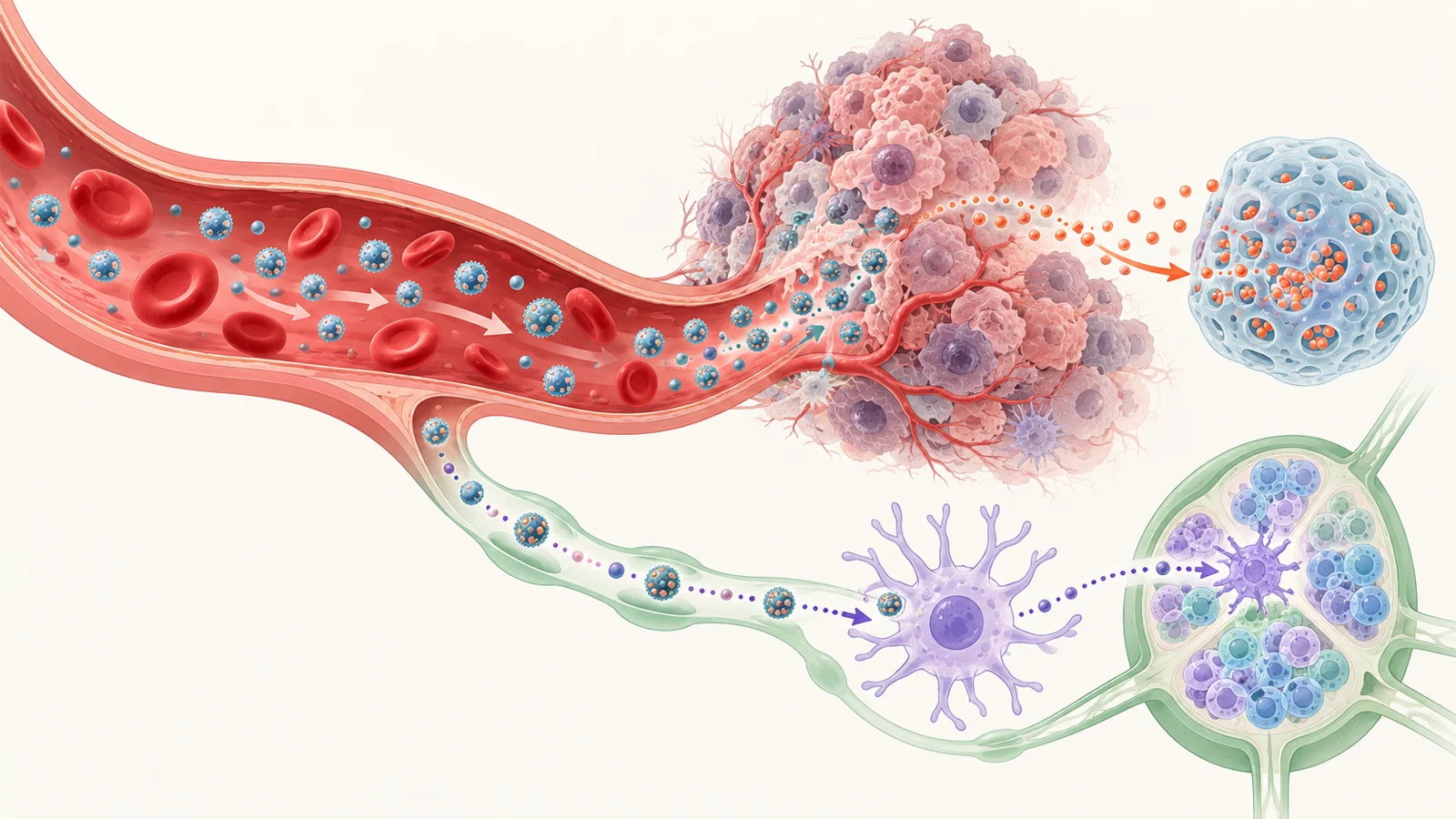
A freely circulating dose and a biodegradable depot have different exposure patterns. In the depot approach, a carrier holds a treatment and releases it over time near a target site. The aim is to maintain local availability while reducing how much of the drug circulates elsewhere.
The review describes microparticles made from a biodegradable polymer that released the checkpoint antibody anti-CTLA-4 for up to 20 days. In a study using mice bearing MC-38 tumors, the antibody level in blood was lower after local delivery, consistent with more of it being retained near the tumor. Those observations concern exposure in a mouse model; they do not show that the same formulation reduces adverse effects in people.
Local treatment can have its own costs. The review also discusses an anti-CD40 antibody delivered locally in mineral oil during a clinical trial. The local approach used a lower antibody dose to produce a systemic immune response and activate T cells, but inflammation and swelling at the injection site were reported. Keeping a treatment close to its target may change where effects occur, rather than eliminating them.
Vaccine carriers help immune cells learn what to recognize
A depot places an immune treatment near a tumor. A vaccine carrier has a different job: deliver instructions to antigen-presenting cells, which process material and show it to T cells. The lymphatic system, including lymph nodes, is one destination for such delivery. For a cancer vaccine, the cargo needs to help immune cells recognize tumor-related antigens; an immune-stimulating ingredient can support that instruction.
The review describes nanoparticles designed to deliver antigens to dendritic cells, a type of antigen-presenting cell, and to release antigen over time. It also discusses a liposomal formulation carrying mRNA that instructs cells to make tumor neoantigens, giving T cells a target to recognize. In a mouse tumor model, the mRNA-liposome complex delivered its cargo into cells and induced effector and memory T-cell responses. RNA is vulnerable to degradation and does not readily enter cells on its own, so protection and delivery are central design challenges.
These examples show why a carrier’s destination and contents matter. Reaching an immune cell with antigen is not the same task as holding an antibody near a tumor, and a vaccine response in mice is not evidence of patient benefit from a particular formulation.
Changing the tumor’s immune neighborhood
Tumors can contain macrophages that help sustain an immune-suppressing environment. The review describes an approach that delivered R848, an immune-stimulating compound, to tumor-associated macrophages in MC38 tumor-bearing mice. The particles accumulated in these cells, and treated tumors showed increased IL-12, a marker associated in the review with an antitumor, or M1-like, macrophage state.
The treatment was associated with prolonged survival and tumor-growth inhibition in that mouse model, and it enhanced the effect of anti-PD-1 in the reported experiments. These results illustrate a different delivery aim: changing the behavior of cells in the tumor environment that can work against an immune attack. They do not establish a survival benefit in people.
Cell death can add immune cues, but timing matters
Checkpoint drugs act on immune regulation. Chemotherapy can contribute a different ingredient: dying cancer cells may expose antigens or other signals that help activate innate and adaptive immune responses. The review discusses combining conventional treatments with immunotherapy as a way to address tumors that are difficult to inflame through immunotherapy alone.
One preclinical example paired doxorubicin, a chemotherapy drug carried in a nanodisc, with the checkpoint inhibitor anti-PD-1. In a mouse CT26 tumor model, the combination produced a sevenfold increase in CD8 T cells producing interferon-gamma, a sign of immune activation, and complete tumor regression. This is a result in a specific model, not a demonstrated patient outcome.
The order and timing of treatments also matter. Giving two treatments at once may change how much of each reaches its target or how their effects interact; giving them in sequence can produce a different interaction. The review notes that simultaneous and sequential treatment cannot be assumed to work equally well, and that combining treatments can also aggravate side effects or limit the effect of an individual drug. A carrier may help coordinate delivery, but it does not make every combination or schedule interchangeable.
From promising materials to dependable treatment
The examples span distinct carriers, cargos, and tumor models. A microparticle depot, a liposome carrying mRNA, and a nanoparticle aimed at macrophages solve different delivery problems. Their results cannot be combined into one estimate of how much nanotechnology improves cancer treatment.
The review identifies reproducibility, manufacturing feasibility, and unresolved material toxicity as barriers to clinical translation. A formulation needs to be made consistently and its behavior understood before results can be relied on beyond the setting where they were observed. The existence of other approved nanoparticle medicines does not establish that these reviewed immunotherapy combinations are approved or effective in patients.
What targeted immune delivery could make possible
More precisely delivered antibodies and vaccines could make immune treatment usable for some resistant solid tumors while limiting exposure elsewhere. For patients, that could mean an immune treatment that reaches the cells and tissues where it is needed, or helps immune cells recognize a tumor that currently draws little response. That possibility depends on reproducible delivery, acceptable toxicity, and demonstrated benefit in people; the reviewed models do not yet establish those conditions for any one formulation.
Key Sources
- Primary source: Nanotechnology synergized immunoengineering for cancer.
DOI or Journal Page · Review or Meta-Analysis · 2021-03-24
Keep exploring