
Research Signal – Source date 2025-10-27
Cells that stop dividing can help contain damage, yet their long-term presence may also disrupt the tissue around them. That double role complicates treatments aimed at cellular senescence: a drug may need to remove some cells, alter others’ behavior, or reach a particular tissue without harming cells that serve useful functions.
A review published on October 27, 2025, surveys drug strategies and engineered nanocarriers intended to address these problems. Nanocarriers—tiny engineered systems that transport drug cargo—could change where and when a treatment is released. But delivery is only part of the challenge. A carrier’s recognition cue may also appear on cells that are not the intended target, and the review describes unresolved questions about safety, tracking, and production.
A stopped cell can still change its surroundings
Cellular senescence is a state in which a cell enters a stable cell-cycle arrest. It is distinct from quiescence, a temporary pause: senescent cells do not resume dividing simply because conditions improve. The review describes several routes into this state, including telomere shortening, DNA damage, epigenetic changes, metabolic imbalance, and loss of protein homeostasis.
Senescence can be protective in the short term. Arrest can prevent a damaged cell from continuing to divide. The difficulty is that senescent cells can also release a mixture of signaling molecules known as the senescence-associated secretory phenotype, or SASP. It includes cytokines, chemokines, growth factors, and enzymes that alter the surrounding tissue. Some signals reinforce arrest; others can prompt nearby cells to respond, spreading senescence-related effects.
With persistent accumulation, those local changes may contribute to disease. The relevant target is therefore not always just the arrested cell. Its secreted signals, the pathways that sustain them, and the immune system’s ability to clear the cell are also possible points of intervention. At the same time, senescent cells can contribute to wound healing, tissue repair, and tumor control. Removing them indiscriminately could interfere with those functions.
Killing cells and changing their signals pose different risks
Senolytics are drugs intended to kill senescent cells, often by interfering with survival pathways on which those cells depend. The review discusses agents such as dasatinib combined with quercetin, fisetin, and BCL-2 inhibitors. Their intended effect is direct clearance. That makes cell selection central: if a treatment also kills healthy or functionally useful cells, the same action meant to reduce disease could cause harm. The review notes examples of off-target toxicity, including thrombocytopenia associated with navitoclax and pulmonary vascular toxicity.
Senomorphics take a different approach. Rather than eliminating cells, they aim to modify senescent-cell activity or reduce harmful SASP release. The review discusses pathways including NF-κB, mTOR, cGAS-STING, JAK/STAT, ATM/ATR, and p38 MAPK. A change in secretion could affect tissue without triggering widespread cell death, but it raises a different question: which senescent-cell activities should be dampened, and could altering them also disrupt useful functions?
Other strategies in the review include NAD+ enhancers and approaches involving inflammation or immune regulation. These are not interchangeable treatments, and the article’s examples come from different experimental and disease settings. The review does not establish safe and effective senescence-targeted nanotherapy across the diseases it discusses.
A carrier changes exposure in several steps
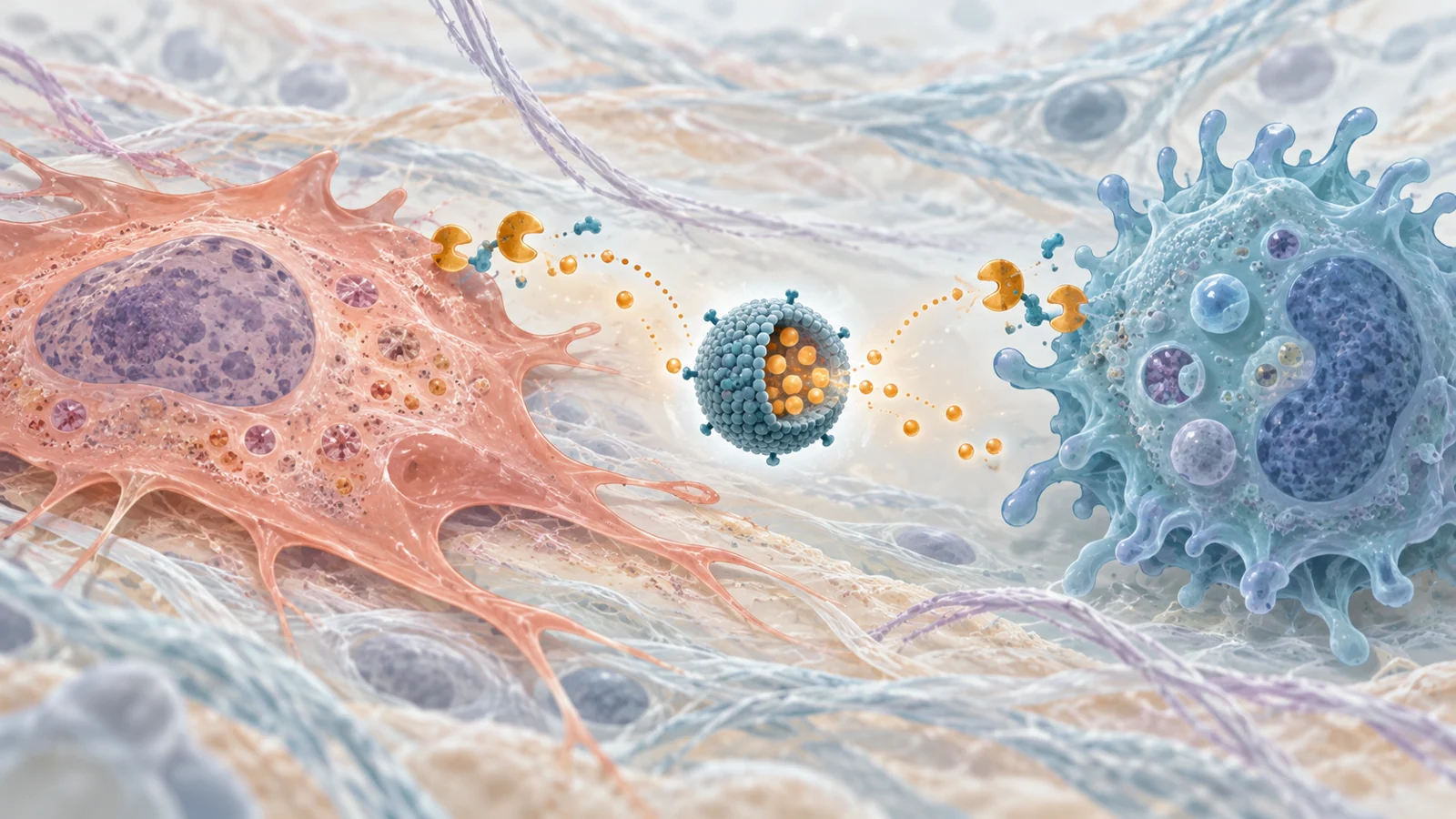
Many candidate anti-aging drugs have practical delivery problems, such as low water solubility, poor pharmacokinetics, or distribution beyond the intended tissue. An engineered nanocarrier can be adjusted in size, shape, composition, and surface chemistry. Those properties may help carry cargo across physiological barriers, influence where it travels, and control when it is released. A carrier can also package more than one agent, which may be useful when a treatment combines approaches such as senolysis and NAD+ enhancement.
Loading the drug is one design decision. Cargo can be attached to a carrier’s surface through adsorption or chemical bonds, or enclosed within its structure. Surface attachment can be relatively simple but may be less stable in the body; stronger bonds can support sustained release. Encapsulation can protect and carry cargo within a particle, while the carrier’s structure and surrounding conditions affect its release. Each option presents a balance among stability, delivery, and availability of the drug where it is intended to act.
The route and distribution matter too. A carrier administered into the body still has to travel through it, reach the relevant organ or tissue, and expose the target cells to an effective amount of cargo. The review describes engineered delivery as a way to improve these steps, but a proposed design does not by itself show how much cargo reaches a particular human cell population or what happens to the carrier afterward.
An enzyme cue can release cargo in the wrong cell
Some proposed systems use an enzyme associated with senescent cells as a trigger. For example, galactose-coated nanoparticles can carry a prodrug intended to be activated by elevated beta-galactosidase activity. The design aims to release a cell-killing drug preferentially where the cue is present.
The cue is not unique to senescent cells. The review notes that activated macrophages and other non-senescent cells can also show high beta-galactosidase activity. A carrier that responds to the enzyme may therefore release its cargo in a cell that was not meant to be targeted. The label “targeted” describes a design intention; it does not guarantee that a biological cue cleanly separates harmful senescent cells from other cells in living tissue.
This is one reason that cell heterogeneity matters. Senescent cells differ, and a feature that identifies one group may miss another. The review cites differing effects among senolytic drugs in particular settings, underscoring that a single recognition strategy is unlikely to apply uniformly across cell types and diseases.
In cancer, timing can reverse the meaning of senescence
Senescence has a particularly complex role in cancer. Stress from treatment or abnormal growth signals can push cancer cells into arrest, limiting their proliferation. SASP from those cells can also affect neighboring tumor cells and recruit immune activity that suppresses tumors.
If senescent cells persist, however, their secretions may contribute to a pro-inflammatory or immunosuppressive tumor environment. The review also describes evidence that prolonged chemotherapy can induce senescence-associated processes linked to drug resistance. This creates a timing problem: inducing arrest may help restrain cancer, while later removing or modifying senescent cells might address harmful effects of their persistence. The balance depends on disease context and when an intervention is used; a general strategy to eliminate senescent cells could also remove cells participating in tumor control.
How targeted delivery could make senescence therapies useful
If carriers can reliably deliver the right drug to the relevant cells while limiting exposure elsewhere, treatments for some aging-related diseases could become more precise and practical. Patients might then benefit from interventions that reduce harmful senescent-cell effects without broadly disrupting repair, immune defense, or cancer surveillance. That possibility depends on resolving several connected hurdles: tracking carrier fate in the body, distinguishing harmful targets from useful or unrelated cells, establishing long-term safety, and producing carriers consistently at scale.
The review presents nanocarriers as a promising design direction, not as a proven treatment that is safe and effective across the diseases discussed. Until those delivery and safety questions are answered in the relevant settings, the proposed precision remains a goal rather than an established patient benefit.
Key Sources
- Primary source: The drug discovery and therapeutic nano-strategies targeting cellular senescence.
DOI or Journal Page · Review or Meta-Analysis · 2025-10-27
Keep exploring