
Research Signal – Source date 2022-12-01
Can a treatment aimed at age-related cell changes become useful for Alzheimer’s disease? A 2022 review connects two research problems that are often discussed separately. One is biological: how senescent cells, inflammation, and declining cellular maintenance may contribute to Alzheimer’s-related damage. The other is physical: how to move a treatment through the blood-brain barrier and release it near the cells where it is needed.
Nanoparticles are presented as a possible bridge between those problems. These tiny carriers can be engineered to protect a drug, alter how long it remains available, and improve its movement toward the brain. But better delivery is not the same as a treatment that improves memory. The review describes nanoparticle-based anti-aging treatment for Alzheimer’s as laboratory-stage research, with evidence drawn from different cell experiments, animal models, and human observations.
Why aging is part of the Alzheimer’s question
Age is the strongest risk factor for Alzheimer’s disease, but age is not a single biological process. The review focuses on cellular senescence, a state in which cells develop altered behavior and signaling. Senescent cells can release a collection of inflammatory factors known as the senescence-associated secretory phenotype, or SASP. These signals may change the surrounding tissue and contribute to chronic inflammation, impaired synaptic function, or loss of neurons.
That description does not mean that every older cell is harmful, or that senescence has been shown to be the sole cause of Alzheimer’s. The review specifically says that the causal relationship between aging and Alzheimer’s remains unclear. It examines possible evidence in aging glial cells, neurons, neural stem cells, and the blood-brain barrier, while noting that the central nervous system contains many interacting cell types whose roles still need to be disentangled.
The practical appeal of an anti-aging strategy is that it could act on conditions that support disease rather than targeting only one visible feature of Alzheimer’s pathology. Yet the intervention must be defined carefully, because clearing a cell, changing its secretions, and restoring its internal recycling systems are different approaches.
Three ways researchers are trying to change cellular aging
Senolytics are drugs intended to remove senescent cells by interfering with the survival pathways that protect them from cell death. In the review’s account, senolytic research has shown benefits in several age-related disease models. For Alzheimer’s-related models, removing senescent astrocytes, microglia, or oligodendrocyte precursor cells was associated in different experiments with changes in inflammation, tau-related pathology, amyloid plaque burden, or brain structure.
Senomorphics take a different route. Rather than eliminating senescent cells, they aim to reduce the harmful effects of their signaling, including the inflammatory secretions that can affect nearby cells. The review discusses regulation of SASP as a way to limit chronic inflammation while leaving the cells themselves in place.
Autophagy-based strategies address cellular recycling. Autophagy helps cells break down damaged organelles and misfolded or aggregated proteins. The review links aging with reduced autophagy capacity and describes evidence that impaired recycling may contribute to protein toxicity and neurodegeneration. Supporting this pathway could therefore affect cellular maintenance, including processes involving amyloid-related material.
These approaches are not interchangeable versions of one anti-aging treatment. They act on different biological processes and can produce different outcomes. A nanoparticle may help deliver any one of them, but the carrier cannot resolve whether the chosen biological target is actually driving disease.
The brain delivery problem begins at the blood-brain barrier
The blood-brain barrier protects the central nervous system from many substances circulating in the blood. Tight junctions between brain endothelial cells restrict movement between cells, while transport systems regulate which nutrients and molecules can pass through. The same protection that helps shield the brain also makes it difficult to deliver many drugs, especially larger molecules and compounds that do not readily cross cell membranes.
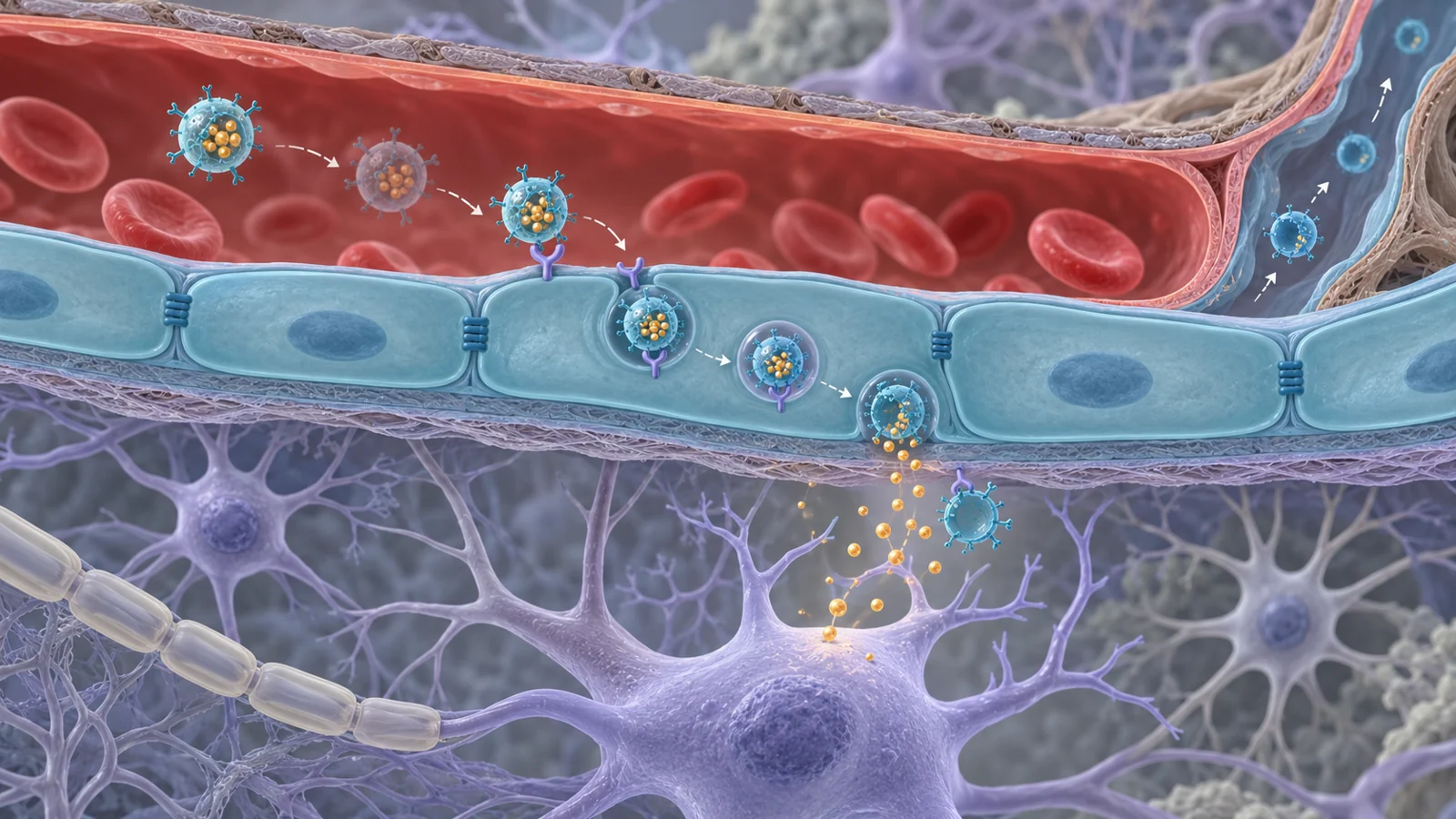
A carrier can be designed to cross the barrier through several routes. One important strategy is receptor-mediated transport. In ordinary terms, the particle is fitted with a surface component that can bind to a receptor on the endothelial cell. The cell then brings the bound material across in a vesicle, allowing the carrier to emerge on the brain-facing side. The review identifies the transferrin receptor as one of the most widely studied targets for this kind of transport.
The barrier itself is also changed by Alzheimer’s-related disease processes. Some transporters may become more or less active, and inflammation or vascular damage can alter the barrier’s integrity. That does not automatically make drug delivery easy. A particle still has to cross in a controlled way, avoid harmful accumulation, and release its payload where it can act.
A particle’s surface can change where its payload goes
The material inside a nanoparticle is only part of the design. The surface can determine how the carrier interacts with blood proteins, barrier cells, immune cells, and possible targets inside the brain.
The review describes unmodified liposomes as poor candidates for passive movement across the blood-brain barrier. Adding surface features can change that behavior. For example, lipid carriers loaded with compounds such as curcumin or quercetin were modified with ligands associated with receptors on brain endothelial cells. In laboratory or animal models, these changes supported greater uptake or improved movement across the barrier. Some designs also aimed at amyloid deposits or neurons after entering the brain.
This creates two related but separate delivery tasks. The first is getting the carrier from the bloodstream to the brain. The second is locating the relevant cells or deposits once it has crossed. A carrier can perform well at the first task without proving that it reaches the right biological target for disease modification. Surface engineering can make a treatment more selective, but selectivity is a property to demonstrate, not an assumption that follows from using nanoparticles.
Polymeric particles offer another set of design options. The review describes biodegradable polymers such as PLGA that can support high drug loading and controlled release. In rats, curcumin-loaded PLGA nanoparticles crossed the blood-brain barrier and localized in the hippocampus after administration. Compared with the same doses of free curcumin, the nanoparticle formulation produced a reported 2.1- to 2.8-fold increase in brain curcumin levels and supported sustained release.
That is a meaningful delivery result. It shows that formulation can change how much of a compound reaches the brain. It does not by itself show that the animals experienced better memory, nor does it establish that the same exposure would be safe, durable, or useful in people with Alzheimer’s.
What the experiments actually measured
The distinction between delivery and disease benefit becomes clearer when the review’s examples are placed side by side.
One group of experiments concerned senolytic treatment in a tau-dependent mouse model. The animals accumulated senescent astrocytes and microglia. Genetic removal methods and the senolytic drug navitoclax were associated with less gliosis, lower levels of hyperphosphorylated tau, and less neuronal degeneration in parts of the brain. A separate intermittent treatment with dasatinib and quercetin also reduced several pathological features in a tau-related model. In that study, however, the reported clearance of senescent cells was not accompanied by an observed improvement in cognitive-related symptoms.
A different example involved a specialized polymeric nanocleaner carrying rapamycin. Rapamycin was included because it can promote autophagy, while the particle was engineered with components intended to respond to the brain’s disease-associated environment and interact with amyloid-related material. In an Alzheimer’s mouse model, the review reports reductions in inflammatory changes, amyloid burden, and phosphorylated tau, along with improved memory-related performance.
These findings should remain attached to their own interventions and models. The first example shows that pathological improvement and cognitive improvement can diverge. The second combines a particular carrier design with a particular payload and reports both pathology and memory-related outcomes in mice. Neither example establishes a general senolytic treatment, a universal nanoparticle design, or a human therapy.
Nanoparticles are active experimental variables
A nanoparticle is not always a passive container that simply transports whatever is placed inside it. Its size and surface chemistry can change how it behaves around biological molecules.
The review describes an in-vitro experiment using glutathione-coated gold nanoparticles and amyloid-beta fibril formation. Larger particles in the reported size range accelerated fibril growth, while smaller gold nanoparticles suppressed it. Gold nanoclusters, which were smaller still, showed a stronger inhibitory effect under the reported conditions. The result illustrates how changing the physical dimensions of a particle can alter its interaction with a disease-associated protein.
It also complicates the idea that smaller must always be better. The review notes that particles below certain sizes may enter cells in ways that create toxicity concerns, including possible interactions with the nucleus and DNA. At the same time, the most efficient size for crossing the blood-brain barrier may differ from the size that produces the desired behavior around amyloid or inside a target cell. There is no universal optimal particle size established by these examples.
The hardest problems start after delivery
A carrier must remain available long enough to deliver its payload, but it must also be cleared safely. The review identifies several possible routes for nanoparticle removal from the central nervous system, including degradation by enzymes, processing by neurons or glial cells, movement into cerebrospinal fluid, return to the bloodstream, and transport out through brain-to-blood systems. Which route dominates can depend on the particle’s composition, size, surface, and location.
Persistence is therefore both a potential advantage and a risk. A longer residence time could support sustained release, while retention or accumulation could increase neurotoxicity. Nanoparticles can also aggregate during storage, acquire a protein corona in the bloodstream, move into lysosomal compartments, or be cleared too quickly to deliver enough drug. Coatings and surface modifications may address some of these problems, but they add further engineering and safety questions.
The biological target presents another constraint. Senescent cells can produce harmful inflammatory signals, yet senescence also has useful roles in processes such as tumor suppression and tissue repair. An effective therapy would need to reduce disease-promoting effects without removing functions that protect tissue. That balance is especially important in the brain, where the interactions between glial cells, neurons, immune signaling, and vascular cells are complex.
At the review’s publication in December 2022, nanoparticle-based anti-aging treatment for Alzheimer’s remained in the laboratory stage. The field had examples of improved brain exposure, altered pathology, and memory-related changes in particular animal models, but those endpoints did not form a single demonstrated treatment. Long-term human safety, reliable clearance for every carrier, and clinical benefit remained unresolved.
What targeted delivery could make possible for Alzheimer’s treatment
If an anti-aging intervention proves biologically useful, dependable nanoparticle targeting could make it possible to concentrate that treatment near the brain cells where it needs to act while limiting exposure elsewhere in the body. The resulting capability would be more than simply getting a drug across the blood-brain barrier: it would connect an effective cellular intervention with controlled release at a relevant site. For people with Alzheimer’s, that could open a route toward protecting memory and daily functioning, but only if the biological treatment works, targeting and release are dependable, clearance is acceptable, and benefit is demonstrated in people.
Key Sources
- Primary source: Nanoparticles-based anti-aging treatment of Alzheimer's disease.
DOI or Journal Page · Review or Meta-Analysis · 2022-12-01
Keep exploring