
Research Signal – Source date 2025-11-04
A CAR-T cell is an immune cell engineered to recognize a chosen marker on a cell’s surface. That recognition has helped make CAR-T therapy an important treatment for some blood cancers. In a solid tumor, however, the cells may not all display the same marker, and the tumor’s surroundings can make it harder for engineered cells to get in and function.
A 2025 review describes one proposed way to address the recognition problem: use nanoparticles to place an added marker on tumor cells, giving CAR-T cells a target that the cancer did not reliably provide on its own. The idea is striking, but it belongs to a wider collection of experimental strategies. The review does not show that this approach safely improves outcomes for people with solid tumors.
Giving the tumor an added marker
CAR-T treatment starts with T cells collected from a donor or patient. They are activated, genetically modified to carry a receptor that recognizes a selected surface marker, expanded, and returned to the patient. Once a CAR-T cell recognizes its target, it can attack the marked cell. The key design choice is the target: if cancer cells vary in whether they carry it, some may escape recognition.
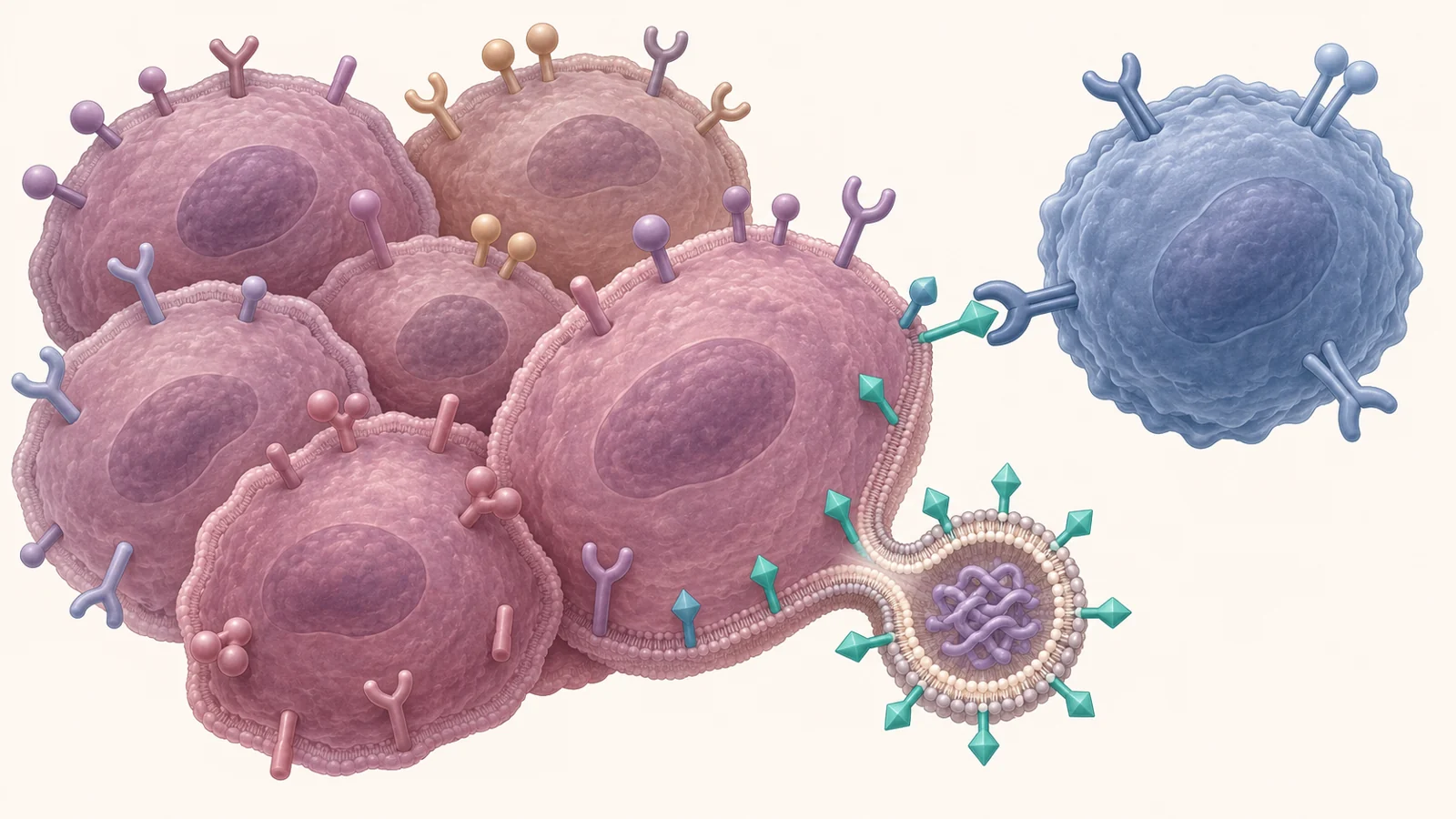
The review discusses fusogenic antigen-loaded nanoparticles as a way to change what CAR-T cells can recognize. These particles carry an external antigen, or marker, and are designed to fuse with tumor-cell membranes. Tumor-derived extracellular vesicles—small membrane-bound particles released by tumor cells—are also part of the described approach, helping the added antigen spread through tumor tissue. With the marker displayed on tumor cells, CAR-T cells designed to recognize that marker could be redirected toward them. The review calls this proposed approach tumor-inherent antigen-independent target-redirected universal CAR-T, or TRUE CAR-T.
The added marker’s amount could be adjusted through dosing, and the review describes repeated administration as a way to address target loss over time. But the strategy depends on the particles preferentially interacting with tumor cells. The review identifies possible uptake by healthy cells as an off-target risk, and notes that accumulation in the liver and spleen raises questions about long-term safety. Target painting is therefore a proposed way to broaden recognition, with selectivity and repeat exposure central to whether it could be useful.
A faster cell preparation experiment
Nanoparticles could also play a role before engineered cells encounter a tumor. Making CAR-T cells outside the body involves activating and expanding T cells, a process that can be labor-intensive. Some nanoparticles can be designed to act like artificial antigen-presenting cells, which provide signals that activate T cells.
The review describes an experiment in which lipid nanoparticles carrying fragments of antibodies to CD3 and CD28 were used to activate T cells and support production of CAR-T cells carrying messenger RNA, or mRNA. In the reported setup, activating lipid nanoparticles reduced cell-culture time from 48 hours to 24 hours. The work was associated with reduced tumor burden in mouse xenograft models, in which human tumor cells are grown in mice.
That is a specific preclinical result, not evidence that clinical manufacturing would take half as long or cost less. The review notes that the study’s long-term safety and ability to scale for clinical use remain unproven. The type of genetic instruction also matters: mRNA can be translated into a CAR after it reaches the cell’s cytoplasm, but its effects are temporary. Maintaining activity may require repeat dosing, which could bring cumulative toxicity or systemic inflammatory responses. The review discusses sustained-release systems and other RNA designs as possible research directions, not established solutions.
Reaching a tumor is a separate problem
A cell can recognize a target and still have difficulty reaching it. The review describes an experimental approach that attaches antibody-carrying magnetic particles to CAR-T cells. In mouse studies, magnetic fields guided these cells against blood flow and toward the edges of tumors; acoustic fields were then used to help them penetrate tumor tissue. The attached antibodies also stimulated the cells in the reported experiments.
This is a physical-guidance strategy, distinct from adding a marker to a tumor. The work was conducted in mice, and the review points to questions about whether magnetic and acoustic control would remain precise and stable in deeper tissue or larger bodies. It also raises possible immune responses to the particles and uncertainty about their long-term safety. Movement through mouse tumors is a useful experimental demonstration, but it does not establish dependable access in people.
Getting genetic instructions into a T cell
For nanoparticles carrying CAR instructions, reaching a T cell is only the beginning. A particle must bind to the cell and enter it. The cell may trap the particle in an endosome, a compartment that can eventually route its contents for breakdown. The cargo must escape that compartment and be released in a form the cell can use.
The route depends on the cargo. DNA must reach the nucleus, where the cell can use it to make a CAR; the review notes that this requires T cells to be in an active dividing state. mRNA can be translated in the cytoplasm without entering the nucleus, but its expression is short-lived. The review describes possible particle adjustments to improve cell binding, uptake, endosomal escape, and cargo release. These are separate delivery hurdles, and a successful design must navigate them without causing unacceptable harm to the cell.
Particle behavior also depends on properties such as size, shape, and surface charge. A particle that binds well may damage a cell if its charge is excessive; one taken up by a cell may still fail if its contents are degraded before release. The review also describes immune responses to some particle coatings, clearance from the body, and the possibility that particles may accumulate in tissues away from the tumor. These factors help explain why carrying genetic instructions is not the same as producing reliable CAR expression in a patient.
Tracking cells and controlling their activity
Tracking asks where engineered cells travel; control asks what they do once there. The review describes an ongoing clinical trial using copper-64 superparamagnetic iron oxide nanoparticles and PET-MRI imaging to study the movement of cilta-cel, a CAR-T therapy, in extramedullary myeloma. As described in the review, the trial was recruiting. Its purpose, as presented there, is to study cell transport—not to establish that nanoparticle guidance improves treatment outcomes.
The review also surveys experimental concepts for changing CAR-T activity. These include gelatinase-responsive particles intended to support controlled, sustained activation, and magnetic iron oxide particles associated in preclinical work with controlling cell activity and changing tumor-cell death. Imaging and activity control answer different questions, and neither alone shows that the combined treatment has benefited patients. The review describes nanoparticle-assisted CAR-T work as being at an early stage overall.
The practical work behind a particle design
Before an experimental particle can be considered for routine use, its composition and behavior need to be consistent from batch to batch. The review identifies sterility, quality control, surface modification, and scalable manufacturing as important challenges. Measuring particle size, shape, and surface properties helps characterize batches, but reliable production at larger scales and suitable sterilization methods also matter because these processes can affect the particles themselves.
The review notes that nanoparticles already appear in some approved cancer medicines, and that CAR-T therapies are approved for certain blood cancers. Those separate precedents do not establish approval or readiness of nanoparticle-assisted CAR-T treatment. Combining the approaches adds questions about targeting, immune effects, distribution through the body, and how to manufacture a consistent product.
What this could change
If added markers can be placed selectively and safely across a solid tumor, CAR-T recognition might become less dependent on whether every cancer cell already carries the same target. In principle, that could give engineered cells a way to attack tumors whose cells differ in their natural markers. Reaching that possibility would also require particles that work predictably in the body, CAR-T cells that can reach the tumor, and a manufacturing process that produces consistent cells and particles.
A meaningful bridge toward that future would be evidence that the added marker reaches tumor cells selectively and supports CAR-T recognition without harmful uptake in healthy tissue. The review’s proposed mechanism and separate preclinical strategies point to that scientific possibility; they do not yet establish a safe, effective treatment for people with solid tumors.
Key Sources
- Primary source: Nanoparticle-based strategy in CAR-T cell immunotherapy: challenges, implications, and perspectives.
DOI or Journal Page · Review or Meta-Analysis · 2025-11-04
Keep exploring