
Research Signal – Source date 2025-05-22
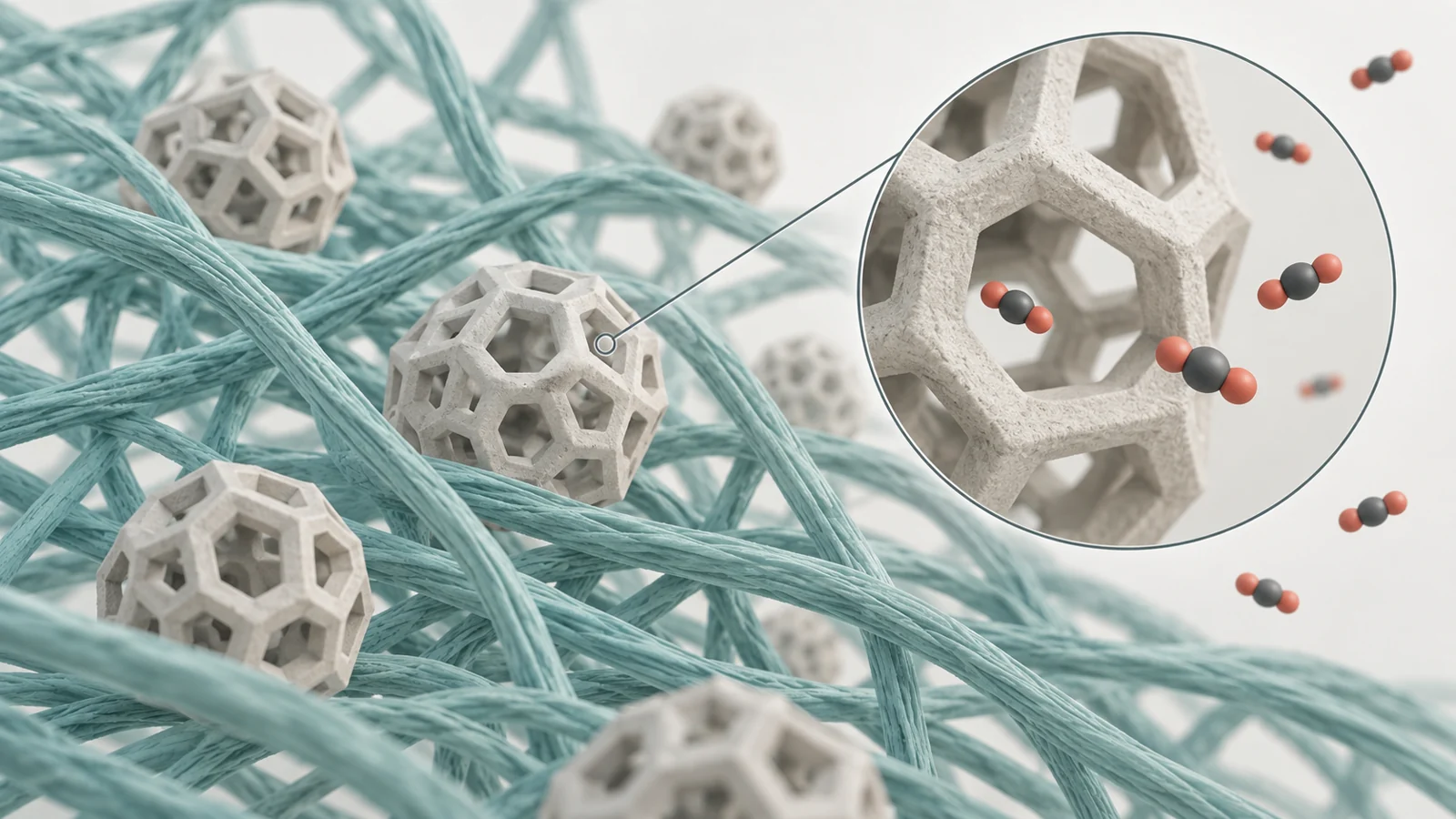
A material can have pores suited to capturing carbon dioxide and still be fragile. That practical difficulty motivates a review published May 22, 2025, exploring combinations of porous capture materials and nanocellulose—cellulose structured at an extremely small scale. The proposed pairing gives the components complementary jobs, bringing gas-capture properties together with a renewable physical support.
The review examines a materials-design approach with potential for carbon dioxide separation. Its abstract explains why the combination interests researchers, while leaving practical performance questions open for readers assessing how far the idea could go.
What each component contributes
Metal-organic frameworks, or MOFs, are porous structures that combine organic and inorganic components. Their pore sizes and chemical features can be adjusted. The authors connect that tunability and high porosity with the ability to separate carbon dioxide from gases.
The capture process discussed includes adsorption, in which gas molecules collect on a material’s surfaces. Pores provide internal surfaces where that interaction can occur. The structure and chemistry therefore matter together when designing a material for gas separation.
Nanocellulose contributes a different set of properties. The authors describe it as renewable, flexible and strong, making it an appealing support matrix for the porous component. Its role in this pairing is physical as well as compositional: researchers want the gas-capturing structures associated with a material that could make them more usable.
The review covers different types of nanocellulose, ways to make the composites, their properties and adsorption mechanisms. It also examines factors affecting stability and capture capacity. That scope makes the relationship between preparation, structure and behavior central to the subject; the name of the composite alone does not tell a developer how it will perform.
From material design to capture performance
Capacity concerns how much carbon dioxide a material can hold under stated conditions. Stability concerns whether it retains the properties needed to do that job. For a useful capture material, both dimensions matter. Physical support would have limited value if the resulting combination could no longer provide useful gas-capture performance.
The abstract provides a rationale for investigating these composites, but it does not establish a numerical advantage, a best formulation or superiority over competing materials. Those judgments would require the underlying comparisons and their test conditions. The abstract alone also cannot settle operating lifetime, performance over repeated use, or what is needed to release captured gas and prepare the material for another cycle.
The distinction matters for environmental claims, too. Renewable cellulose is one ingredient; its properties do not determine the safety, cost or environmental footprint of the finished composite and capture system.
Capture and permanent sequestration are also separate achievements. Holding carbon dioxide on a surface or separating it from a gas mixture does not establish that the carbon will remain out of the atmosphere. Although sequestration appears in the paper’s title, the abstract does not provide a basis for concluding that the approach delivers permanent storage, measured net emissions reductions or commercial readiness.
What this could change
If these combinations retain useful capture capacity and adequate stability under relevant operating conditions, gas-separation developers could gain a broader choice of physically usable materials. That could help them incorporate porous capture structures into systems designed to separate carbon dioxide from emission streams. The downstream opportunity is an expanded set of materials for emissions control, with cellulose contributing to how the capture component can be handled and used.
Key Sources
- Primary source: Nanocellulose – metal-organic framework (MOF) composites for efficient carbon dioxide capture and sequestration: a review.
DOI or Journal Page · Review or Meta-Analysis · 2025-05-22
Keep exploring