
Research Signal – Source date 2025-02-03
Growing a fungal material that resembles leather or foam opens up possibilities. Designing one to meet a particular need poses a different challenge. Developers must connect the choices they make at the start with the properties of the material they eventually obtain. Finding that connection through repeated trials can be costly.
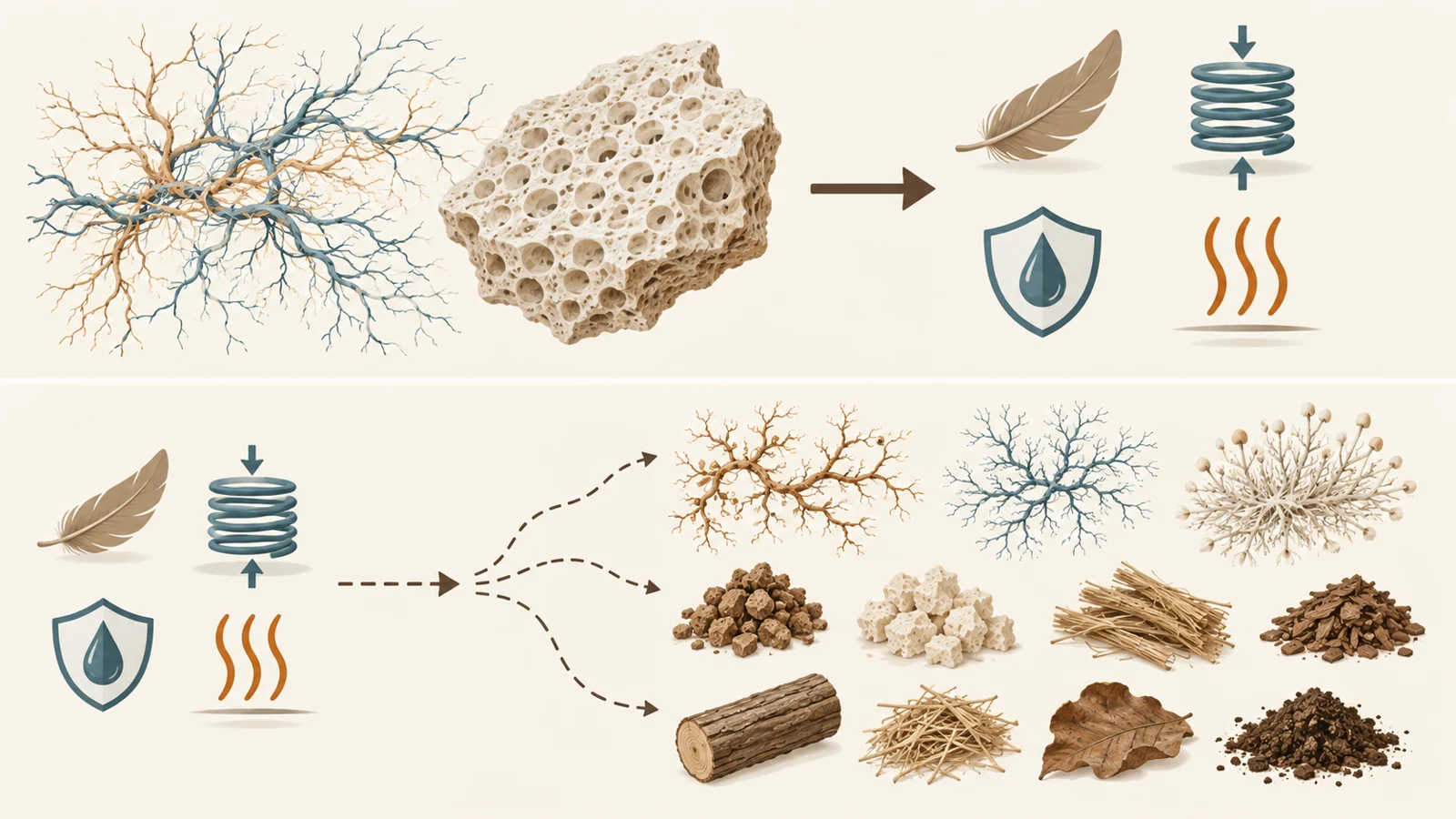
A review published on February 3, 2025, proposes borrowing computational design techniques from metamaterials research to help address this problem. Its focus is mycelium, the network of fungal threads used to make mycelial materials. The authors describe applications including mock leather and foam, and argue that robust inverse design could eventually make developing such materials faster and cheaper.
The change in direction is straightforward to explain. Forward design starts with a material recipe, makes the material, and examines its properties. Inverse design starts with desired properties and searches for inputs that could produce them. Making that reversal useful for fungi requires a biological description that computers can work with.
Giving the search something meaningful to change
The authors identify clear, concrete design parameters as a prerequisite. They point to two sources for those parameters: genotype, meaning genetic characteristics, and bulk phenotype, meaning observable characteristics of the material as a whole. Together, these would help connect the biological starting point with the material developers want to obtain.
A computer cannot search meaningfully through “something leather-like” as an undivided idea. It needs a description of the target and a defined set of candidate inputs. The challenge is to express the relevant fungal characteristics in a form that supports that search without losing what matters to the finished material.
Measurement and control have different roles here. A characteristic may be observable and useful for describing a material without being something a developer can independently adjust. Identifying a measurable variable therefore does not, by itself, establish a usable design control. An inverse-design approach needs to distinguish what can be specified at the start from what must be predicted or measured afterward.
That distinction gives the proposed biological parameters a practical purpose. They must do more than catalog fungal diversity; they must help describe the relationship between possible inputs and desired material properties.
Three computational jobs that depend on each other
The review identifies three needs: heuristic search or optimization algorithms, efficient mathematical modeling, and dimensionality reduction. Each addresses a different part of the design problem.
Search and optimization concern which candidates to investigate. A heuristic is a practical way to guide a search among possibilities. In this setting, the aim would be to identify combinations worth considering for a chosen target. Naming this need does not select a particular algorithm or establish how well it would work with fungal materials.
Mathematical modeling concerns the relationships the search relies on. A model would represent how design inputs relate to material properties, giving the search a basis for judging candidates. Its usefulness would depend on how faithfully those relationships describe the relevant material behavior. A search can only make useful recommendations if its way of assessing candidates is informative.
Dimensionality reduction concerns the size of the description. When a material is represented by many variables, this technique seeks a more manageable representation that retains information relevant to the task. Simplifying that description could make it more usable for modeling and search, provided the simplification preserves the distinctions that matter for the intended properties.
These are interacting requirements. The representation determines what the model can describe, and the model influences what the search selects. The authors bring them together as elements of a proposed approach; the abstract does not establish an implemented sequence with verified performance.
How to read the proposal
The review draws on mycelial-material case studies and computational techniques used in metamaterials research. Its contribution is to connect those areas and propose how their design methods might be brought together. Evidence that fungal materials can serve different applications helps motivate that proposal, but it does not measure the performance of the proposed design approach.
The abstract provides no basis for calculating a reduction in development time or cost. Assessing the proposal’s effectiveness would require details and validation beyond the abstract available here. Likewise, the application examples do not establish commercial readiness, production scalability, or an overall environmental advantage.
The useful distinction is between a promising design direction and evidence that it delivers a particular result. The review identifies the biological and computational foundations needed to make working backward a tractable research problem.
What this could change
If usable fungal parameters can be established and the computational methods can reliably connect them to material properties, developers could begin with the requirements of a particular application and search for suitable ways to make the material. For foam-like or leather-like materials, that could help turn a broad resemblance into a more deliberate match between a material and its intended use.
The downstream benefit would be a more targeted development process, potentially requiring fewer costly trials to find suitable candidates. The possibility rests on joining biological description, prediction, and search closely enough that a desired property becomes a useful starting point for making a fungal material.
Key Sources
- Primary source: Generalizable Metamaterials Design Techniques Inspire Efficient Mycelial Materials Inverse Design.
DOI or Journal Page · Review or Meta-Analysis · 2025-02-03
Keep exploring