
Evidence date · 2025-07-14 · Research note 2 of 2
1 2
See current Track status →
Since the previous research note · Changed direction
Track continuity
Since the previous research note: A better fungal pathway brings more glowing plants into view
Previous expectation: Brighter plants with an internal substrate supply could let researchers repeatedly follow biological processes in the same living plant with less substrate dosing and more accessible imaging.
What this study adds: This study demonstrated transient complementation using a compact substrate-making construct in N. benthamiana, while tomato experiments and tissue assays exposed substrate instability, quenching and transport-dependent light output. It redirects attention toward making light a usable biological readout without testing the earlier longitudinal-imaging forecast.
What changed in this study
A plant that makes its own luciferin—the chemical consumed in a bioluminescent reaction—could eventually carry a light-based reporter without repeated additions of luciferin from outside. In that arrangement, the plant supplies the substrate while a separately introduced luciferase enzyme produces light when researchers want to follow a biological process.
That idea is more demanding than simply making a plant emit light. The July 14, 2025 study “Expression of a multigene mushroom luciferin biosynthesis pathway as a pseudo-polycistron in plants” tested whether several mushroom-pathway genes could be packaged together and used to make luciferin inside plants. The experiments produced a useful transient result in Nicotiana benthamiana, but the tomato work exposed how quickly chemistry, tissue handling and transport can complicate the reading.
A plant can make the substrate without carrying the light reporter
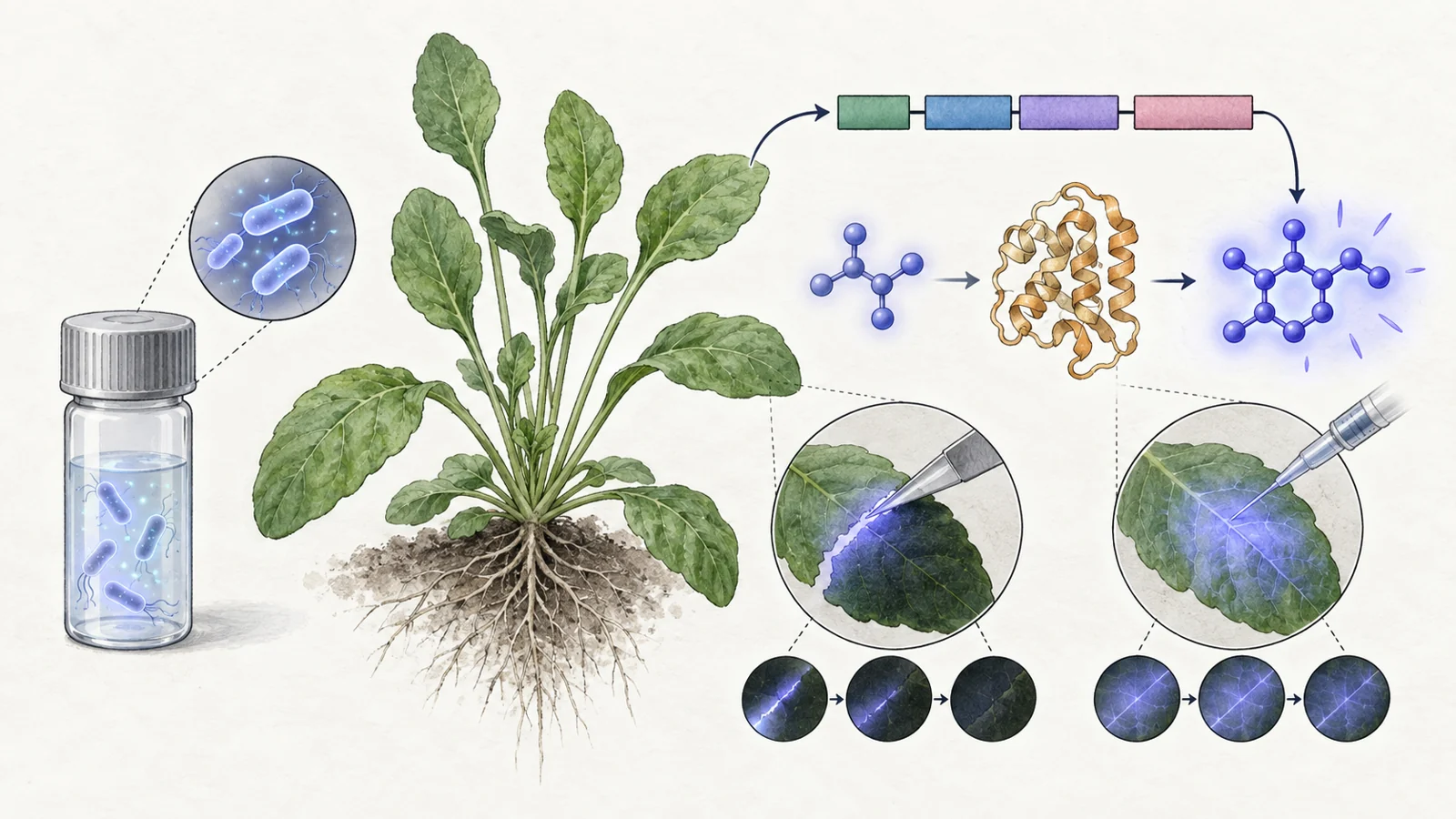
The pathway begins with caffeic acid, a compound connected to plant cell-wall chemistry. In the mushroom system studied here, an enzyme called hispidin synthase adds two malonate groups to caffeic acid, producing hispidin. A second enzyme, hispidin-3-hydroxylase, converts hispidin into 3-hydroxyhispidin, the fungal luciferin that can feed the light-producing reaction. Luciferase then uses the luciferin and oxygen to generate light, while another enzyme, caffeylpyruvate hydrolase, helps recycle the reaction product back toward caffeic acid.
The researchers tested NpgA, a phosphopantetheinyl-transferase that activates hispidin synthase by modifying it after it is made. Adding NpgA increased light output in the transient experiments, but substantial bioluminescence was also detected without it. Making luciferin requires coordinated activity across several components, but these results do not establish that an introduced NpgA gene is always indispensable.
The authors kept luciferase out of the main luciferin-biosynthesis constructs. This separation allowed the pathway that makes the substrate to be tested independently from the reporter that consumes it. Researchers could then introduce luciferase as a complement and ask whether the plant material contained something capable of supporting light production.
That distinction also changes what a positive result means. Light can indicate that luciferin reached a working luciferase under the assay conditions. It does not by itself reveal how much substrate the plant made, how stable that substrate was, or whether the same setup would provide a dependable readout over time.
One message packages a four-part pathway
Putting all of the pathway genes into a plant normally creates a large engineering problem. The study describes the largest gene, nnHispS, as about 5.1 kilobases, while plant promoters can add another substantial amount of DNA when each gene is controlled separately. A construct using several independent promoters can therefore become large and difficult to coordinate.
The researchers addressed that problem with a pseudo-polycistron. Instead of giving every gene its own promoter, they placed multiple coding sequences in one long transcript. Self-cleaving intein-F2A linkers were inserted between the protein segments. The F2A portion helps separate products during translation, while the intein component provides additional cleavage so the pathway proteins can be released in a usable form.
This design reduced the construct to about 11 kilobases in the configuration described by the authors and required only one promoter. It also placed the genes in the same cells and made their expression more comparable. The tradeoff is control. A single-message arrangement is less flexible when one pathway component needs to be produced at a different level from the others.
The transient experiments in N. benthamiana made that tradeoff visible. The complete concatenated pathway produced bioluminescence, but the response was greater when NpgA was supplied separately from the luciferin-biosynthesis polycistron. The result shows that the compact arrangement could function in a model plant under transient expression, while also showing that packaging convenience and pathway performance are not the same thing. The experiment does not establish why the separate NpgA arrangement worked better or whether it would be best in another plant.
The signal was also modest and sensitive to timing. Measurements were higher at three days after infiltration than at four days, and the leaf-disk response reached a distinct maximum after the reading began. That behavior made the transient demonstration useful as a proof that the components could work together, but it did not turn the construct into a durable plant reporter.
The tomato lines changed the question
The researchers then moved from transient expression to regenerated tomato plants carrying luciferin-biosynthesis constructs. Two arrangements were examined, including one with NpgA included in the concatenated pathway and another without it. The plants were screened for pathway DNA and then tested with luciferase supplied from transiently transformed N. benthamiana material.
The first functional screen produced a small but statistically significant elevation in extracts from three regenerated lines that were also positive by PCR for multiple pathway genes. This was an initial indication that some pathway activity might be present. The signal was very low compared with the levels associated with other reporter assays, however, and it came from a restricted subset of the regenerated material.
Following the lines through selection and segregation made the story less straightforward. Only a limited set of plants retained the relevant pathway evidence, and one line was carried through further segregation toward homozygous descendants. Later assays of selected segregated tomato plants, including lines characterized through selectable-marker copy number, produced readings indistinguishable from wild-type background under the tested conditions.
Those two kinds of result answer different questions. PCR and digital PCR can show that a construct or selectable marker is present and can help characterize copy number. They do not show that every pathway gene is actively expressed, that all of the encoded proteins are functional, or that luciferin has accumulated to a detectable level. Conversely, a background-level light reading does not identify which step failed. Production, substrate loss, delivery of the luciferase reporter and the behavior of the assay can all affect the outcome.
The tomato experiments therefore did not establish a durable, functional substrate-producing reporter across the selected generations. They showed how quickly a promising transient complementation result can become a more difficult inheritance and measurement problem.
The assay itself became part of the biology
To investigate that measurement problem, the authors used Agrobacterium expressing mushroom luciferase as a biosensor. The bacteria supplied a protected source of the light-producing enzyme. If plant material contained luciferin, the bacterial reporter could respond to it without requiring luciferase to be successfully expressed inside the plant tissue being tested.
The comparison made the effect of tissue disruption hard to miss. Light from the bacterial biosensor itself stayed comparatively steady. When disrupted N. benthamiana tissue was present, the signal fell by more than two orders of magnitude in under four minutes. Tomato tissue caused almost immediate suppression to background under the same general type of assay. Duckweed showed much less decay in the bacterial assay. In a separate assay using luciferase-expressing N. benthamiana tissue, pepper strongly reduced the signal without matching tomato’s complete suppression.
A memorable way to read this result is that the bacterial detector was still working, but the sample around it could rapidly remove the conditions needed for light. Fresh substrate restored the bacterial signal in a follow-up test, and resuspension in disruption-related buffers caused faster loss than resuspension in culture supernatant. Together, those observations support instability of the luciferin substrate as an important contributor to the fading response.
They do not identify a particular tomato compound responsible for quenching, and they do not show that quenching alone explains the later transgenic-plant results. The practical point is narrower and more important: breaking plant tissue can change the chemical environment so strongly that the assay may begin measuring substrate survival and tissue interference as much as pathway activity.
A steadier glow can reflect transport
The study also compared heavy tissue disruption with a gentler way of introducing luciferin. In N. benthamiana tissue expressing luciferase, vacuum infiltration produced a lower but steadier light response, whereas maceration caused a rapidly decaying signal. The authors interpret the steadier pattern as a transport-limited condition: luciferin enters cells gradually, so the rate at which substrate reaches the enzyme helps determine the observed light.
That interpretation changes the meaning of a stable-looking trace. Under saturated enzyme conditions, a glow assay can often be related to the amount of active enzyme. Under the transport-limited conditions described here, the signal can instead be governed by how quickly the substrate moves through the tissue and into cells. A steady reading may therefore show a relatively steady supply route, not a direct measurement of luciferase expression.
This distinction also helps explain why instrument choice matters. Light that was measurable with a luminometer in the tested transiently transformed N. benthamiana material was not detected with the camera setup described in the paper. The transient signal was low, and the measurement depended on the assay arrangement. A luminometer result therefore cannot be treated automatically as successful visible imaging of a living plant.
Taken together, the experiments separate several goals that are easy to blend together. A compact gene cassette can make a multi-enzyme pathway easier to introduce. Transient complementation can show that the pathway produces a usable substrate under particular conditions. A bacterial biosensor can reveal that the substrate is unstable around disrupted tissue. A steadier response can reflect limited entry into cells. None of those observations, alone or in combination, demonstrates the proposed repeated imaging of a biological process in tomato or another crop.
What this could change
If plants could maintain a detectable internal supply of luciferin, and if a separately controlled luciferase reporter produced a signal that remained interpretable, researchers could eventually follow where a reporter-bearing virus moves through a living plant without repeatedly adding luciferin from outside. That would turn the substrate-making pathway into infrastructure for biological tracking rather than a one-time light-producing demonstration.
The capability is conditional. It depends on sustained substrate availability, enough light for the chosen detector, limited interference from plant chemistry and a validated relationship between the measured signal and the process being followed. The study shows why each condition matters, while the tomato results show that carrying pathway DNA through plant generations is not enough by itself.
The authors point toward a possible route based on accumulating hispidin, a precursor that can avoid exposing the plant to as much reactive luciferin before the reporter is needed. Combined with improvements to the pathway and luciferase, that strategy could make internal substrate production more practical. At the July 2025 stage, however, it remained a proposed direction. The demonstrated advance was a clearer understanding of how gene packaging, substrate stability and transport shape the possibility of a useful plant light readout.
Key Sources
- Primary source: Expression of a multigene mushroom luciferin biosynthesis pathway as a pseudo-polycistron in plants.
DOI or Journal Page · Peer-Reviewed Paper · 2025-07-14