
Research Signal – Source date 2023-01-15
A microwave absorber has two practical demands to meet. It needs to work across the frequencies that matter, and it needs to fit into the space available. Strong performance at one frequency does not automatically deliver useful absorption across a broad band.
A study published on January 15, 2023, approaches that problem through design at two scales, combining hollow microscopic tubes with a larger engineered surface. The authors report striking reflection-loss results in thin material configurations and broad frequency coverage in a thicker manufactured structure. The distinction matters immediately: the broad-band result belongs to a 5.0 mm absorber, not the one-millimeter configuration.
From hollow tubes to an engineered surface
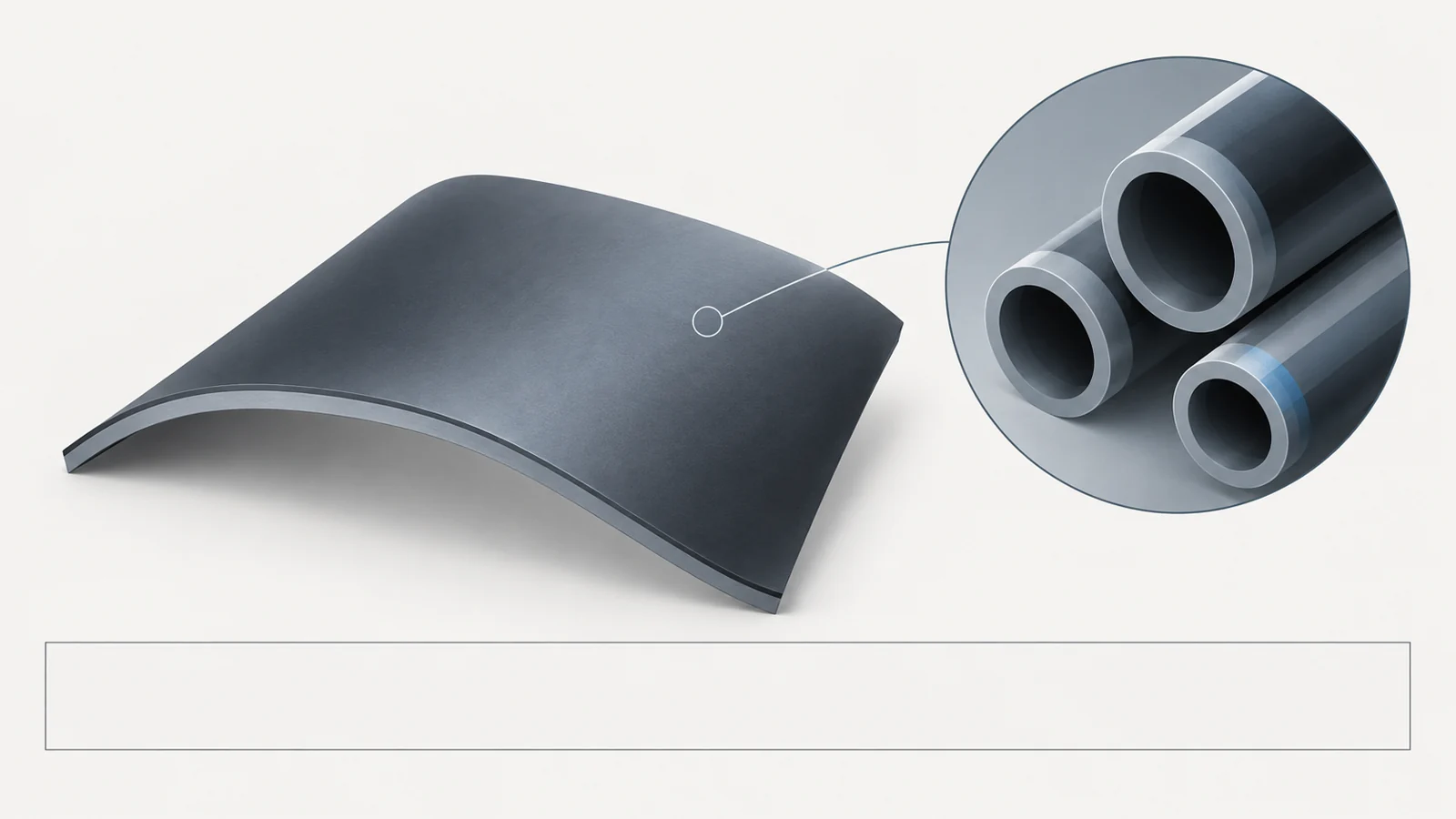
The researchers fabricated a composite combining hollow carbon, MXene and molybdenum carbide, written as Mo₂C. They call the material HCMM. Its microscopic structure consists of hierarchical microtubes—elongated, hollow structures that form the starting point for the larger absorber.
The construction sequence extends beyond choosing a mixture of materials. After developing the microtube composite, the team used it as the basis for a three-dimensional engineered surface. The authors report simulating and optimizing that larger structure, then manufacturing a flexible microwave metamaterial absorber. Here, the term “metamaterial” points to the deliberate use of structure as part of the electromagnetic design.
That sequence gives the study its central idea. Material composition and microscopic architecture are one set of design choices; the shape of the larger surface is another. The reported device brings those choices together. The abstract establishes this progression from composite to manufactured surface, while a detailed account of how each feature contributes would require the paper’s methods and results.
What the three performance figures mean
The reported results answer different questions about performance.
| Configuration | Result reported by the authors |
|---|---|
| Material at a matching thickness of 1.0 mm | Reflection loss of −66.30 dB |
| Material at a matching thickness of 1.4 mm | Strongest reflection-loss minimum of −87.28 dB |
| Manufactured flexible surface at 5.0 mm thickness | Effective absorption across 3.7–40.0 GHz |
Reflection loss describes how much of an incoming wave is reflected, expressed on a logarithmic decibel scale. A more negative value indicates less reflection under the conditions used to obtain it. A deep minimum identifies particularly strong performance at a particular frequency and thickness; it does not describe the width of the useful frequency range.
“Matching thickness” therefore belongs with the reported minimum. It is part of the configuration that produces that result, rather than a thickness at which the same performance can be assumed across all frequencies.
The frequency interval reported for the manufactured surface is a different kind of achievement. It describes coverage across a band, using the study’s criterion for effective absorption. The abstract alone does not establish the precise criterion or the frequencies at which the two reflection-loss minima occur. Those details would be needed to compare the response with an application’s requirements.
Nor should an extremely low reflected signal automatically be translated into a claim that virtually all incoming power was absorbed. Establishing absorbed power also requires the relevant transmission and measurement context. Keeping the results in their reported forms preserves what each number can tell us.
From a flexible sample to an electronics component
The authors describe the manufactured absorber as flexible. That is relevant to fitting an absorber around shapes, but flexibility by itself does not establish that microwave performance survives repeated bending. Assessing that possibility requires mechanical and electromagnetic results under the relevant conditions.
The same applies to installation. Waves may reach an absorber from different angles, and a component may encounter temperature changes or other environmental stresses. This abstract-level account cannot establish performance under those conditions, reproducibility or useful service life. Evaluating them calls for access to the detailed methods and results; the abstract should not be treated as an inventory of every test in the paper.
For an engineer choosing between materials, the exceptionally deep reflection-loss values would also need context before supporting a ranking. Thickness, frequency coverage and test conditions all affect whether a comparison is useful. This single study offers a candidate design, without establishing universal superiority or commercial readiness.
What this could change
If the flexible surface retains its absorption performance under relevant installation and operating conditions, it could give electronics designers another way to suppress unwanted microwave reflections across a broad frequency range. Covering more frequencies with one absorber could make it useful where interference is spread across several parts of the microwave spectrum.
The causal path is practical: a structure that absorbs unwanted microwave energy could reduce the energy available to reflect through an electronic assembly and contribute to interference. That would support electromagnetic compatibility—the ability of equipment to operate together without unacceptable electromagnetic disturbance. The opportunity depends on the structure fitting the available space and delivering its reported behavior in use. The study’s contribution is a manufactured design that makes that possibility worth examining.
Key Sources
- Primary source: Multi-Scale Design of Ultra-Broadband Microwave Metamaterial Absorber Based on Hollow Carbon/MXene/Mo 2 C Microtube.
DOI or Journal Page · Peer-Reviewed Paper · 2023-01-15
Keep exploring