
Research Signal – Source date 2022-09-28
A fungus growing through straw is doing something that a fuel producer might find useful. It can release enzymes that loosen the tough material in plant cell walls, making buried carbohydrates easier to reach. But natural decomposition serves the organism’s needs. Turning that activity into a manufacturing step requires control over what breaks down, how long treatment takes, and what remains available afterward.
A review published on September 28, 2022, examines that problem across biological treatments for lignocellulose, the structural material that gives straw and wood much of their strength. It connects plant-wall chemistry with treatments using fungi, bacteria, microbial communities, and added enzymes, then follows those treatments toward fuels, chemicals, and pulp. Its experimental examples come from earlier studies, rather than a new experiment by the review’s authors.
The useful question is how a particular treatment prepares material for its next job. Making fermentable sugars and making strong paper fibers call for different kinds of change.
Why processing enzymes struggle to get inside
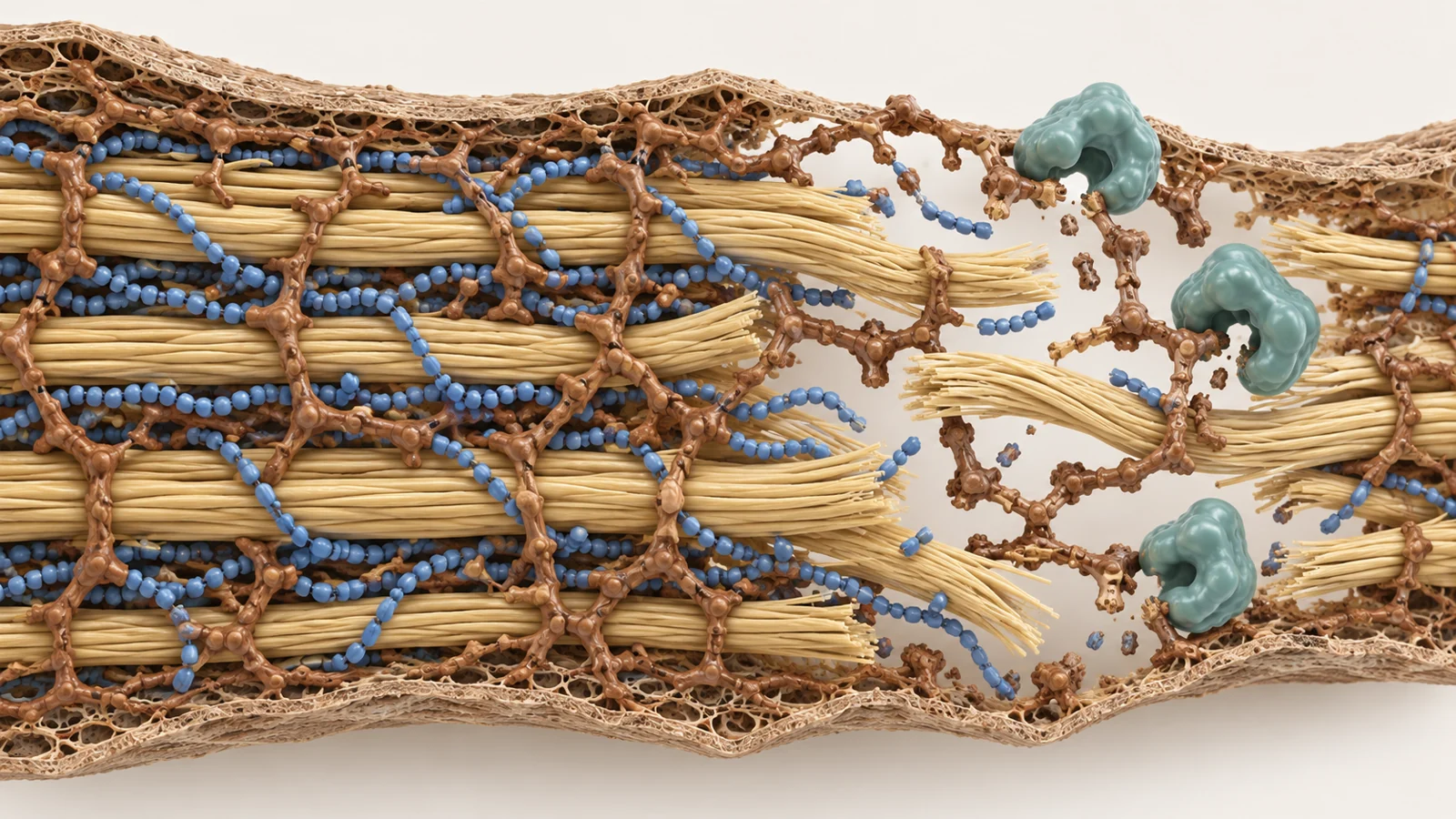
A plant cell wall is an organized composite. Cellulose forms fine, reinforcing fibers. Hemicellulose associates with those fibers, while lignin contributes a complex, connected network in the thickened walls of woody and fibrous tissues. These components give plants mechanical strength and help protect their structure against breakdown.
That arrangement creates several obstacles for processing enzymes. Lignin can physically restrict access to carbohydrates. The tightly ordered regions of cellulose also resist attack, and differences within and between pieces of biomass make access uneven. Some enzymes bind to lignin without doing useful work on the carbohydrates they were meant to break down. Adding more enzyme therefore does not automatically solve the access problem.
Pretreatment changes the material before the main conversion step. It can disrupt connections, expose more surface, and make cellulose more accessible to enzymes that split its chains into sugars. The review gives particular attention to cleavage of beta-aryl ether bonds, a common type of linkage within lignin. Breaking these connections is one route to dismantling the lignin structure.
This physical picture explains why the same recipe need not work equally well on poplar wood, wheat straw, and corn cobs. Their starting structures help determine which connections a treatment can reach and how much that changes subsequent processing.
Selective breakdown has a measurable cost
One poplar study summarized in the review makes the tradeoff concrete. After seven days of treatment with a white-rot fungus, researchers reported 70% lignin removal alongside 16% cellulose loss. The fungus acted preferentially on lignin, but the cellulose loss was substantial enough to matter when judging what the treatment delivered.
Those percentages describe changes in two different components. They cannot be subtracted to calculate a net fuel yield. Nor does 70% lignin removal mean that 70% of the wood became usable sugar. The result shows why an assessment needs both the opening of the structure and an accounting of the desired material. The review also describes Phanerochaete chrysosporium, a fungus capable of degrading lignin, cellulose, and hemicellulose together. Strong decomposition alone is therefore an incomplete criterion for choosing a pretreatment organism.
Growing a microbe and adding its enzymes directly also create different operating requirements. A living fungus must establish itself in the material and produce the relevant enzymes. Its growth takes time and can change which components it consumes. Direct enzyme treatment bypasses microbial growth during that treatment step, allowing the enzyme preparation to act without waiting for a population to develop.
That distinction does not eliminate the work of making enzymes. Commercial preparations still require production, and the chosen enzymes must perform under the treatment conditions. It changes where the biological work happens and which parts of the process need to be controlled.
Compatibility and sequence change the result
Combining organisms can broaden the activities available in a treatment, but the organisms also interact with one another. The review describes a tested bacterial combination in which two strains had a negative relationship that could impair extracellular enzyme secretion. A mixture assembled from individually useful microbes can consequently perform poorly as a community.
A staged treatment offers another way to coordinate biological activities. In one corn-cob study summarized by the review, researchers first used white-rot fungi, which released enzymes involved in lignin degradation. They then added the brown-rot fungus Fomitopsis pinicola for a shorter second treatment. In that experiment, the second stage preferentially removed hemicellulose without a significant effect on cellulose content, and subsequent hydrolysis improved.
The sequence gave each stage a different starting material. The second fungus encountered corn cobs already altered by the first treatment. That is a different design problem from asking several organisms to grow together successfully at the same time.
Chemical steps can also prepare a substrate for biological treatment. Another study described in the review treated straw with a 1% sodium hydroxide solution for 24 hours before introducing a microbial community, providing more sites for microbial growth. Such combinations offer ways to adjust access and treatment time, while adding chemical inputs and another operation to the process. Their value depends on how the stages work together.
Accessible sugar still has to become fuel
For ethanol production, pretreatment is followed by enzymatic hydrolysis, which splits carbohydrate chains into individual sugars. Fermentation organisms then convert those sugars into ethanol. Better access at the first step can help the second, but the final stage has its own biological constraints.
The sugar mixture matters. Cellulose supplies glucose, while hemicellulose can contribute sugars such as xylose. The review highlights the inability of the conventional Saccharomyces cerevisiae fermentation route it describes to use xylose. A process can therefore release sugars successfully and still leave part of that mixture unconverted if its fermentation organism cannot use them.
Other organisms broaden the options. The review discusses Scheffersomyces stipitis, which can ferment both six-carbon and five-carbon sugars, while noting its limited tolerance of inhibitory chemicals. Sugar utilization and inhibitor tolerance are separate requirements. An organism that handles a broader menu may still struggle with the chemical conditions of the liquid arriving from upstream processing.
This makes the handoff between stages consequential. Lignin removal, sugar release, sugar conversion, and final ethanol concentration answer different questions. A gain in one measure becomes a useful fuel-production gain only if the following stages can take advantage of it.
Pulp production asks for a different endpoint
For pulp and paper, fibers themselves remain part of the product. Treatment can be useful if it changes how fibers separate, combine, or respond to bleaching. Complete conversion into dissolved sugars would take the process away from that goal.
The review describes a rice-straw study using a commercial microbial mixture before preparation of a composite membrane. The treatment disrupted connections between lignin and hemicellulose. Subsequent mechanical beating required less time, with a reported 43.75% reduction in energy consumption for that step, while the material’s tensile index increased. This links a biological change to both a processing operation and a property of the resulting material.
The scope of the energy result matters. A reduction during beating is not a measurement of energy use across the entire production chain. It nevertheless identifies a concrete place where pretreatment can affect manufacturing demand.
Bleaching provides another example. In a separate study summarized by the review, broth from a bacterial culture increased pulp whiteness by 7% under the tested conditions and reduced chemical bleach requirements. Here, the useful endpoint was a change in pulp processing and appearance, rather than a fermentation yield. The intended product determines which measurements reveal whether treatment helped.
Moving from a promising example to a working process
The reported results span different feedstocks, organisms, treatment durations, and endpoints. They do not provide a common performance ranking. A lignin-removal percentage from poplar and an energy reduction during rice-straw processing cannot establish which treatment is best. Even apparently similar percentages may refer to different starting compositions or stages of conversion.
Reliable operation also requires more than reproducing an isolated result. Growth time affects how long material occupies the treatment stage. Strain stability affects consistency, and the conditions created by one operation can help or hinder the next. The review emphasizes these connections, including the need for suitable organisms, well-designed conversion processes, and control of inhibitory effects.
Mild treatment conditions are a reason to investigate biological approaches, but they do not establish lower cost or environmental impact across a whole process. Enzyme production, chemical inputs in hybrid treatments, processing time, and subsequent conversion all belong in that assessment. The examples support specific technical possibilities; extending them to routine performance across facilities requires evidence at that broader scale.
From the review’s 2022 perspective, modifying strains or enzymes through genetic engineering is one proposed direction for improving conversion efficiency. Its practical value would depend on whether those improvements remain useful when connected to the rest of the process.
What this could change
If biological treatments can deliver reliable, economical performance through the full conversion chain, processors could turn more straw and woody residues into feedstock that downstream enzymes and fermentation organisms can use. The causal path runs from better access inside the plant wall to recoverable sugars, then to organisms capable of converting the resulting mixture into useful products.
For pulp producers, the opportunity is different. Treatments that consistently improve fiber processing could reduce some mechanical work and bleaching demand while retaining useful material properties. The studies assembled in this review point toward that possibility through specific changes in beating energy, strength, and whiteness. Bringing those effects into dependable production could give residue processors and paper manufacturers more ways to adapt treatment to the product they actually need.
Key Sources
- Primary source: Lignocellulose dissociation with biological pretreatment towards the biochemical platform: A review.
DOI or Journal Page · Peer-Reviewed Paper · 2022-09-28
Keep exploring