
Research Signal – Source date 2022-03-07
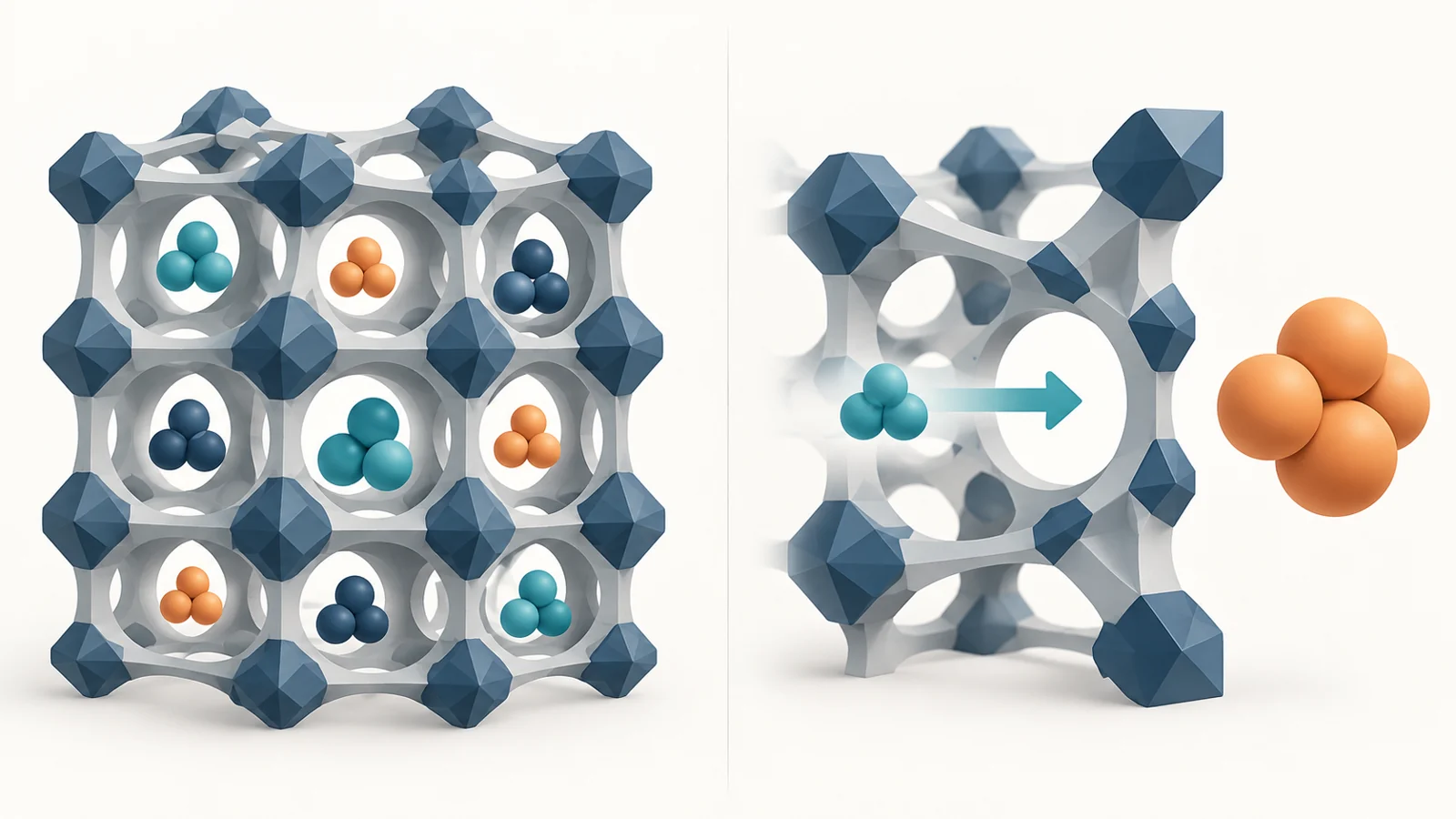
A material full of tiny spaces can serve two different purposes. Molecules can accumulate inside those spaces, making them useful for storage. The openings can also act as a molecular sieve, admitting molecules that fit while excluding larger ones. Holding molecules and sorting them draw on the same porous architecture, but ask different things of it.
Metal-organic frameworks, often shortened to MOFs, are porous materials combining organic and inorganic components. A review published on March 7, 2022, examines how researchers make these materials, vary their structures and combine them with other substances. Its central subject connects a physical feature—the pores—to a broad range of design choices.
The distinction between storage and separation helps make that breadth understandable. For storage, the pores provide room to accommodate molecules, while the material’s large internal surface area offers extensive surface within a small amount of material. Separation depends on discrimination. In the simplest size-based picture, an opening that admits a smaller molecule but excludes a larger one can help sort a mixture. Simply accommodating many molecules does not tell us which molecules a pore can distinguish.
Making the material and choosing its structure
The review brings together several routes for synthesizing MOFs, including solvothermal, electrochemical, mechanochemical, ultrasonication and microwave methods. These names concern how a material is made. They belong to a different design question from the dimensional structure of the resulting material or the substances combined with it.
Its structural coverage spans categories labeled zero-, one-, two- and three-dimensional. Those labels organize the range of structures under discussion; they should not be read as successive grades of quality. Choosing a synthesis route and describing a dimensional structure are distinct parts of describing a material. Neither label, by itself, identifies the right candidate for a particular storage or separation task.
Composition adds another choice. The review covers MOF composites incorporating polymers, carbon materials, metal nanoparticles, metal oxides or biomolecules. A composite combines the framework with another material, extending the design beyond the porous framework alone. The identity of that partner tells readers what has been combined; understanding what the combination accomplishes requires evidence about the particular material.
Keeping fabrication, structure and composition distinct makes this research easier to follow. A new way of making a MOF, a different structural arrangement and a new composite partner are different kinds of change. Their relevance ultimately depends on the function being sought. The review accordingly discusses porosity and stability alongside structural characteristics and applications.
How to read the range of applications
The application areas extend from gas separation to sensors, energy storage, drug delivery and environmental cleanup. That breadth shows why researchers are interested in this family of materials. A review brings such work together, but an application appearing in its scope does not establish that a particular product is ready for use.
The abstract supports an explanation of these design possibilities. It does not provide a basis here for choosing a best synthesis route, dimensional structure or composite partner. Nor can this account assign numerical storage capacities, separation performance, service lifetimes or costs. Those judgments require verified details about specific materials and the conditions in which they were tested. The useful conclusion at this level is that several design choices are available, with porosity and stability among the properties that matter to their use.
What this could change
For gas-separation system designers and the people who use those systems, the concrete possibility is a material tailored to distinguish molecules within a mixture. If its pores discriminate between the intended molecules and the material remains stable under operating conditions, it could help separate a desired component from the rest. Fabrication, structural design and composite choices offer avenues for pursuing that capability. From the review’s March 2022 perspective, the downstream opportunity is more choice in how to build materials around a specific separation task.
Key Sources
- Primary source: Synthesis of various dimensional metal organic frameworks (MOFs) and their hybrid composites for emerging applications – A review.
DOI or Journal Page · Review or Meta-Analysis · 2022-03-07
Keep exploring