
Research Signal – Source date 2025-05-01
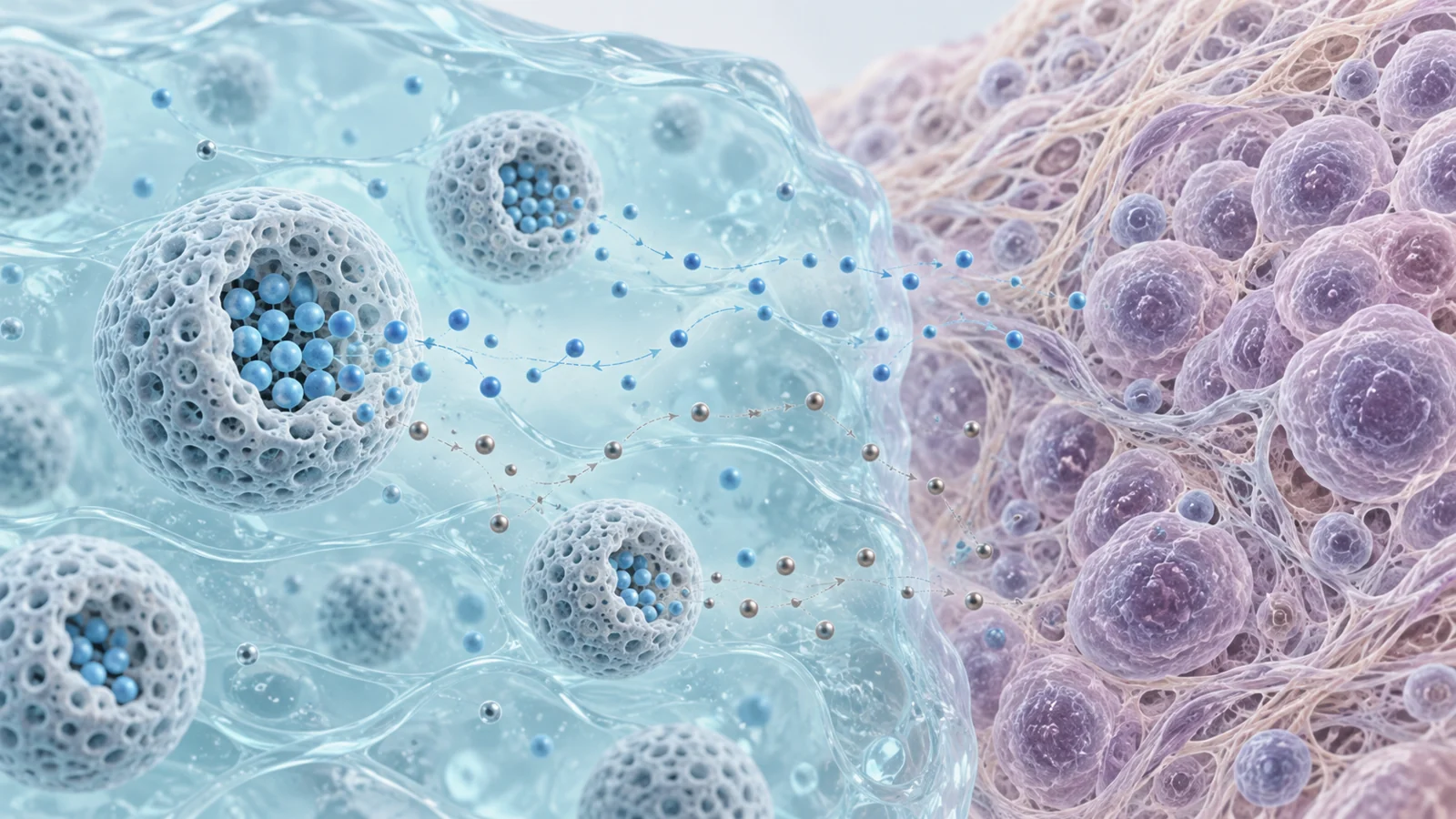
A medicine that reaches a tumour may also circulate through healthy tissue. Researchers are exploring materials that could hold cancer drugs close to a tumour and release them over time. A review published on May 1, 2025, brings together work on one such design: porous metal-organic frameworks (MOFs), which can carry drug molecules, combined with hydrogels, water-rich gels that may be injected or placed locally.
The review describes different materials and experiments rather than reporting one new treatment result. Its examples range from cancer-cell tests to studies in tumour-bearing mice, and it also discusses ways artificial intelligence (AI) might help design or assess these materials. The results offer a look at a possible delivery strategy, not evidence that patients benefit from it.
Two materials with different jobs
MOFs are built from metal ions connected by organic molecules into porous structures. Their internal space and surfaces can hold drug molecules, while their structure can be adjusted for different cargo and release properties. Hydrogels form soft, water-rich networks. In biomedical settings, they can provide a matrix that holds material in place and can be shaped for local delivery.
Combining the two changes how a drug carrier can be handled. In one example discussed by the review, drug-loaded MOF particles were linked to a hyaluronic-acid polymer modified with bisphosphonate groups. The resulting gel had dynamic bonds that let it shear during injection and reform afterward, a behavior described as shear-thinning and self-healing. The formulation also released drug in response to lower pH and added adenosine triphosphate (ATP) in release tests.
These properties describe a material and its behavior under particular test conditions. Whether a gel stays where intended, releases a useful amount of drug, and remains compatible with surrounding tissue are separate questions that depend on the formulation and the body environment.
Cell tests and mouse studies answer different questions
One oral-cancer example combined MOFs and a temperature-sensitive hydrogel with doxorubicin, a chemotherapy drug, and celecoxib, a second drug. In tests involving several cancer-cell lines, the formulation showed pH-responsive release and dose-dependent toxicity to cancer cells. The review also describes evidence that the drugs acted together in those experiments and that the MOFs helped drug entry into cells.
Those observations concern release behavior and cells in experimental conditions. A separate study tested an injectable hyaluronic-acid-based MOF hydrogel carrying doxorubicin in tumour-bearing mice. The review describes tumour-growth and survival measurements, body-weight tracking, and tissue examinations in that experiment, and reports encouraging antitumour activity and biocompatibility findings in the animals.
The formulations, models, and outcomes differ. The cell experiments do not show what happens in a whole organism, while mouse results cannot establish a treatment’s benefit or safety in people. They are distinct pieces of early evidence, not a shared estimate of how much these materials improve cancer treatment.
When treatment depends on coordinated components
Some designs combine more than a drug and a carrier. The review describes an ultrasound-assisted platform that brought together a hydrogel, a titanium-based MOF modified with gold, a chemotherapy prodrug, and another component intended to affect the tumour environment. In mouse models, ultrasound was part of the treatment approach, alongside the formulation’s multiple components. The reported work examined tumour outcomes and biological changes associated with the combined treatment.
This kind of design makes coordination central to the result. The external ultrasound input, drug release, and other intended effects must work together in the right conditions. Combining several mechanisms may create opportunities, but it also raises questions about timing, dose, and whether one component interferes with another. The review notes that these interactions are not fully understood and that optimizing multi-part treatments is difficult.
AI could help model release and immune responses
The review presents AI as a possible tool for making complex formulations easier to study. Models could estimate how different MOF and hydrogel combinations might affect the rate and amount of drug release under varying conditions. Analysis of immune-cell data could also help researchers assess responses to antigen delivery and explore treatment plans.
These are proposed uses, not evidence that AI has independently improved treatment performance. The review identifies variable data quality and limited algorithm adaptability as barriers, particularly for combining information from multiple biological measurements. An AI prediction would still need to be checked against experiments, and a predicted release profile is not itself evidence of a better outcome.
The material must be understood inside the body
A gel’s water-rich character may support compatibility, but the MOF introduces components whose behavior also matters. The review highlights possible toxicity from metal ions or organic ligands, immune reactions, and concern about accumulation in organs. Some studies discussed in the review focus on cells or shorter-term observations, while longer-term bodily fate and metabolism remain important development questions.
Stability is another practical constraint. A MOF that breaks down too quickly in physiological conditions may not carry or release its cargo as intended; one that persists raises questions about its eventual clearance. Pore size and drug-loading capacity also need to be balanced against safety and stability. Materials that are difficult or costly to make could be harder to scale beyond laboratory research.
Local placement alone cannot answer these questions. The full formulation—including the gel, framework, drug, and any other active components—needs to be evaluated in relevant biological conditions over time. Encouraging cell or animal results are useful steps in that process, but they do not resolve long-term safety, clearance, or clinical practicality.
What more precise local delivery could offer patients
A treatment placed near a tumour could, in principle, keep useful drug exposure concentrated at the target while limiting exposure elsewhere. For patients, that might eventually mean a local option that controls drug release without relying on the same degree of whole-body exposure. That possibility depends on whether these materials can release drugs reliably, clear safely, and show meaningful benefit in human-relevant testing. The review describes an avenue for research; it does not establish that this capability is ready for clinical use.
Key Sources
- Primary source: Research prospects and AI-driven strategies for metal-organic framework-hydrogel composite materials in cancer treatment.
DOI or Journal Page · Review or Meta-Analysis · 2025-05-01
Keep exploring