
Research Signal – Source date 2023-08-22
A metal can withstand a large force yet remain vulnerable once a crack starts. Strength describes its resistance to deformation or failure under load; fracture toughness concerns its resistance to the growth of a crack. Improving the first can compromise the second when the material loses the ability to deform around damage.
That tension matters for metal matrix composites—metals containing reinforcing material. Adding reinforcement can help them carry greater loads, but the amount added is only part of the design. Where the reinforcement sits, how its particles connect with the surrounding metal, and how that metal’s grains are arranged can change what happens when local damage begins.
A review published on August 22, 2023, brings those choices together across larger reinforcement patterns and finer internal structures. Its contribution is to connect reported mechanical behavior with explanations of how different regions interact, then propose energy dissipation as a more quantitative basis for design. The examples span different composite systems and studies, rather than a single experiment ranking every arrangement under identical conditions.
What happens around a crack
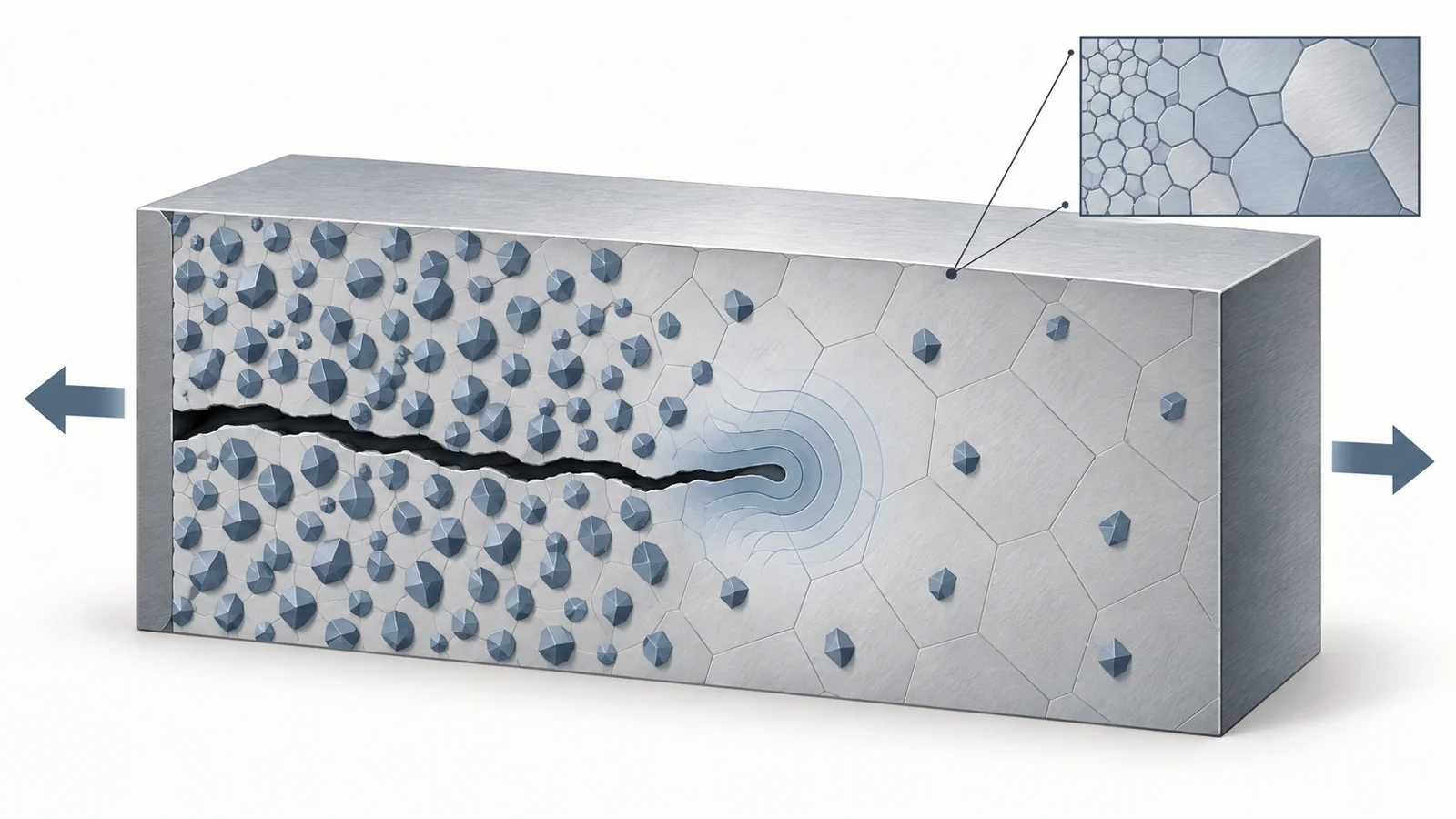
Consider a composite with neighboring regions containing different concentrations of reinforcing particles. A reinforcement-rich region may be strong but relatively brittle. A reinforcement-lean region may deform more readily. Here, “hard” and “soft” describe the behavior of whole regions, not two different kinds of individual particle.
Under load, those regions cannot deform independently because they are joined together. Their different responses create local variations in strain—the amount of deformation—and stresses near their boundaries. The review discusses how these interactions can contribute to strengthening. An interface therefore does more than hold the ingredients together; it helps determine how they share a load.
The same arrangement changes the course of damage. The authors describe microcracks beginning in brittle, reinforcement-rich zones. When a crack reaches a neighboring ductile zone, that metal can deform permanently around its tip. This plastic deformation can blunt the tip and impede further crack growth. A region that yields locally can thus help protect the surrounding structure from a sharp, advancing crack.
Dimensions matter. Too much soft material can reduce the composite’s overall strength. In an example involving two grain-size populations, the review describes narrow bands of coarse grains as more effective for strengthening and toughening than either wider or extremely narrow bands, because of their effect on microcrack blunting. That finding makes the width of a deformable region a functional design choice, rather than a detail of its appearance.
Crack direction, the strength of the interfaces, and the properties on either side also influence the response. A useful arrangement has to place deformation where it helps while maintaining load support elsewhere. These dependencies make it difficult to transfer a successful pattern unchanged between different metals, reinforcements, and loading conditions.
What stronger and more stretchable actually means
The metal surrounding the reinforcement has its own structure. It consists of grains, and a composite can contain distinct populations of larger and smaller grains. One comparison summarized by the review concerns carbon-nanotube-reinforced 2024 aluminum with either two grain-size populations, called bimodal, or three, called trimodal.
The reported tensile strength was 625 megapascals for the bimodal configuration and 723 megapascals for the trimodal one. Uniform elongation increased from 3.8% to 6.7%. These are two different measurements, and their combination is more informative than either number alone.
Tensile strength describes the maximum tensile stress sustained during a pulling test. Stress expresses force relative to cross-sectional area, so the higher value indicates greater resistance to tensile loading in that comparison. Uniform elongation describes how far a specimen stretches while deformation remains distributed, before it becomes concentrated in a narrowing region. The larger percentage means more stretching was accommodated before that localization.
The trimodal material therefore combined higher tensile strength with greater uniform stretching in the results reported by the review. The authors discuss intermediate-sized grains as helping reduce stress concentrations and the tendency for deformation to concentrate in one place. That provides a proposed explanation for why adding a third grain population could be useful.
But uniform elongation is not a fracture-toughness measurement. The change from 3.8% to 6.7% cannot be translated into a corresponding improvement in resistance to a growing crack. Nor does this comparison isolate grain configuration as the sole cause of the differences. Its value is a concrete example of two desirable tensile properties improving together, with a mechanism worth investigating—not a numerical answer to every question about fracture.
Following the energy through the material
The review’s forward-looking proposal begins with the energy stored as a material is loaded. Local deformation can dissipate some of that energy around damage. How much is dissipated, and where, depends on the material’s internal structure. Concentrated deformation and widely distributed deformation can have very different consequences for its ability to tolerate a crack.
This suggests a demanding design question. Could researchers start with a desired mechanical response and work backward to choose the sizes, positions, and interfaces of the constituent regions? Doing so would require predicting how those choices affect energy dissipation, rather than relying mainly on trying arrangements and measuring the outcome afterward.
The authors propose combining theory, numerical simulation, and experimental validation. Finite element analysis can investigate how a modeled structure responds to loading, while molecular dynamics can examine behavior at much smaller scales. Mechanical tests, impact tests, and acoustic emission measurements can then provide evidence against which explanations and predictions are checked.
The distinction is between explaining a promising specimen and reliably predicting a new one. A mechanism such as crack-tip blunting can help explain an observed result without yet supplying a general recipe for another composite. The energy-based approach is presented as a research direction toward that predictive capability. It requires quantitative links between local deformation, interfaces, and mechanical behavior that remain useful across the relevant scales.
The manufacturing process can change the design
Even a well-reasoned internal arrangement must survive fabrication. Reinforcing particles with different sizes, densities, shapes, and surface properties do not necessarily disperse under the same processing conditions. A process that distributes one component effectively may leave another poorly distributed, undermining the intended relationship between neighboring regions.
More forceful processing has its own cost. The review discusses the difficulty of dispersing carbon nanotubes and graphene while preserving their structures. Excessive energy during ball milling, along with unwanted reactions at interfaces, can compromise these reinforcements. Dispersion, reinforcement integrity, and adhesion to the metal must be coordinated; improving one does not automatically improve the others.
Controlled gradients present another obstacle. These designs vary the structure across a distance, but conventional processing struggles to control such variations precisely from very small scales to much larger ones. Reinforcements can also pin grain boundaries, complicating efforts to establish the intended changes in grain size through the metal.
Processing does not end when the initial pattern has formed. The authors describe how subsequent heat treatment can alter structures created by some dispersion methods. They also identify cost, large-part fabrication, mass production, and direction-dependent properties as limitations for additive manufacturing approaches discussed in the review. These are practical reasons why a promising small specimen does not by itself establish a dependable route to a large component.
For designers, the relevant material is the one that emerges from the complete manufacturing process. Its particles, grains, and interfaces must retain the features responsible for the desired behavior. Reproducibility is therefore part of the scientific challenge of transferring individual results into useful structures.
What this could change
If manufacturers can reproducibly coordinate regions that carry load with regions that accommodate deformation around cracks, aerospace and vehicle designers could gain more scope to reduce the mass of load-bearing components while preserving structural performance. Aluminum-based composites are especially relevant to that possibility because the review considers them for applications where low weight matters.
The causal path depends on achieving both useful load capacity and resistance to crack growth in a manufacturable material, then retaining those properties under the intended service conditions. That combination could allow a component to meet its requirements with less material. As of the review’s August 2023 perspective, this is a conditional opportunity for lighter structures, with fabrication control and reliable mechanical behavior determining whether it becomes a practical design option.
Key Sources
- Primary source: Reviewing the Integrated Design Approach for Augmenting Strength and Toughness at Macro- and Micro-Scale in High-Performance Advanced Composites.
DOI or Journal Page · Review or Meta-Analysis · 2023-08-22
Keep exploring