
Research Signal – Source date 2022-02-10
A first-line trial reported a median overall survival of 18.1 months for people treated with two immune drugs, compared with 14.1 months for those given platinum-based chemotherapy. The result marked a meaningful advance after a long stretch with few new treatment options for mesothelioma. Yet researchers were still testing vaccines and engineered immune cells. The reason is that helping the immune system recognize cancer is only part of the problem: the tumor can also make it harder for immune cells to act, and early promise is not the same as a proven treatment choice.
A survival gain after a long wait
Mesothelioma is a rare cancer that can arise in the lining around the lungs or in the abdomen. Treatment has commonly combined surgery, chemotherapy and radiotherapy. Pemetrexed with cisplatin became a standard chemotherapy regimen in 2004; the review describes a 16-year gap before a new drug combination was approved for first-line treatment. Nivolumab and ipilimumab, two checkpoint inhibitors, entered clinical use for mesothelioma in late 2020.
The large comparison highlighted in the review was CheckMate 743. It included 713 people, primarily with mesothelioma that could not be removed surgically. Median overall survival was 18.1 months with nivolumab plus ipilimumab and 14.1 months with platinum-based chemotherapy. This is the difference between the two groups’ median outcomes in that trial. It is not a prediction of how long any one person will live, and the review itself did not conduct a new treatment trial.
In a separate study discussed by the review, serious side effects (grade 3 or 4) were more common with the two-drug combination than with a single drug. Other checkpoint-inhibitor trials reported measurable tumor responses in about 20–30% of participants, and the authors caution that serious side effects such as lung inflammation (pneumonitis) matter when judging results. The survival finding was important, while leaving room to improve treatment and understand who benefits.
Releasing an immune brake does not clear every obstacle
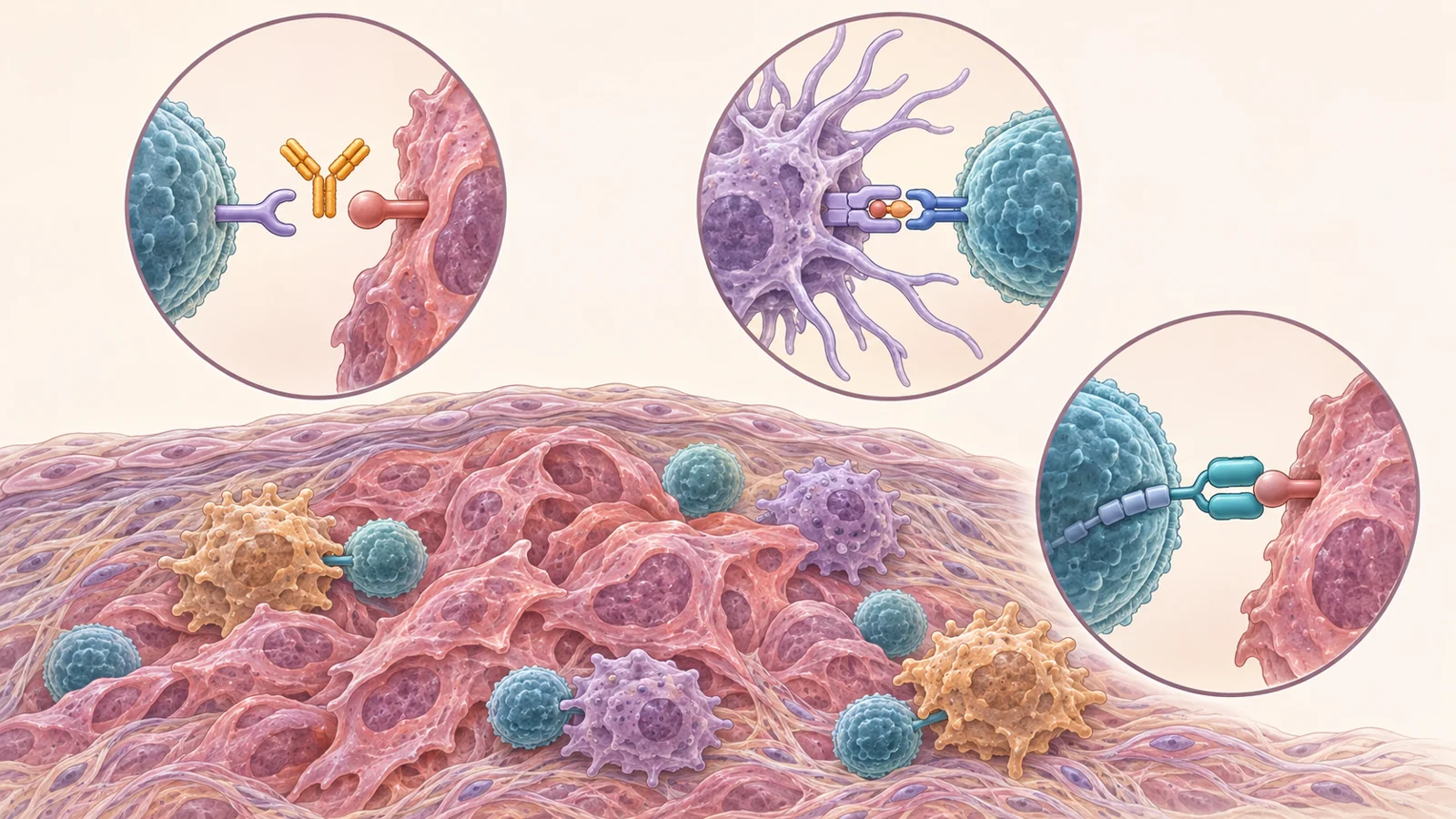
Nivolumab blocks a checkpoint called PD-1, while ipilimumab blocks CTLA-4. These checkpoints normally restrain immune activity. Blocking them can release some of that restraint, giving immune cells a better chance to attack cancer. But a tumor’s surroundings can impose other brakes.
The review describes mesothelioma tissue as an environment where several kinds of cells can suppress an immune attack. Tumor-associated macrophages can take on an immunosuppressive role. Myeloid-derived suppressor cells can inhibit T-cell growth, and the cancer can release factors that encourage these suppressor cells to multiply. Fibroblasts and other immune cells also contribute to the local environment.
This helps explain why checkpoint drugs alone may not be enough for every tumor. The treatment challenge is not simply to switch on immune cells; it is also to understand what is stopping them from working. That question led researchers to investigate approaches that try to stimulate or direct immune activity in different ways.
Vaccines try to recruit an immune response
Therapeutic cancer vaccines are intended to teach or encourage the immune system to respond to cancer. Dendritic cells, for example, help present targets to T cells. The review describes studies using dendritic-cell therapy to encourage an inflamed immune environment in mesothelioma. The DENIM trial was still recruiting in the review’s account. It was designed to compare dendritic-cell therapy with best supportive care, with overall survival as its main measure. Results were pending, so the trial’s design showed what researchers hoped to learn, not a demonstrated survival benefit.
The NIPU trial was another pending test. It enrolled 118 people with inoperable mesothelioma who had received prior chemotherapy. Both groups received nivolumab and ipilimumab; one group also received the UV1 telomerase vaccine during the first three months. The comparison could help assess whether adding the vaccine changes outcomes. At the time covered by the review, the results were not yet available.
Other vaccine ideas were at earlier stages. The review describes laboratory work with a modified measles-virus strain that damaged mesothelioma cells, and an adenoviral vaccine that prompted a T-cell response in a mouse model. Such experiments can reveal whether an approach is biologically plausible. They answer a different question from a human trial that measures whether patients live longer or feel better.
Engineered T cells need to persist as well as find a target
CAR-T therapy uses T cells genetically engineered to recognize a marker on the surface of cancer cells. The review identifies mesothelin as the main target studied in mesothelioma because it is abundant on these cancer cells. It also discusses podoplanin as a possible target under investigation.
The human studies described were early. At the time of the review’s search, all 11 mesothelioma CAR-T trials it found were in phase I, an early stage of human testing. In one study of 15 people with different solid cancers, including mesothelioma, treatment produced no reported clinical benefit beyond stable disease (no substantial change in measured tumor size). The engineered cells could be detected in blood for only 28 days. These findings underline why recognizing a tumor target is not enough by itself: researchers must also show that the engineered cells can produce meaningful, durable clinical benefit.
Genetic clues may help identify future targets
Tumors can carry chromosomal rearrangements that create unusual gene junctions. The review describes how these changes might produce neoantigens—features that the immune system could recognize as foreign. Researchers had identified T cells responsive to such neoantigens in a patient’s circulation, raising the possibility that tumor genetics could help guide vaccine or other immune strategies.
That is a biological clue, not a validated test for choosing treatment. The review also discusses genetic and gene-based approaches studied in cell lines and animal models. These can help researchers find targets or understand how a tumor behaves, but they do not show that a particular genetic feature reliably identifies the best therapy for an individual.
The authors searched PubMed for literature published from 2000 through 2021 and screened 1,127 records, including 24 papers in their review. They also screened 450 ClinicalTrials.gov records and included 12 relevant trials. The date range is the authors’ stated search limit; the review was published on February 10, 2022. Its evidence therefore brings together different kinds of answers: a large comparative trial measured survival, smaller studies described early clinical experience, pending trials had not yet supplied outcomes, and laboratory or animal work explored mechanisms and targets.
What this could change
For someone whose mesothelioma cannot be removed, a future treatment decision could account for features of the tumor’s immune environment and genetic makeup, alongside established treatment options. The nivolumab–ipilimumab trial showed that an immune-drug combination could improve median survival compared with chemotherapy in a large first-line study. The review’s findings about suppressive cells and possible genetic targets offer clues about why responses vary and where further strategies might act. The combination already existed by the review’s publication date; the new capability would be a dependable way to use a person’s tumor features to choose among effective treatments.
A meaningful next milestone would be a study that follows patients from treatment onward and tests whether a defined tumor feature predicts which of two treatments gives them a better outcome. Even then, turning that result into a reliable choice would require validated testing and other diagnostic and clinical advances. The evidence gathered in this review points toward that possibility, while leaving the individual matching step ahead.
Key Sources
- Primary source: Novel and Future Treatment Options in Mesothelioma: A Systematic Review.
DOI or Journal Page · Review or Meta-Analysis · 2022-02-10
Keep exploring