
Research Signal – Source date 2022-07-18
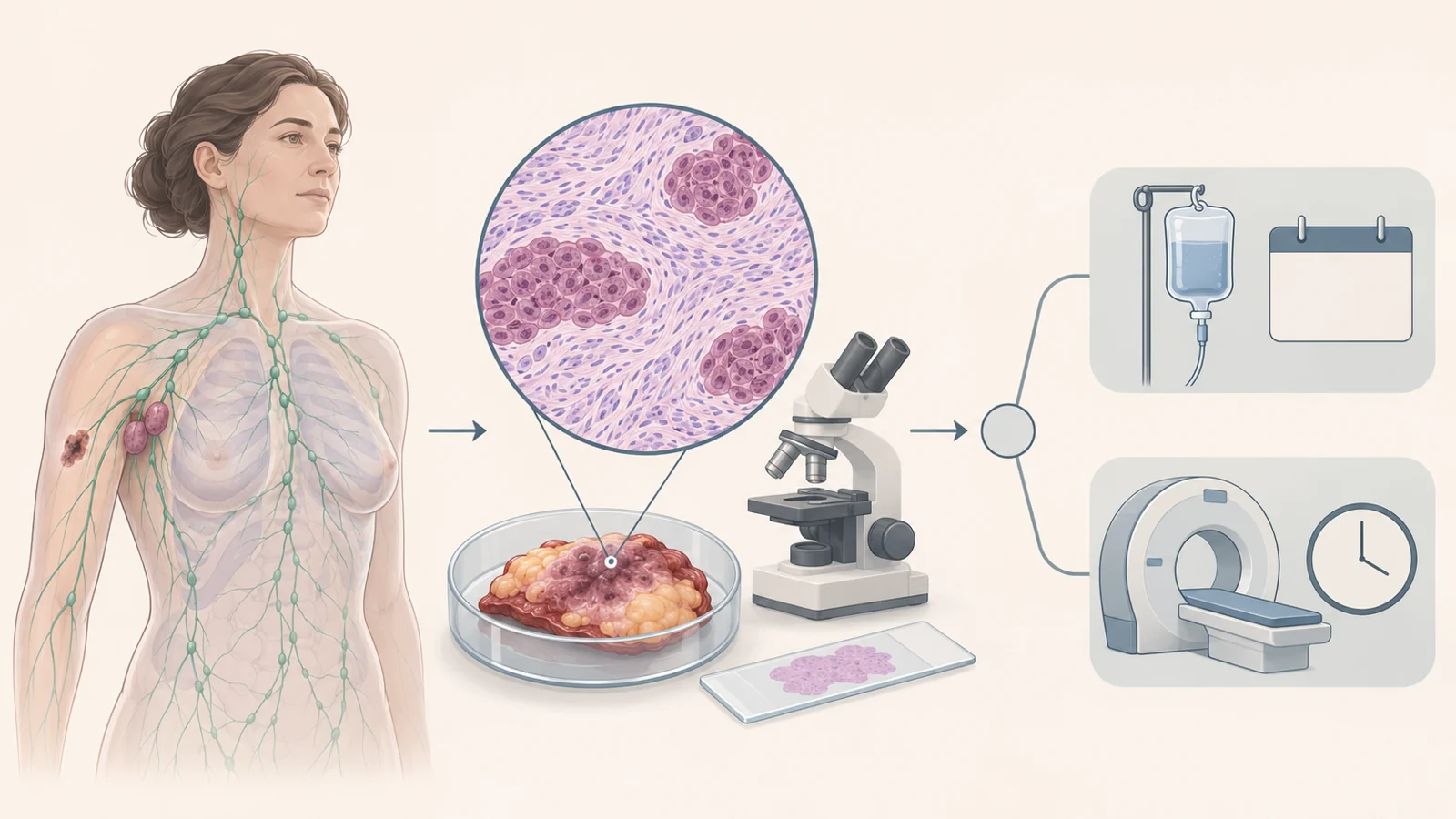
For some people with stage III or IV melanoma that can be surgically removed, treatment has traditionally started with surgery, with drug treatment considered afterward. A different sequence gives medicines first and surgery later. The appeal is that doctors can examine the removed tissue and see how much tumor remains after treatment.
A 2022 review of clinical trials describes encouraging results from this preoperative approach, also called neoadjuvant treatment. The tumor’s response may offer information that could shape later care. But the review draws on multiple small phase I–II trials, and it does not settle whether treating before surgery is better than treating after it.
The removed tissue offers a direct view of response
After preoperative treatment, surgeons remove tissue that can be examined for remaining cancer. A complete pathologic response means that no detectable residual tumor is found in the surgical tissue examined. It is an observation about what the tissue shows at that point in care.
The review links complete pathologic response after neoadjuvant therapy with a benefit in disease-free survival—the length of time people remain free of detectable disease after treatment. These are related but distinct measures: the tissue examination records the tumor’s response, while disease-free survival describes what happens over time. The review’s abstract does not provide a numerical estimate of that relationship, so it cannot tell readers how large the benefit was.
This tissue-based information is one reason to study treatment before surgery. With surgery first, there is no preoperative drug response to inspect in the removed tumor. When medicines come first, a response assessed before the operation could eventually inform surgical planning; examination of the removed tissue afterward could inform postoperative treatment. The review identifies tailoring both decisions to response as a future direction, but does not establish that doing so improves outcomes.
What the trials tested before surgery
The trials surveyed in the review tested several treatment families. They included interferon, targeted drugs aimed at particular cancer-related proteins, and immune checkpoint drugs that act on the immune system. These are distinct approaches, rather than one interchangeable preoperative treatment.
For readers, the practical point is that a treatment choice involves both the response doctors hope to observe and the toxicities a patient may experience. The review describes efforts to refine treatment strategy and dosing to improve clinical and pathologic responses while minimizing toxicities. Clinical response concerns how the disease appears during care; pathologic response comes from examining tissue. Both response and toxicity matter when weighing a course of treatment.
The abstract does not establish a ranking among these drug families or identify a preferred regimen. Its account is of a developing set of strategies tested in small early-phase trials, where the treatment and its possible harms both inform what can be learned before surgery.
Encouraging results leave the timing question open
The comparison that matters is not simply whether tumors can respond to preoperative treatment. It is whether giving treatment before surgery offers an advantage over the established sequence of surgery followed, in some cases, by postoperative treatment. The review says the early trials show advantages for neoadjuvant targeted or immune therapy in resectable stage III/IV melanoma, while also calling for research to determine the advantages of preoperative compared with postoperative treatment.
Those statements describe different levels of evidence. A review of multiple phase I–II trials can show why a strategy is promising and what responses have been observed. It is not itself a trial comparing the two treatment sequences, and the evidence summarized here does not settle which timing leads to better outcomes. Treatment before surgery creates a chance to observe response in the tumor; the value of using that observation to direct later care remains a question for further clinical work.
How this could shape the future
If clinicians can reliably use a tumor’s response to preoperative treatment to guide later care, two people whose advanced melanoma appears similarly removable could eventually receive different plans. The amount of residual tumor seen after surgery could one day help guide postoperative drug treatment. That would make the observed response part of an individualized care decision, beyond the assessment already available today.
The review supports studying this possibility, but it does not establish a response-guided decision rule or show that changing later care on that basis benefits patients. A nearer milestone would be a prospective study that sets out such a rule in advance, applies it to treatment decisions, and reports both disease-free survival and toxicity. Results of that kind would begin to show whether response-guided care can deliver a meaningful benefit while accounting for treatment harms.
Key Sources
- Primary source: Educational Review: Neoadjuvant Approaches to Melanoma.
DOI or Journal Page · Review or Meta-Analysis · 2022-07-18
Keep exploring