
Research Signal – Source date 2022-01-01
A man treated for skin melanoma 24 years earlier was alive 38 months after doctors found melanoma in his pancreas and treated him without surgery. The authors described 10 months as the longest survival among the nonsurgical pancreatic cases they had found in the English-language literature. The gap is striking, but it comes from one patient’s course alongside a small collection of different case reports—not from a test comparing treatments.
The mass raised a question about where the cancer began
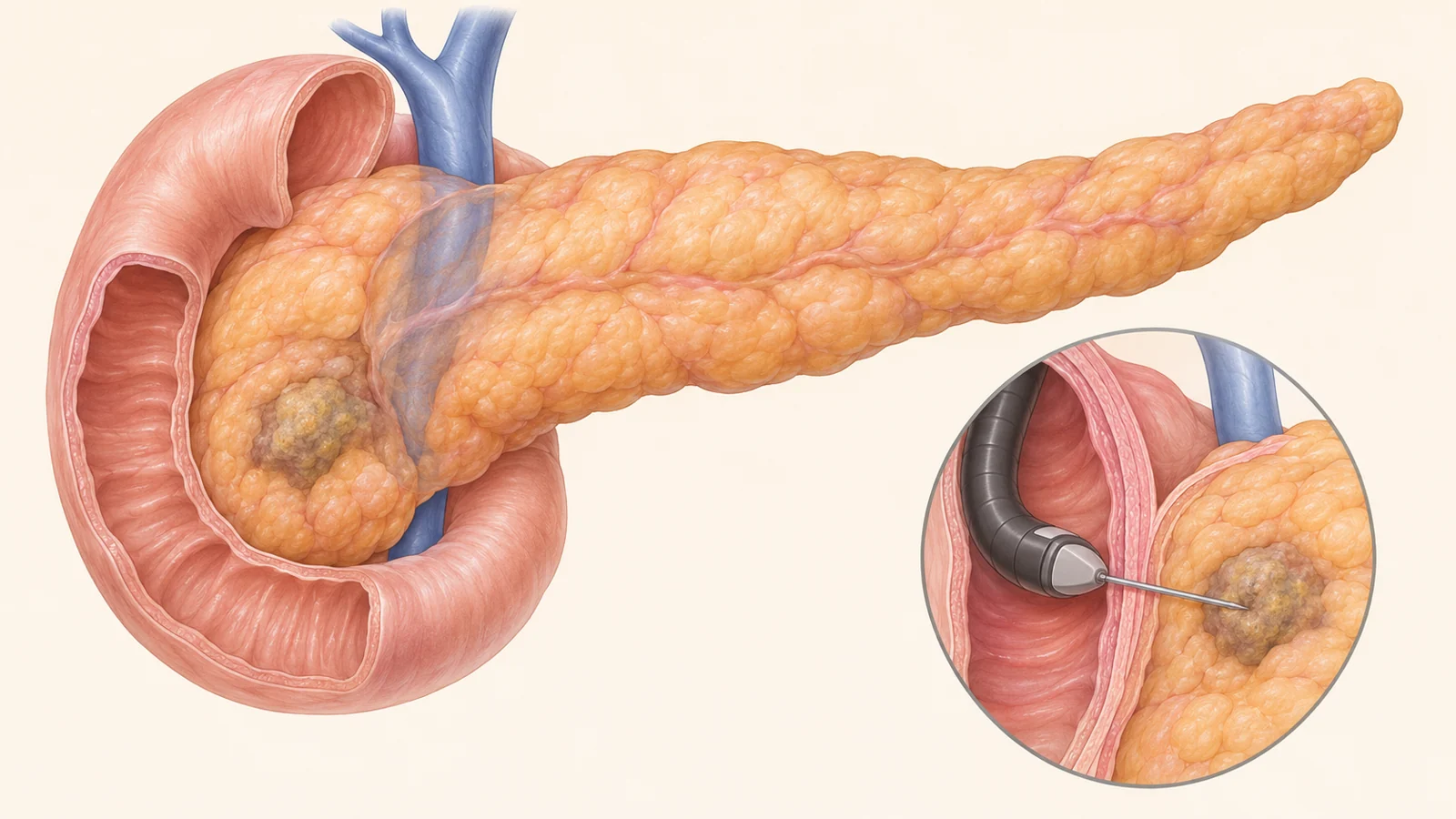
At age 75, the patient came to the emergency department with jaundice, dark urine, pale stools, nausea, and unintentional weight loss. Imaging showed a mass about 4.4 centimeters across in the head of the pancreas, where it was obstructing the bile ducts. A pancreatic mass can be a cancer that began in the pancreas, or it can be cancer that spread there from another part of the body. The scan alone could not settle which explanation applied.
Doctors used endoscopic ultrasound to examine the mass and take a sample with a fine needle. This procedure, known as EUS-FNA, let the team look at tumor cells under a microscope and test for proteins associated with melanoma. The sample’s findings supported melanoma that had spread to the pancreas. That mattered because the man had had a cutaneous melanoma—melanoma that began in the skin—removed 24 years earlier, even though the examination found no skin lesion concerning for recurrence.
The long gap between the original melanoma and the pancreatic mass made tissue diagnosis especially useful. The mass’s location and appearance could identify where it was, but the biopsy helped identify what kind of cancer it was. In this case, the diagnosis connected the pancreatic tumor to the earlier melanoma rather than treating its location as proof that it began in the pancreas.
A major blood vessel changed the surgical options
The ultrasound showed that the mass invaded the portal vein, a large vessel that carries blood from the digestive organs toward the liver. The authors said this made complete surgical removal infeasible. The decision was therefore shaped by the tumor’s relationship to a major vessel, not simply by a general preference for medicine over surgery.
The case report’s review found 83 published cases of melanoma metastases to the pancreas in the English medical literature. Seventy-two patients had surgery, eight were treated without it, and management was not reported for three. The authors noted that the longest survival among the surgically treated cases was 228 months. They also discussed a separate group of patients with melanoma spread to abdominal organs, in which people who had surgery had longer reported median survival than those who did not.
Those observations help explain why surgery has been considered when a pancreatic metastasis can be completely removed. They do not establish that surgery itself caused the difference. People selected for surgery may differ from those who cannot undergo it, and the reported cases do not provide a controlled comparison. For this patient, portal-vein invasion ruled out complete resection, leaving the team to pursue treatment without an operation.
The reported response was unusual, but it was one course
The patient received interferon therapy and immunotherapy. The authors reported progressive shrinkage of the tumor and that he was alive 38 months after treatment. They presented this as longer than the 10-month longest survival they had identified among the eight earlier nonsurgical cases in their review.
That earlier figure is a description of the cases the authors found, not a ceiling on survival or a forecast for another patient. The case table includes different treatments and follow-up; some entries lack reported outcome or follow-up information. The 38-month observation is therefore notable as a documented course, but it cannot show that the combination caused the shrinkage or survival, or tell clinicians what another patient should expect.
The paper also discusses checkpoint-inhibitor studies involving medicines such as nivolumab and ipilimumab as broader context for changing treatment options in metastatic melanoma. The supplied account does not identify those named drugs as this patient’s regimen. Keeping that distinction clear prevents evidence from other patients and studies from being mistaken for details of this case.
What this could make possible
For a future patient with biopsy-confirmed melanoma in the pancreas, the first practical questions may be whether the diagnosis is secure and whether the tumor can be completely removed. This case shows those questions meeting in one person: a tissue sample linked the pancreatic mass to melanoma, portal-vein invasion made complete surgery infeasible, and the authors later observed tumor shrinkage during interferon therapy and immunotherapy. A single report cannot turn that sequence into a dependable estimate of benefit.
If reports and studies eventually follow more patients with comparable diagnoses and treatment constraints, doctors could have a firmer basis for discussing likely responses when complete resection is not possible. A nearer step would be a series that records how diagnosis was confirmed, whether surgery was feasible, which treatments were used, how tumors changed on measurement, and how long patients were followed. Better records would not guarantee a particular outcome, but they could make treatment discussions for this rare situation less dependent on scattered, uneven case histories.
Key Sources
- Primary source: Nonsurgical Approach to Isolated Pancreatic Metastatic Malignant Melanoma: A Case Report and Review of the Literature.
DOI or Journal Page · Review or Meta-Analysis · 2022-01-01
Keep exploring