
Research Signal – Source date 2026-01-06
After melanoma surgery, treatment may continue to focus on the immune system. A personalized mRNA vaccine is being tested as an added way to help immune cells recognize a patient’s tumor. One trial summarized in a January 2026 review reported better recurrence-free survival with the vaccine plus pembrolizumab than with pembrolizumab alone.
That result is encouraging, but it answers a specific question about a combination in a particular group of patients. It does not show that the vaccine works by itself, or that one delivery approach is better than another. The review compares two ways to present tumor targets to the immune system: lipid particles that carry mRNA into the body, and dendritic cells prepared with vaccine instructions outside the body.
Why add a vaccine to checkpoint treatment
Checkpoint inhibitors such as pembrolizumab help sustain T-cell activity by blocking signals that can restrain it. But they mainly amplify immune responses that are already under way. If the immune system has not recognized enough of a tumor’s antigens to begin with, releasing that brake may not be sufficient.
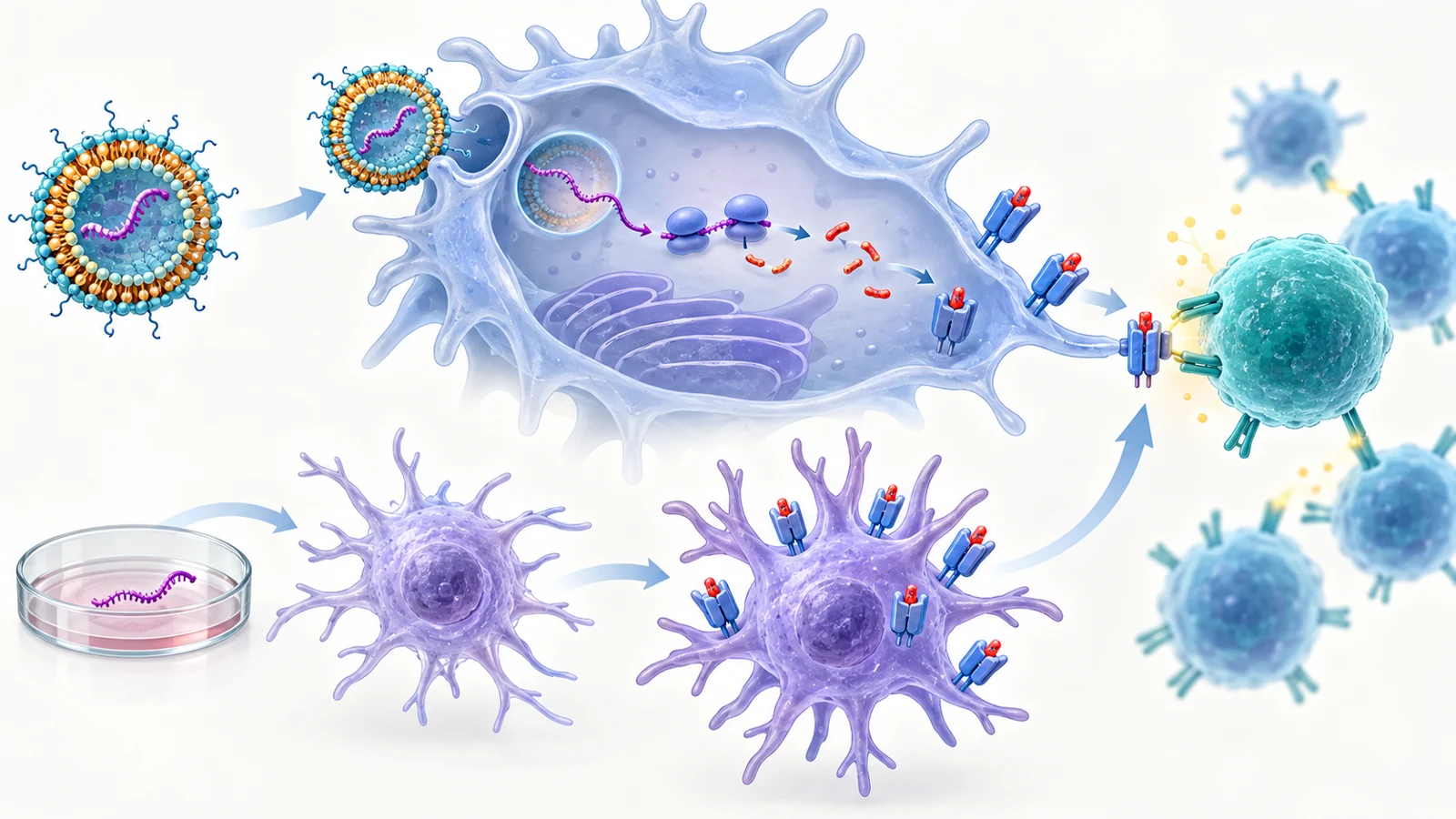
A vaccine could help supply that recognition. Its mRNA carries temporary instructions for cells to make selected tumor antigens. The resulting proteins can be processed and displayed to T cells, helping activate CD8 cells that can kill target-bearing tumor cells and CD4 helper cells that support the broader response.
Some vaccines are personalized to mutations found in an individual’s tumor. Others use shared tumor targets that occur across patients. Personalized targets may help focus the response on features of that person’s cancer, while shared targets are more readily standardized. The approaches therefore pose different challenges in target selection and production.
The review, published January 6, 2026, searched for English-language studies published between 2015 and October 2025 and qualitatively synthesized 79 selected studies. It brings together preclinical research and clinical studies with different vaccines and patient groups. Its findings are a synthesis of earlier work, not a new clinical trial.
Two routes for presenting tumor targets
Lipid nanoparticles, or LNPs, are tiny fat-based particles that protect mRNA as it travels into the body. After uptake by antigen-presenting cells, the mRNA must escape from an internal cell compartment into the cytosol, where the cell can read it and make the encoded tumor antigen. The antigen can then be displayed to T cells.
The dendritic cell route prepares an immune cell outside the body. Dendritic cells are collected or generated, loaded with mRNA, and matured in a laboratory before being administered. These cells are specialized to present antigens and activate T cells. In both approaches, the goal is to make tumor targets visible to the immune system, but the vaccine material reaches the immune cells by a different path.
The distinction matters when interpreting the clinical evidence. An LNP vaccine must deliver enough intact mRNA to suitable cells inside the patient. A dendritic cell vaccine depends on the preparation and function of cells handled outside the body. Neither route’s theoretical strengths alone establish a clinical advantage.
The recurrence result came from a combination trial
The clearest recurrence finding in the review comes from KEYNOTE-942, a Phase IIb trial in people whose stage IIIB–IV melanoma had been completely removed. It compared pembrolizumab alone with pembrolizumab plus mRNA-4157, also called V940, a personalized LNP vaccine designed around each patient’s tumor mutations.
At 18 months, recurrence-free survival was 79% in the combination group and 62% with pembrolizumab alone. The review also reports a hazard ratio of 0.56 and recurrence or death events in 22% versus 40% of participants, respectively. The combination’s reported side effects were mostly mild or moderate, with similar rates of immune-mediated events in the two groups.
These figures describe the comparison of the treatment combinations in that trial. They do not isolate the vaccine’s effect on its own, and recurrence-free survival is not the same outcome as overall survival. An earlier Phase I study of the personalized vaccine found new and expanded T-cell responses against vaccine targets, particularly with pembrolizumab. That supports the proposed immune mechanism, but immune responses are not themselves proof of longer survival.
Dendritic cell results involve different vaccines
The review also describes clinical studies of dendritic cell vaccination, but those examples are not a direct comparison with the personalized LNP-mRNA trial. Nor are all of them studies of mRNA-loaded dendritic cells. One targeted shared melanoma antigens; another used peptides from tumor blood vessel antigens; a third used tumor-lysate-loaded particles to prime dendritic cells. Their patient groups, vaccine preparations, and companion treatments differed.
In one study, an engineered dendritic cell vaccine targeting three shared melanoma antigens was followed by observation or interferon-alpha treatment. Many participants developed stronger T-cell responses, but adding interferon-alpha did not improve the reported clinical outcomes. In a separate small pilot study, peptide-loaded dendritic cells were combined with dasatinib in patients with advanced melanoma, many of whom were resistant to PD-1 treatment. The study reported immune responses and clinical benefit among some participants, with results varying by treatment schedule.
A larger study compared dendritic cells loaded with tumor-lysate particles with an acellular particle approach intended to prime dendritic cells in the body. Both approaches were associated with disease-free survival results above placebo; a group that received GM-CSF before treatment did not show the same pattern. This study illustrates how cell maturity and preparation can matter, but its vaccines were not evidence that mRNA-loaded dendritic cells produce the same results.
Across these examples, the outcomes cannot be placed on one scoreboard against the LNP mRNA trial. The vaccines targeted different antigens, were used with different treatments, and were studied in different settings. The review does not report a direct patient comparison of LNP mRNA vaccines and mRNA-loaded dendritic cell vaccines.
Delivery and preparation still constrain the approach
For LNPs, getting the mRNA to the intended cells remains a practical hurdle. The review notes that only a fraction of administered particles successfully reach antigen-presenting cells and release their contents into the cytosol. LNPs can also accumulate in the liver, which may divert delivery from the intended cells and raise concerns about unintended inflammation or tissue injury. Better targeting and efficient release are part of making the approach reliable.
Dendritic cell vaccines face a different bottleneck. The cells must be prepared, loaded with antigen instructions, and matured so they can activate T cells effectively. In the tumor environment, suppressive cells and signals can dampen immune activity. A well-prepared vaccine cell may therefore still face resistance once it encounters the patient’s cancer. The review points to cell preparation and immune suppression as continuing constraints alongside delivery efficiency.
Personalization adds a production challenge to either strategy. A tumor’s mutations must be identified and suitable targets selected; for an individualized mRNA vaccine, a matching sequence then needs to be manufactured consistently. The review sees scalable production and better targeting as important steps toward broader clinical use.
What personalized vaccines could change after melanoma surgery
For people whose melanoma has been removed, a reliably produced vaccine matched to the tumor could become an additional way to reduce the chance of recurrence alongside checkpoint treatment. The Phase IIb result gives that possibility a clinical foothold, while the immune-response findings help explain how a vaccine might complement checkpoint blockade.
That added option depends on the recurrence benefit being confirmed and on delivery and production becoming workable in practice. The current evidence gives a reason to study personalized vaccines further; it does not yet establish that they will prevent recurrence for every patient or that one delivery platform will prove best.
Key Sources
- Primary source: Advances in mRNA-Based Melanoma Vaccines: A Narrative Review of Lipid Nanoparticle and Dendritic Cell Delivery Platforms.
DOI or Journal Page · Review or Meta-Analysis · 2026-01-06
Keep exploring