
Research Signal – Source date 2021-03-23
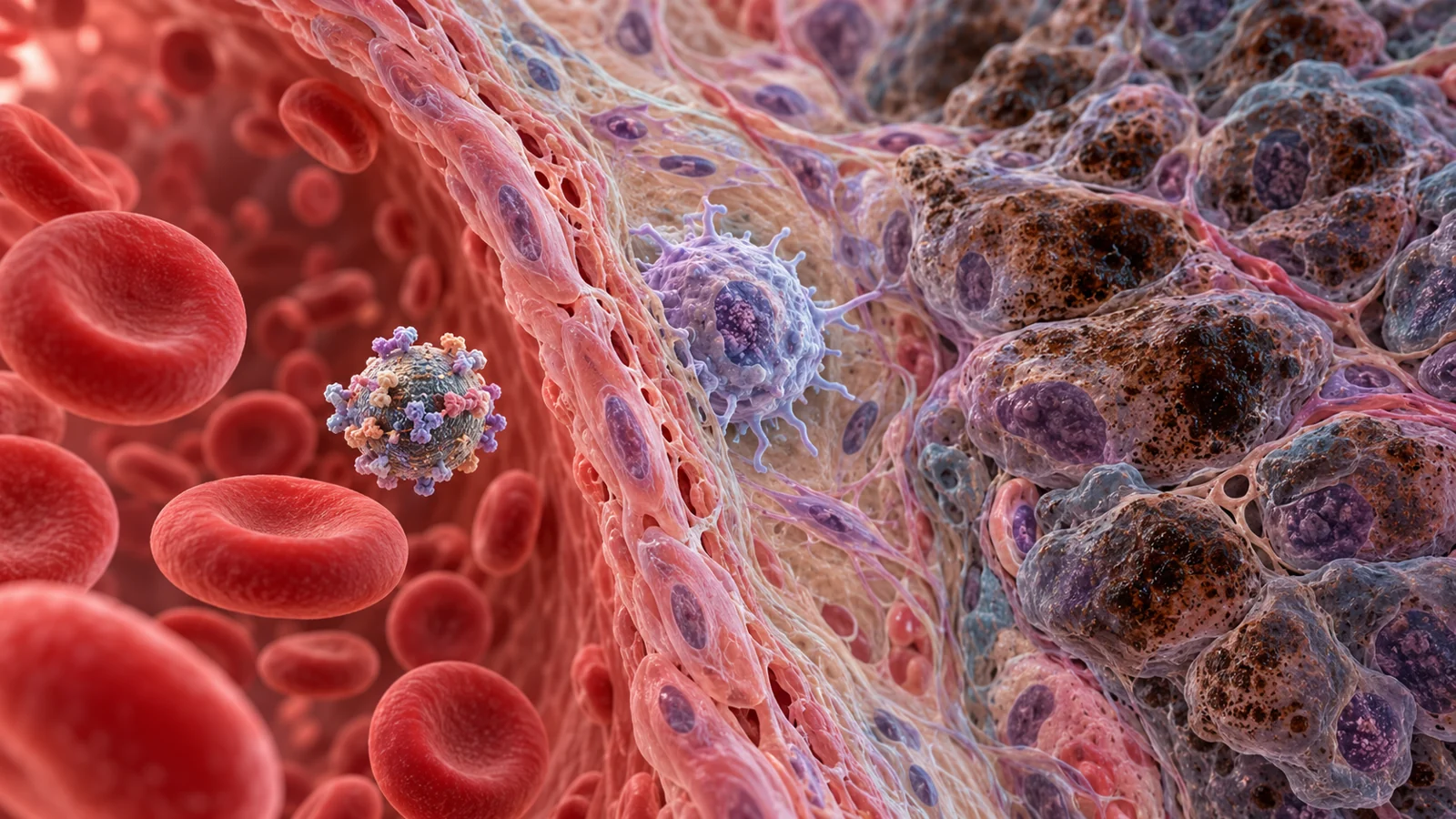
A tiny carrier designed to deliver a melanoma treatment can acquire a new identity as soon as it enters the body. Proteins from blood may coat its surface, hiding the signal it carries or prompting an unintended response from immune cells. Even a carefully engineered particle can therefore behave differently from the design on paper.
That problem matters because immune treatments depend on reaching the right place and engaging the right cells. A carrier might need to deliver a tumor marker to cells that teach the immune system what to attack, or bring a drug to an established tumor and alter the conditions that suppress immune activity there. The 2021 review Nanomedicine to modulate immunotherapy in cutaneous melanoma describes both ambitions, alongside the biological obstacles between a design and its intended effect.
A particle’s first encounter can change its identity
Nanomedicine uses very small engineered carriers to transport treatment molecules. In blood and other biological fluids, a particle’s surface meets proteins, fats, and other molecules. Some proteins can collect on that surface, forming what researchers call a protein corona. The coating can give the particle a biological identity that differs from the one its designers intended.
This coating can interfere in two ways. It may cover an antigen or stimulating molecule, making it harder for the intended immune receptor to recognize the cargo. A coated particle may therefore fail to deliver the intended immune signal. In other cases, proteins in the coating may engage immune-cell receptors and provoke an unwanted response, including uptake by scavenging cells such as macrophages.
The outcome depends on both sides of the encounter. Particle size, shape, charge, and surface coating matter, as do conditions in the surrounding fluid, including its protein concentration, acidity, and temperature. A carrier’s design is therefore only part of its behavior: its interaction with the body can alter whether the immune system ignores it, takes it up, or responds in an unintended way.
Reaching a tumor is a separate hurdle
Some tumor blood vessels are irregular and more permeable than healthy vessels. This can allow large molecules and nanoparticles to leave the bloodstream and enter tumor tissue. The process is often called the enhanced permeability and retention effect. It offers a possible route for concentrating treatment near a tumor, but the opening is not consistent: permeability varies between tumors and even across regions of one tumor. Tumors also change as they grow and as inflammation changes around them.
A carrier that crosses one vessel may not reach another tumor region in the same way. Its size, surface charge, shape, and ability to remain in circulation can affect where it goes and how quickly it is cleared. Physical access is only one step, too. The particle must still release or present its cargo where the intended immune cells can use it. In other words, arrival near a tumor does not guarantee useful delivery within it.
Some carriers aim to teach T cells what to attack
To understand one role for a carrier, it helps to start with the immune system’s handoff. Antigen-presenting cells, including dendritic cells, collect identifying pieces of a target and display them to T cells. This helps train tumor-killing T cells to recognize cells carrying the same marker. A vaccine can provide a tumor antigen for that lesson, while an immune-stimulating signal can encourage the presenting cells to activate a stronger response.
The review describes experiments in melanoma-bearing mice using particles made from PLGA, a biodegradable material. One vaccine design carried a melanoma-associated antigen called TRP2 together with an immune stimulant that activates a Toll-like receptor. In the mouse studies, vaccination was associated with immune activity and slower tumor growth. The review also describes a peptide-bearing PLGA vaccine whose anti-tumor effect was enhanced when used with interferon-gamma, a signaling protein.
These examples show why packaging can matter: a particle may carry both the target to be recognized and a cue that helps activate the immune response. They are preclinical findings in mice, however. They do not show that the same formulation will reach the same cells or produce the same effect in people.
Other particles try to change the tumor’s conditions
Not every delivery strategy teaches immune cells to recognize a new target. Some aim to make the tumor environment less hostile to immune cells that are already there. In mouse melanoma models discussed in the review, one experimental particle carried RNA designed to suppress an enzyme that helps tumor cells produce lactate. Lactate contributes to the tumor’s acidic environment. The treatment was associated with a less acidic environment, more tumor-infiltrating killer T cells and natural killer cells, and slower tumor growth. The researchers also reported that this change supported a response to a PD-1 checkpoint inhibitor, a drug that releases a brake on T-cell activity.
A separate approach targeted tumor-associated macrophages, immune cells that can help a tumor suppress an attack. In mice with melanoma, particles carried a short RNA molecule designed to block a survival signal in a tumor-supporting group of these cells. The review reports 52% fewer of those macrophages, an 87% decrease in tumor size, and longer survival in the treated mice. It also reports more tumor-killing T cells entering the tumors.
These approaches work at a different stage from a vaccine. Instead of supplying an antigen for immune cells to learn, they attempt to change conditions or cell behavior inside an existing tumor. The reported results are from animal models, so they offer possible mechanisms rather than established effects in patients.
Human evidence and a distinct viral treatment
The review also describes exploratory human data for FixVac, an intravenous liposomal RNA vaccine targeting four tumor-associated antigens. In a phase I dose-escalation study of 50 patients, an immune assay detected responses in more than 75%; that test measured immune activity, not tumor shrinkage. Clinical responses were reported for 42 patients with stage IV melanoma. In the vaccine-alone group, 12% had a partial response and 28% had stable disease; among 17 patients receiving FixVac with checkpoint inhibitors, 35% had a partial response.
These figures come from an early study and small groups. The combination result cannot isolate the vaccine’s contribution from the checkpoint treatment, and the reported response data do not establish a comparative survival advantage. The human findings are a step beyond mouse experiments, but they do not establish that nanoparticle carriers as a class improve melanoma outcomes.
The review separately discusses T-VEC, a cancer-killing virus used to treat certain melanoma lesions that cannot be removed by surgery. Its clinical use and trial results concern a viral therapy, not a nanoparticle carrier. They show that immune modulation can take different forms, but cannot establish clinical readiness for the experimental particle approaches discussed alongside it.
For nanomedicine, the practical challenges remain substantial: directing carriers to the intended tumor and cells, controlling delivery versus clearance, and keeping toxicity acceptable. A particle must retain useful activity in biological fluids, reach the relevant tissue, and deliver its cargo in a form the intended cells can use. Evidence from one carrier or treatment cannot settle those questions for all others.
What targeted delivery could change for melanoma patients
Reliable delivery could help immune treatments reach tumor cells or the immune cells that coordinate an attack, making it possible for more patients to benefit from immunotherapy. That possibility depends on carriers targeting and releasing their cargo reproducibly, clearing safely, and producing convincing outcomes in patients. The review presents ways researchers are trying to meet those conditions; it does not establish that nanomedicine has yet delivered that broader clinical benefit.
Key Sources
- Primary source: Nanomedicine to modulate immunotherapy in cutaneous melanoma (Review).
DOI or Journal Page · Review or Meta-Analysis · 2021-03-23
Keep exploring