
Research Signal – Source date 2022-12-31
Cancer immunotherapy works by helping the immune system recognize and destroy malignant cells. Its effects can sometimes last because immune memory may help the body respond to a tumor again. But an immune treatment still has to reach the tumor, work in a hostile local environment and bring enough immune activity to bear. Tumors may present too few recognizable signals, restrict T-cell entry or produce inhibitory signals that weaken an immune response.
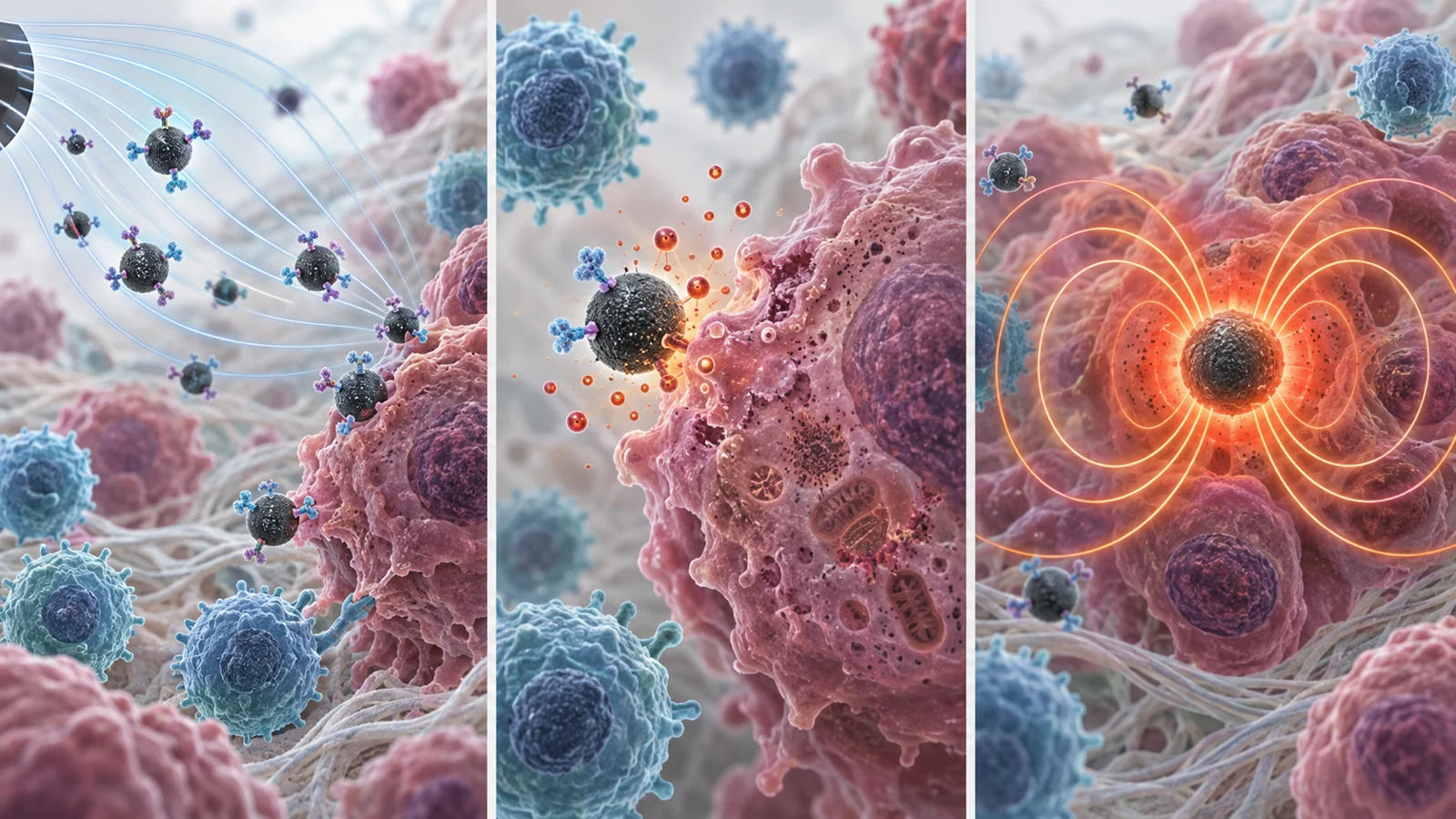
A review published on December 31, 2022, examined whether magnetic nanoparticles could address several of those problems. These are tiny particles that respond to magnetic fields. The review did not describe one finished treatment. It brought together separate experimental uses of magnetic particles as drug carriers, biologically active iron-containing materials, imaging labels and heat-generating agents.
The important question is therefore not simply whether a magnet can make cancer therapy stronger. It is how each magnetic function might change what happens around a tumor, and how far those effects had been demonstrated by the end of 2022.
Delivery turns a magnetic field into a transport tool
Many immune treatments are difficult to concentrate where they are needed. Some have poor solubility, degrade easily or distribute beyond the tumor. A magnetic particle offers a surface that can be modified with biological molecules, while an external field can exert a force on the particle and influence its movement or accumulation. The intended benefit is more controlled transport, not an automatic change in the drug itself.
The review describes a magnetic carrier called IO@FuDex3 that bore several immune-active components: an antibody blocking the PD-L1 checkpoint, plus anti-CD3 and anti-CD28 agents that activate T cells. In a 4T1 tumor model, magnetic manipulation improved the delivery of these cargos to the tumor compared with their soluble forms. The carrier’s magnetophoresis helped enrich the material at the tumor site, where the treatment was associated with renewed activity among tumor-infiltrating lymphocytes and changes in the immunosuppressive local environment.
The model also showed more CD8-positive and CD4-positive T cells among CD3-positive cells, fewer regulatory T cells and longer median survival with the magnetic treatment. Those results belong to that carrier, those attached agents, that tumor model and its experimental magnetic setup. They do not show that every checkpoint inhibitor or T-cell activator will behave the same way when attached to a magnetic particle, nor do they establish a patient benefit.
Iron can change the biology around a particle
Magnetic particles are not necessarily passive containers. Iron oxide materials can participate in chemical reactions that produce reactive oxygen species, chemically reactive molecules capable of damaging cells. In the tumor environment or inside cancer cells, iron-containing particles may promote hydroxyl radicals through a Fenton reaction. The resulting stress can damage tumor cells and may also make their death more visible to the immune system.
The review connects this route with immunogenic cell death. When damaged cells undergo this form of death, they can expose or release signals such as calreticulin, ATP and HMGB1. These damage-associated signals may help stimulate dendritic cells and support a later adaptive T-cell response. Some iron-based particles were also described as inducing ferroptosis, a form of cell death linked in the review to iron-mediated oxidative stress.
One example used ultrasmall iron particles with a metallic iron core and an iron-oxide shell. The shell was described as stable in physiological conditions but vulnerable to the acidic tumor environment, exposing a more reactive core. In the reviewed experiments, this design produced markers consistent with ferroptosis and induced immunogenic cell death at very low concentrations. The point of the example is the relationship between particle structure, local chemistry and immune-alerting damage; it is not evidence that one formulation is broadly safe or effective in people.
Chemical activity can also affect immune cells directly. In a separate line of work, B16F10 tumor cells and iron oxide particles surrounded by a silica structure were administered into the same flank of mice. The review associates the iron oxide formulation with more M1-like macrophage activity and suppression of M2-associated function. Macrophages can have different roles in a tumor, so changing their behavior is a different mechanism from carrying an antibody or generating a heat pulse. The material is interacting with the cellular environment rather than merely transporting a payload.
Heating adds a separate way to activate stress
A magnetic field used to guide a particle is not the same as an alternating magnetic field used to heat one. Under an alternating field, magnetic nanoparticles can convert electromagnetic energy into heat. The review discusses this magnetic hyperthermia as a way to damage tumor cells, release cargo on demand or alter the immune conditions around a tumor.
The immune effects described in the review extend beyond temperature alone. In rat T-9 glioma experiments, magnetic heating was associated with CD8-positive and CD4-positive T cells appearing in tumor tissue, while untreated tissue did not show those cells in the reported comparison. The rats also developed long-lasting, tumor-specific immunity in the reviewed work. One proposed sequence is that heat and related cell stress promote the release of heat-shock proteins and other tumor-associated signals. Antigen-presenting cells can then process those signals, helping activate an adaptive T-cell response.
Later experiments discussed in the review suggested that reactive oxygen species could contribute alongside heat. This means that two particles receiving the same alternating-field treatment could still produce different biological effects if their chemistry and ability to generate reactive oxygen differ. Magnetic hyperthermia therefore represents an externally activated intervention with its own variables, rather than a general synonym for magnetic targeting.
The review also notes that magnetic heating has entered clinical cancer treatment in other contexts. That experience does not automatically validate a new particle formulation carrying immune agents, or prove that a particular heating-and-immunotherapy combination improves outcomes for patients. The biological response depends on the particle, dose, field exposure and immune setting.
MRI can show where immune cells go
Magnetic particles can also make an immune process more observable. In one example, a core-shell iron oxide–zinc oxide particle carried carcinoembryonic antigen to dendritic cells outside the body. The labeled cells could then be followed by magnetic resonance imaging after they were administered to mice.
MRI showed labeled-cell trafficking to draining lymph nodes. Tissue staining located the labeled dendritic cells mainly in a central T-cell region rather than in B-cell follicles. These complementary readouts address where the labeled cells went after administration.
The same work separately assessed immune reaction, tumor growth and survival in mouse models. Those outcomes provide information about biological function, while MRI provides information about cell distribution. Seeing a labeled cell population in a lymph node does not, by itself, show that the cells generated an effective immune attack or controlled a tumor. Imaging can connect treatment to movement and timing, but it cannot substitute for an immune or tumor outcome.
More particles are not automatically better
The different functions described by the review create an engineering tradeoff. Increasing the amount of material might increase the chance of carrying a useful dose, generating chemical stress or producing heat. It might also change how immune cells respond, increase exposure to iron or create unwanted effects in organs.
Dose-dependent findings in mice with otherwise normal immune systems illustrate the problem. After Fe3O4 nanoparticle administration, the lowest tested dose was associated with a higher spleen-cell transformation rate than the control group, while higher doses substantially inhibited splenocyte proliferation. Low and medium doses were associated with higher proportions of CD4-positive and CD8-positive T cells in peripheral blood. The review also describes changes in IL-2, interferon-gamma and IL-10, with increased IL-2 and interferon-gamma linked to greater cytotoxic activity by CD8-positive T cells in that experimental setting.
The pattern is not a simple more-is-better curve. The amount of material changed the measured immune effects, and the relevant dose for one particle would not automatically transfer to another. The review raises concerns about increased plasma iron, oxidative stress and possible cardiac or hepatic toxicity at high exposure. It also identifies unresolved questions about which cells take up the particles, what uptake does to those cells, how long heating should last and when heating should be combined with an immune treatment.
Another unresolved issue is integration. The review discusses delivery, imaging, iron chemistry, macrophage behavior and alternating-field heating across different studies and formulations. The supplied evidence does not show one demonstrated device that performs all of those functions together. Combining them could create useful control, but it could also make dosing, manufacturing, field exposure and safety harder to manage.
What magnetic control could add to cancer treatment
The longer-term possibility is a treatment platform that coordinates several decisions at the tumor site: where an immune agent is delivered, when it is released, how tumor-cell stress exposes immune signals and how researchers observe the movement of labeled immune cells. A single particle system might eventually combine drug delivery with locally activated heating, potentially helping patients whose tumors resist immune attack.
That prospect remained conditional from the review’s December 2022 perspective. The combined functions would need to produce useful immune effects with controllable exposure and acceptable safety in patients. Until those links are demonstrated, magnetic nanoparticles are best understood as a set of experimental engineering tools whose delivery, chemistry, heating and imaging roles must be tested separately and then shown to work together.
Key Sources
- Primary source: Engineering magnetic nano-manipulators for boosting cancer immunotherapy.
DOI or Journal Page · Review or Meta-Analysis · 2022-12-31
Keep exploring