
Research Signal – Source date 2026-06-04
Tumors can make immune treatment harder
Cancer immunotherapy aims to help the body’s defenses recognize and attack cancer. Yet a tumor is more than a cluster of cancer cells. It also contains immune cells and other local conditions that can restrain an attack. This tumor immune microenvironment, or TIME, can help explain why a treatment such as blocking PD-1 or its partner PD-L1 does not benefit every patient. The review describes suppressive cells, including MDSCs and M2-like macrophages, as part of that barrier.
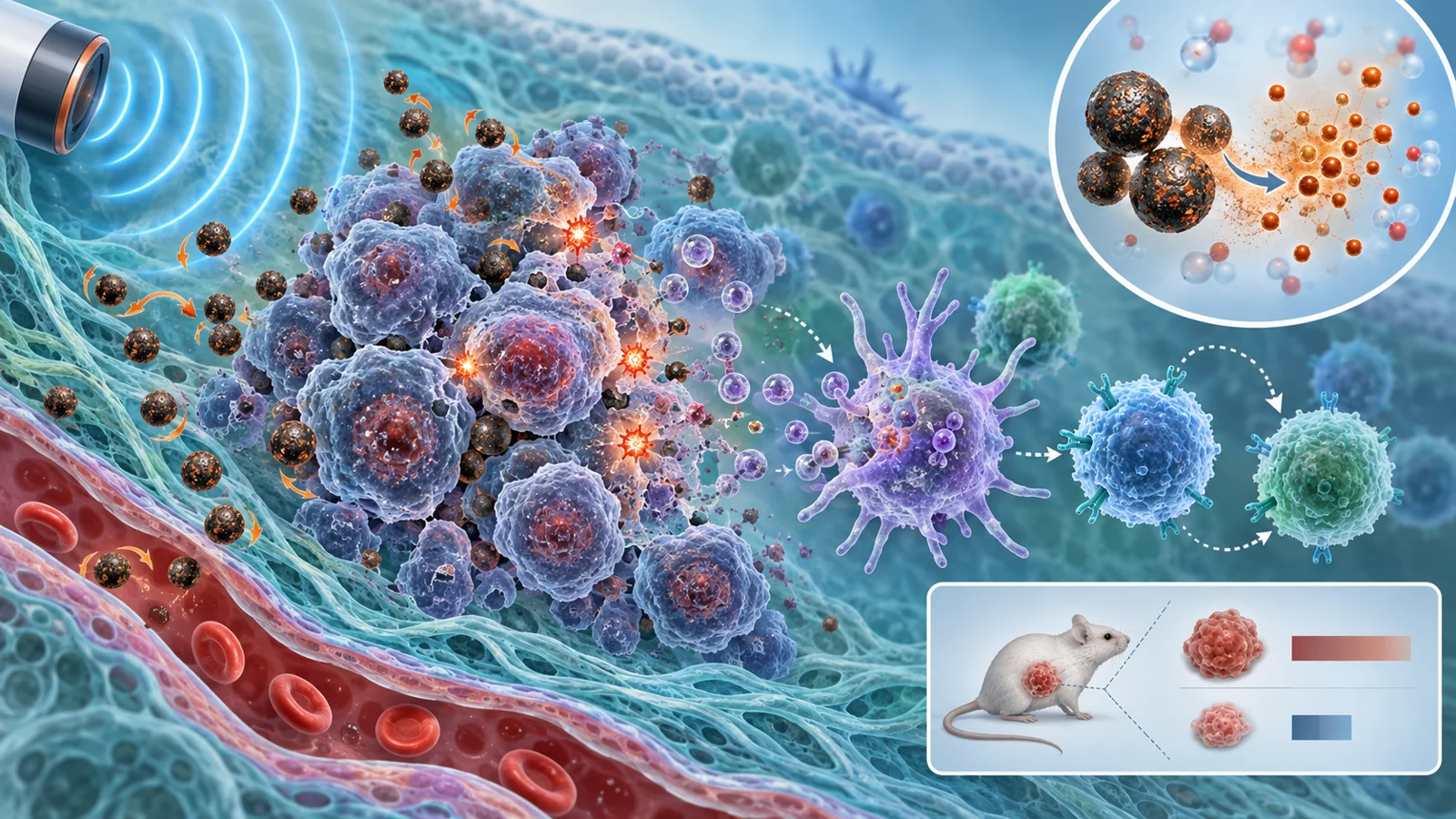
A review published June 4, 2026, asks whether iron-based magnetic nanoparticles might do more than carry a drug or help create an image. These are tiny iron-containing particles whose magnetic response and iron chemistry could produce stress inside a tumor and, in turn, change how nearby immune cells behave. The central idea is a handoff: damage to tumor cells may release cues that immune cells can use to mount a more active response.
The review brings together several proposed routes to that handoff. They are related, but they do different things, and the experimental examples do not all test the same particle or immune outcome.
Three ways to stress a tumor
One route is localized heating. An alternating magnetic field can make iron-based particles dissipate energy as heat. If particles are present in a tumor, this may raise the temperature locally and injure cancer cells through changes to proteins, metabolism, membranes, and cell structures. The intended advantage is that a magnetic input can help direct the heating. Whether that becomes a controlled treatment depends on where the particles actually accumulate and how the heating is delivered.
A second route uses movement rather than heat. A rotating or other low-frequency dynamic magnetic field can make particles rotate, oscillate, shift, or cluster. Those motions may create small mechanical forces that disturb membranes and structures inside cells. A static field serves a different purpose in the review’s account: it can guide particles toward a target. Magnetic guidance and mechanically driven disruption are therefore distinct uses of a field.
Iron chemistry provides a third route. In the mildly acidic tumor environment or after particles break down in lysosomes, iron ions can help convert hydrogen peroxide already present into highly reactive hydroxyl radicals. These radicals can damage cellular material, including membrane lipids. Lipid damage is associated with ferroptosis, a regulated form of cell death linked to iron and oxidative stress. Unlike field-driven heating or movement, this chemical activity does not require an applied magnetic field in the mechanism described by the review.
These inputs could be combined, but the review does not show that every platform activates all three in a single reliable treatment. Their value lies in the possibility of applying different kinds of stress with one adaptable material, provided the design and treatment conditions support the intended action.
From injured cells to immune activity
Tumor injury matters to immunity when it leaves cues that immune cells can detect. The review describes stress-associated release or exposure of danger signals, including ATP, HMGB1, and calreticulin, alongside reactive oxygen species and tumor material. Such cues can help connect local cell damage with immune activation. They are a proposed bridge, not proof that damage automatically produces a lasting antitumor response.
Dendritic cells are one important link. They collect material and present pieces of it to other immune cells. When mature, they display more costimulatory molecules, including CD80 and CD86, and can help prime tumor-reactive T cells. The review’s model is that stress and released tumor material may give dendritic cells both something to collect and signals that support this maturation.
Other changes could shape the local environment too. The review discusses possible relief of hypoxia, or low oxygen, in some catalytic or oxygen-generating systems; a shift in tumor-associated macrophages away from an immunosuppressive M2-like state; and stronger recruitment or activity of cytotoxic T cells. These effects could reinforce one another, but the review presents them as connected pathways across studies, not as a single established sequence that has been demonstrated in every tumor.
Mouse experiments offer distinct clues
In one magnetothermal example, a mitochondria-targeted magnetic nanomedicine was tested in tumor cells and a bilateral mouse tumor model. The review reports that ATP and HSP70, a stress-associated signal, were released, and that the share of macrophages carrying the F4/80 and CD86 markers rose from 8.0% in the control group to 28.8% in the group receiving the magnetic treatment. The finding is consistent with a shift toward a more inflammatory macrophage state in that experiment. A marker change in a mouse model, however, is not itself evidence of patient benefit or durable immune control.
A separate example used starch-coated iron oxide particles in mouse models of metastatic breast cancer. The review describes systemic innate immune activation through TLR/TRIF/IRF3 signaling, improved effector T-cell responses, suppression of primary tumor growth and lung metastases, and longer survival. It also notes that the immune benefit appeared despite minimal tumor retention of the particles. This is a different formulation and experimental result from the magnetothermal macrophage comparison; it suggests that particle effects need not depend only on large amounts accumulating inside a tumor.
A third example, using platelet-membrane-coated iron oxide particles, paired ferroptosis-associated tumor stress with a PD-1-blocking treatment in a mouse breast cancer model. The review reports increased dendritic-cell maturation and improved response to the checkpoint treatment. Taken together, these studies give experimental reasons to investigate immune effects alongside direct tumor injury. They vary in particle composition, magnetic input, model, and readout, so they do not establish that one general mechanism will work across cancers.
Delivery and dose are part of the treatment
A particle’s magnetic properties alone cannot guarantee a useful intervention. The review points to the importance of particle distribution, image-guided planning, delivery technique, heating equipment, thermal dosimetry, and treatment control. For heating in particular, a treatment plan must connect the intended field input to the heat actually produced where particles are located. A tumor’s structure and access to particles can differ from another’s, making uniform delivery an unsafe assumption.
This also complicates patient selection. The review cautions against assuming that nanoparticles will reliably reach tumors through a general permeability effect. Future studies would need to relate material properties and magnetic input to biodistribution, immune changes, and outcomes in clinically relevant models. A useful platform might ultimately be valuable through compatibility with other treatments or a better safety profile, rather than by making every tumor more accessible or producing a dramatic effect in all patients.
Long-term fate and manufacturing matter
After systemic delivery, iron-based magnetic particles are often taken up by the mononuclear phagocyte system, with accumulation in the liver, spleen, bone marrow, and other tissues rich in phagocytic cells. That distribution makes long-term clearance and iron handling central questions. Repeated dosing, organ retention, iron overload, and delayed effects need attention as these materials move toward broader use.
Manufacturing adds another challenge. A particle coated with a membrane, fitted with targeting ligands, or carrying multiple components can be sensitive to changes in materials and processing. Those changes may affect its physical properties, distribution, immune activity, and safety. Consistent batches, stable storage, clear quality specifications, and meaningful long-term safety studies are part of whether a complex design can become a dependable product.
Iron-based particles already have limited clinical uses, including imaging, iron replacement, lymph-node mapping, and magnetic hyperthermia. These uses show that some iron particle products and magnetic procedures can reach clinical settings. They do not establish that multifunctional particles can reliably remodel tumor immunity. The review characterizes the evidence for that broader immune use as predominantly preclinical.
What magnetic particles could add to cancer immunotherapy
If researchers can make delivery and magnetic dosing reproducible, these particles could offer a way to localize physical or chemical stress and use the resulting immune cues to help an existing treatment work in tumors whose local environment suppresses immune activity. Imaging may eventually help show where particles have accumulated and inform adjustments to a localized intervention. The practical payoff would depend on durable immune effects, reliable treatment control, and acceptable long-term safety—not simply on adding more functions to a particle.
Key Sources
- Primary source: Iron-based magnetic nanoplatforms for immune microenvironment remodeling and cancer immunotherapy: progress and prospects.
DOI or Journal Page · Review or Meta-Analysis · 2026-06-04
Keep exploring