
Research Signal – Source date 2023-07-26
A gram-scale bed of a porous magnesium material captured about 90% of the carbon dioxide in a humid, simulated coal-flue-gas stream. In a separate test, the material released its captured CO₂ when heated to 85°C. Both results came from laboratory experiments, but together they show why the shape of a pore can matter: a roomier structure let the researchers use bulky CO₂-binding groups without splitting gas uptake into two stages.
The material, called ee-2–Mg₂(olz), belongs to a family of solids designed to selectively take up CO₂. It was tested with a gas mixture containing 15% CO₂ in nitrogen and about 2.3% water vapor, at 40°C and atmospheric pressure. The result offers a promising materials-design example, while leaving open how the solid would perform in an operating capture plant.
A roomier framework avoided a second uptake step
These porous solids have channels lined with amine molecules, which can bind CO₂. Earlier materials in this class were made by attaching diamines—molecules with two nitrogen-containing ends—to a magnesium framework called Mg₂(dobpdc). Some versions with bulky amines stood up well to repeated heating and cooling. But as CO₂ was captured, the resulting chains of bound molecules could crowd one another. The material then took up CO₂ in two distinct steps, a pattern that can make it harder to reach full capacity without more demanding regeneration.
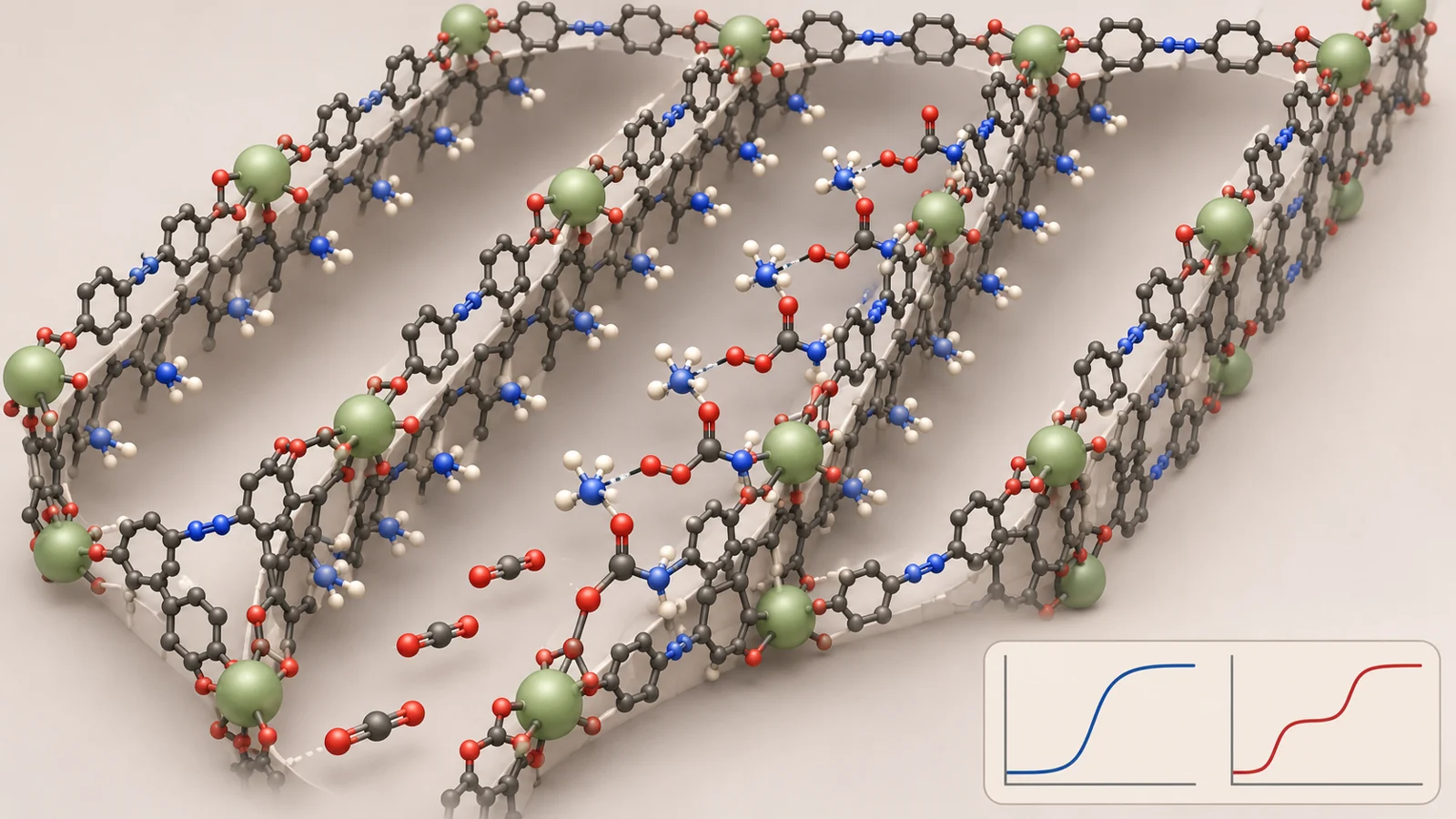
The researchers tested a different magnesium framework, Mg₂(olz), built with an olsalazine-based linker. This linker makes the pores somewhat roomier than those in Mg₂(dobpdc), while avoiding a costly palladium catalyst used to make some other alternative linkers. The added space appears to reduce interference between neighboring CO₂-bound chains.
Across the diamines they tested, the Mg₂(olz) materials showed a single sharp uptake step, including versions with bulky groups that had shown two steps in related Mg₂(dobpdc) materials. A single step means most of the uptake occurs over a narrower range of pressure or temperature. It can make more of a material’s capacity available under a chosen operating condition and allow full loading with a smaller temperature swing than in the two-step relatives. The pore design mattered because it accommodated the amines without the same crowding between chains.
The gas formed linked chains inside the pores
The sharp step reflects a cooperative process: when one CO₂ molecule binds, it helps make further binding along the channel favorable. CO₂ inserts into bonds between magnesium and the pore-bound amines, producing linked ammonium and carbamate groups. In plain terms, the gas and amines form a repeating chain inside the pore rather than attaching as isolated molecules.
Several measurements supported this account for ee-2–Mg₂(olz). Infrared spectra showed signals associated with carbamate, and carbon-13 nuclear magnetic resonance detected chemisorbed CO₂ in environments consistent with carbamate formation. The researchers also observed signals assigned to both carbamate and ammonium groups. Calculations corrected for weak intermolecular forces supported the proposed chain structure. Together, these results connect the sharp uptake to a specific chemical arrangement; they do not, by themselves, show how the material would behave at plant scale.
Amine size shifted the threshold and softened the step
The pressure at which a material begins its sharp uptake and the sharpness of that uptake are different properties. The researchers could tune the step pressure of the Mg₂(olz) materials at 40°C across roughly three orders of magnitude, from 0.2 to 200 millibars. That range matters because different gas streams contain different CO₂ concentrations, and therefore expose a capture material to different CO₂ pressures.
Amine structure helped determine where the step occurred, but bulk alone did not predict it. A more basic pore-bound amine can favor CO₂ binding; steric bulk can work against it by making the binding environment more crowded. The results included a bulky amine variant whose uptake began at lower pressure than a less bulky comparison, consistent with basicity partly offsetting steric effects. In another comparison, substantial bulk appeared to counteract the advantage of a more basic amine.
Bulk also affected how abrupt the step was. Within comparable families of amines, increasing steric bulk generally reduced the sharpness of uptake, indicating less cooperativity. So the design problem was not simply to make the amine as large as possible: its size and basicity both shaped the threshold, while its geometry also influenced how collectively the molecules bound CO₂.
Humidity changed what the measurements counted
The researchers assessed the lead material in more than one way. In a thermogravimetric experiment, which measures changes in sample mass, ee-2–Mg₂(olz) still showed stepped uptake under humid gas containing 15% CO₂. But the mass gain in such a test can include water as well as CO₂. In a separate humid-nitrogen measurement, the material took up water even though it adsorbed negligible nitrogen under dry conditions. This is why total mass gain in a humid-gas test should not automatically be read as CO₂ captured.
The fixed-bed breakthrough experiment provided a more direct separation test. The researchers packed binder-free pellets into a gram-scale bed, presaturated the material with water, then passed humid gas containing 15% CO₂ in nitrogen through it at 40°C. Nitrogen emerged from the bed before most of the CO₂ did, showing that the material held back CO₂ as the mixture flowed through. From the outlet measurements, the team calculated a total CO₂ capacity of 3.9 ± 0.3 millimoles per gram and a 90% capture rate corresponding to 3.6 ± 0.3 millimoles per gram. They regenerated the bed by heating it to 85°C under humid helium.
This was a controlled test using simulated flue gas, not actual coal-plant exhaust. The result shows that water did not prevent CO₂ separation in this experiment; it does not establish performance amid the full range of conditions and contaminants in an operating plant.
The heat advantage is an estimate, not a plant measurement
In separate adsorption and desorption measurements, ee-2–Mg₂(olz) showed a working capacity of 3.53 millimoles per gram under the tested conditions: adsorption at 40°C and 150 millibars of CO₂, followed by desorption at 85°C under one bar of CO₂. The researchers estimated regeneration energy at 2.15 megajoules per kilogram of CO₂ from laboratory measurements of adsorption enthalpy and heat capacity. That estimate was lower than comparison values reported for monoethanolamine and another magnesium framework.
The figure is not measured heat consumption for a complete capture process. A working process would involve more than heating the adsorbent, and the study’s calculation does not establish an energy bill for a full installation. What the experiment supports is narrower: this material released CO₂ under the reported conditions at a comparatively low temperature, and its measured properties yielded a favorable estimate for regeneration energy.
The team also tested durability separately. In thermogravimetric cycling, ee-2–Mg₂(olz) underwent 1,000 short adsorption and desorption cycles in humid gas with CO₂ and oxygen. After an initial equilibration period, its measured CO₂-and-water mass uptake stayed relatively steady through the final 300 cycles. The material also retained its crystalline structure and 99% of its diamine loading. This is meaningful evidence of stability under repeated lab cycling, though it is not 1,000 repetitions of the gram-scale fixed-bed separation test.
Where this research could lead
A porous solid that separates CO₂ from humid gas and releases it at a comparatively low test temperature could, if its performance carries through to practical equipment, make capture systems easier to regenerate and reduce the demand for higher-temperature heat. That could help make CO₂ capture more practical at facilities where heat supply and the energy required to recover captured gas shape the cost of operation. The path from these experiments to that capability still depends on showing reliable separation and regeneration in working equipment over realistic operating conditions; the laboratory breakthrough, energy estimate, and cycling tests each answer a different part of that challenge.
Key Sources
- Primary source: Cooperative Carbon Dioxide Capture in Diamine-Appended Magnesium-Olsalazine Frameworks.
DOI or Journal Page · Peer-Reviewed Paper · 2023-07-26
Keep exploring