
Research Signal – Source date 2024-01-01
Repairing a large or complicated bone defect asks several things of a material at once. It needs suitable mechanical performance, compatibility with living tissue and the ability to support new bone formation. Strength alone cannot meet that combination of demands. A material’s physical properties and its interaction with the body both matter to its usefulness in repair.
A January 2024 review of magnesium-based biomaterials—materials designed to work in the body—examines that challenge. The authors point to magnesium’s mechanical strength and biological safety as reasons for research interest, alongside work on tissue compatibility and bone-forming activity. These are qualities researchers hope to bring together in a usable material; they do not, by themselves, establish that a particular bone defect will heal.
When the material breaks down too quickly
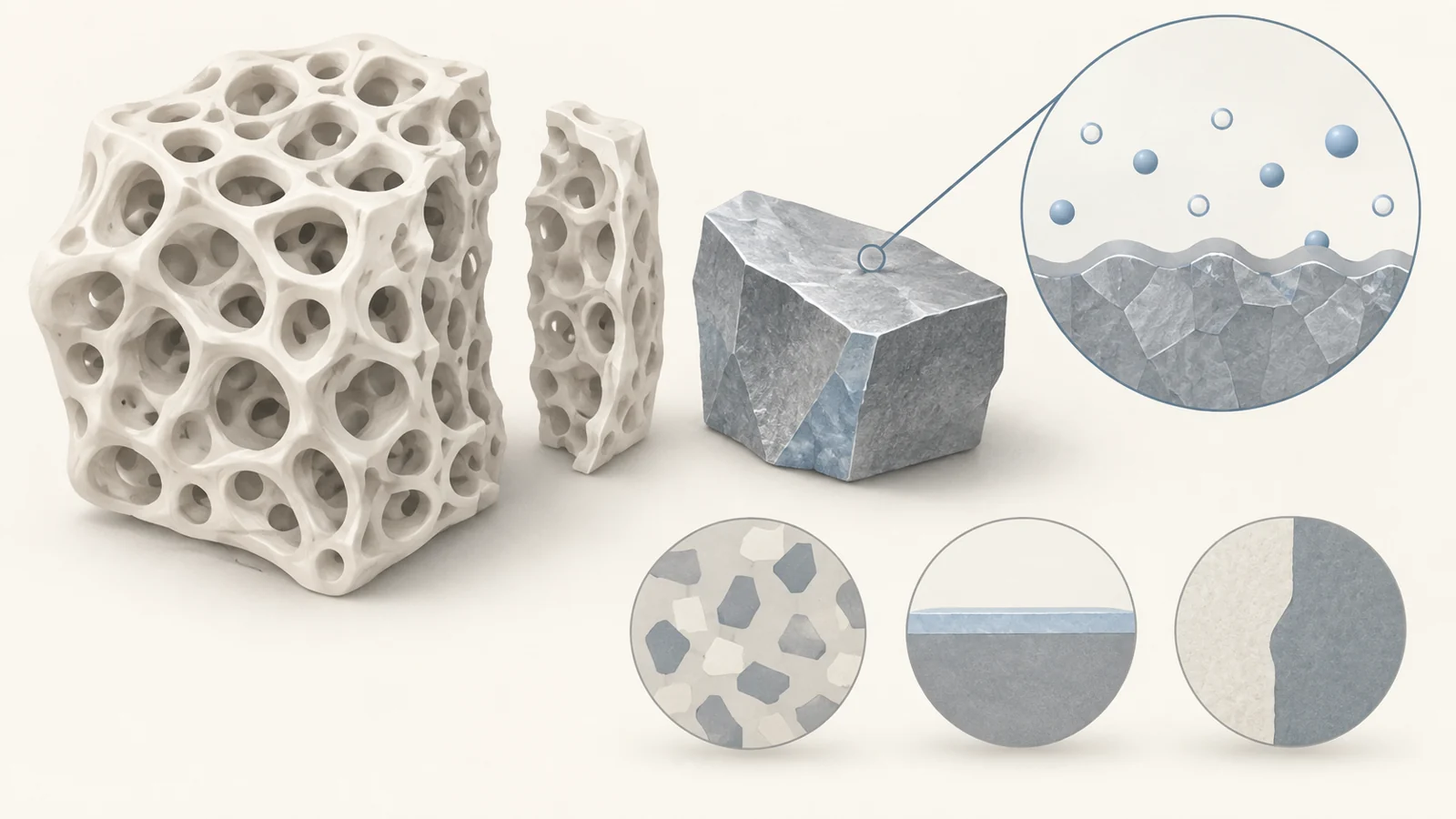
The review identifies rapid degradation as a main limitation of magnesium-based materials. As the material breaks down, it can produce excessive magnesium ions and hydrogen. Magnesium ions are electrically charged magnesium particles. The authors describe how excessive release can affect healing, making the material’s behavior after implantation central to its potential use.
This adds a time-dependent requirement to material design. A candidate must have appropriate properties while it is being used in the body, where it is also undergoing change. The review therefore treats a suitable degradation rate as part of the engineering problem alongside mechanical performance and support for bone formation.
Changing the composition, surface or combination
Researchers have explored three broad approaches to improving these materials and controlling their degradation after implantation. They act on different parts of the design.
Alloying changes the metal’s composition. Magnesium is combined with other elements, so the intervention is in the material itself. Coatings modify its surface, placing a layer at the boundary between the underlying material and its surroundings. Composites combine materials, making magnesium part of a material combination whose properties researchers can investigate.
These distinctions help explain why “magnesium-based” covers more than one kind of candidate. Changing what a metal contains, changing its outer surface and combining it with another material are different engineering choices. The review brings these approaches together around the shared need to achieve appropriate behavior after implantation, while retaining the other qualities bone repair requires.
The scientific account here is based on the review’s abstract. It supports an explanation of the design problem and the approaches being investigated, but cannot establish which formulation performs best, quantify patient benefit or determine comparative clinical safety. Assessing those questions would require verified details of the underlying studies and their results. The abstract also identifies bone-forming mechanisms as a topic of the review without providing enough detail to explain those mechanisms here.
What this could change
If material modifications can preserve mechanical performance and bone-forming activity while achieving suitable degradation and tissue compatibility, clinicians could gain additional material options for repairing large or complicated bone defects. The potential patient benefit would come from having more suitable materials available for difficult repairs. From the review’s January 2024 perspective, bringing that combination of properties into clinical use is the opportunity these engineering approaches could help open.
Key Sources
- Primary source: The development of magnesium-based biomaterials in bone tissue engineering: A review.
DOI or Journal Page · Review or Meta-Analysis · 2024-01-01
Keep exploring