
Research Signal – Source date 2022-02-01
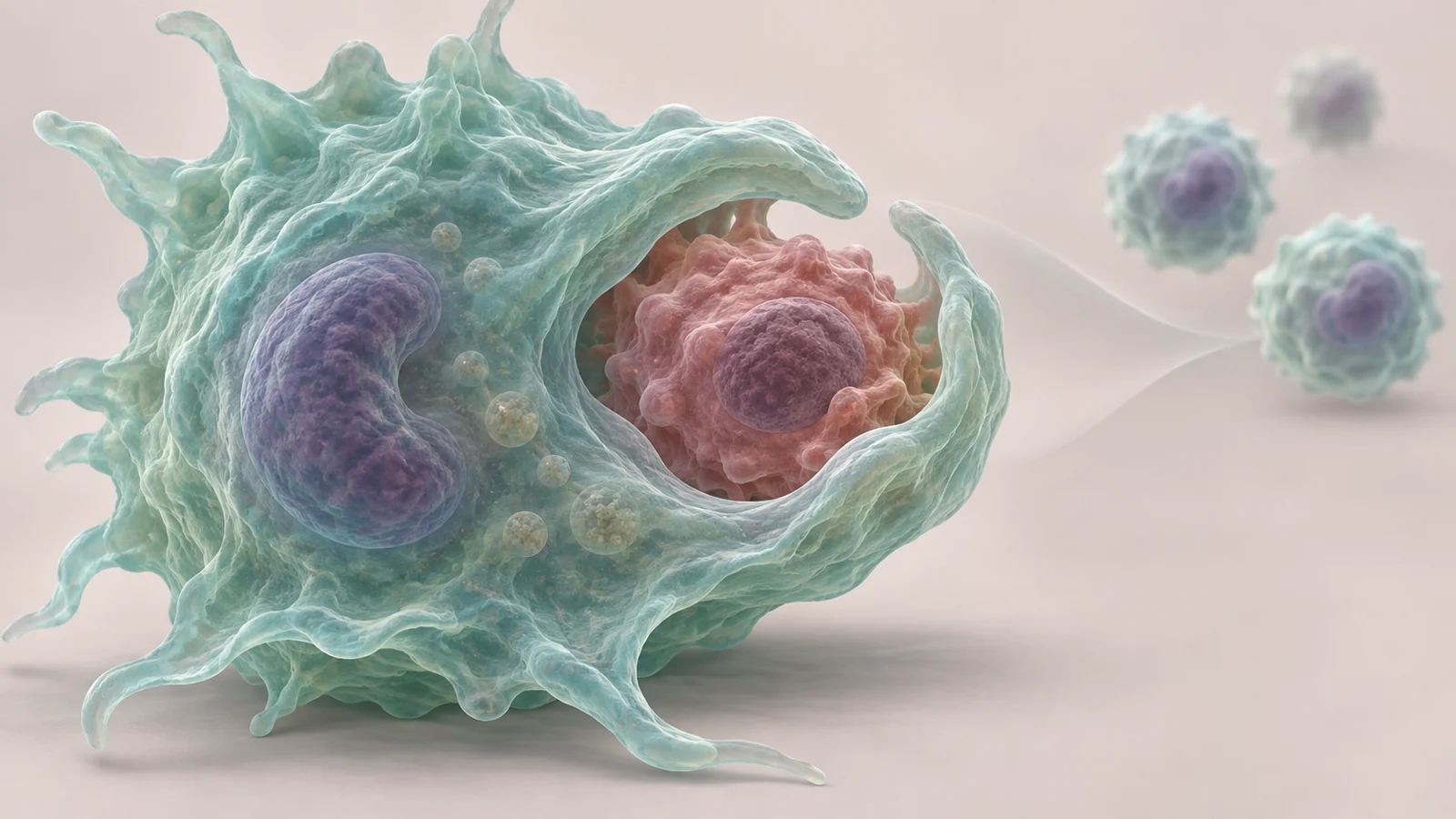
A macrophage is an immune cell that can engulf other cells. When the target is a tumor cell, researchers are interested in more than the act of engulfment itself: could the event also help the immune system recognize the cancer more broadly?
A 2022 review considers that possibility alongside three ways researchers are trying to encourage macrophages to consume tumor cells. The idea is notable because, as the review describes the field, much of cancer immunotherapy has focused on adaptive immunity—the part of the immune system that can learn to recognize particular threats. The authors connect macrophage phagocytosis, or cellular engulfment, with a possible next step called cross-priming, which could help activate adaptive immune responses.
Engulfment may connect two parts of immunity
Phagocytosis is the process by which a cell takes another cell or material inside it. In this research, the proposed target is a tumor cell. Cross-priming describes a possible route by which information from that engulfed cell could help activate adaptive immune cells. If the link works as hoped, macrophages could contribute both direct tumor-cell uptake and a wider immune response.
The review presents this as a reason to investigate macrophages in cancer therapy. Its abstract does not establish that engulfment leads to cross-priming in patients or improves treatment outcomes. The proposed connection remains unproven as a treatment strategy.
Three ways to encourage macrophage activity
The approaches differ in what they try to change. Phagocytosis checkpoint blockade aims to block signals that restrain engulfment, removing a brake on macrophages. The abstract does not name specific checkpoint targets, so the approach can be described here only at that general level.
Nanoparticles are another proposed way to increase macrophage engulfment of tumor cells. The review names them as an approach, but its abstract does not specify particle designs or how particular interventions work.
CAR-macrophage therapy takes a more direct engineering approach. Researchers engineer macrophages to carry a chimeric antigen receptor, or CAR, intended to guide immune-cell activity toward a target. The review frames these cells as a potential bridge between innate immunity, which includes macrophages, and adaptive immunity. The abstract does not provide enough protocol detail to describe how a particular CAR-macrophage product is built or performs.
These are distinct routes: blocking a restraint, using nanoparticles, and engineering the immune cell itself. The review discusses all three as ways to harness or amplify macrophage phagocytosis. Its abstract gives no basis for ranking their clinical performance.
Encouraging research, with outcomes still to establish
The authors point to positive preclinical evidence and early clinical data as reasons for interest in this research direction. Those phrases signal that investigation has moved beyond a purely theoretical proposal, but they do not tell a reader which approach produced which result, how large any effect was, or whether one strategy outperformed another.
This 2022 review synthesizes approaches rather than reporting a new trial. Its abstract gives no trial-level outcomes, numerical efficacy or safety data, or proof that any strategy improves patient outcomes. The work supports further investigation of macrophage engulfment; patient benefit still requires clinical proof.
Where this research could lead
A future cancer clinic might have a dependable treatment route that recruits tumor-engulfing macrophages and helps mobilize wider immune defenses, extending treatment beyond the field’s predominant focus on adaptive immunity. That possibility follows from the review’s proposed link between engulfment and cross-priming. It depends on that connection proving useful, and on treatments becoming safe and effective in people; neither is established by the abstract.
A nearer milestone would be a human study that measures whether macrophages engulf tumor cells and whether adaptive immune activation follows, while also assessing safety. Evidence of both steps would help test the proposed bridge. Only further development and clinical proof could show whether it can support a reliable treatment for patients.
Key Sources
- Primary source: Targeting macrophage-mediated tumor cell phagocytosis: An overview of phagocytosis checkpoints blockade, nanomedicine intervention, and engineered CAR-macrophage therapy.
DOI or Journal Page · Review or Meta-Analysis · 2022-02-01
Keep exploring