
Research Signal – Source date 2026-06-30
Pull on a structure and imagine it getting wider as it stretches. That sideways expansion, called a negative Poisson’s ratio, is one of the unusual responses possible in mechanical metamaterials—materials whose internal geometry controls how they deform. Their arrangement of struts, cells, or curved surfaces gives engineers another way to tune behavior alongside the choice of what the structure is made from.
That possibility invites a design question. Could an engineer specify a desired response and ask software to find an internal architecture that delivers it?
A review published June 30, 2026, examines how machine learning is being used to approach that question. It brings together studies of property prediction, inverse design, and generative models, connecting them to the practical work of representing a shape, calculating its response, and eventually making it. Its useful contribution is this connected account of the design process. The studies it compares address different structures and tasks, so their results need to be understood within those settings.
Two directions through the design problem
The starting question can run in either direction. Given a geometry, what will it do under load? Or, given a desired response, which geometry might produce it?
The first is forward prediction. Researchers train a model on examples linking structures to their calculated or measured mechanical properties. Once trained, the model can estimate the response of another geometry within the kind of problem it has learned. It acts as a surrogate: a faster approximation to a more expensive calculation. The review describes applications ranging from predicting elastic properties to estimating more complicated, nonlinear behavior, where the response changes as deformation progresses.
Inverse design starts at the other end. An engineer specifies a target, such as an energy-absorbing response, and a computational method searches for structures that might achieve it. The review describes diffusion models used for this purpose, as well as generative approaches aimed at a chosen Poisson’s ratio that changes with strain. Here the output is a proposed geometry, rather than a property estimate for a geometry already supplied.
These tasks can also be combined. A fast forward model can score candidates inside an optimization process. A genetic algorithm, for example, varies a population of designs and uses their scores to guide which candidates are carried forward and modified. This lets the search explore many possibilities without running the most expensive simulation for every preliminary choice. The learned predictor becomes part of the search machinery.
A shape has to become data
Before a model can learn anything about an architecture, researchers must decide how to describe it digitally. That choice influences both what the model can recognize and what kinds of designs it can explore.
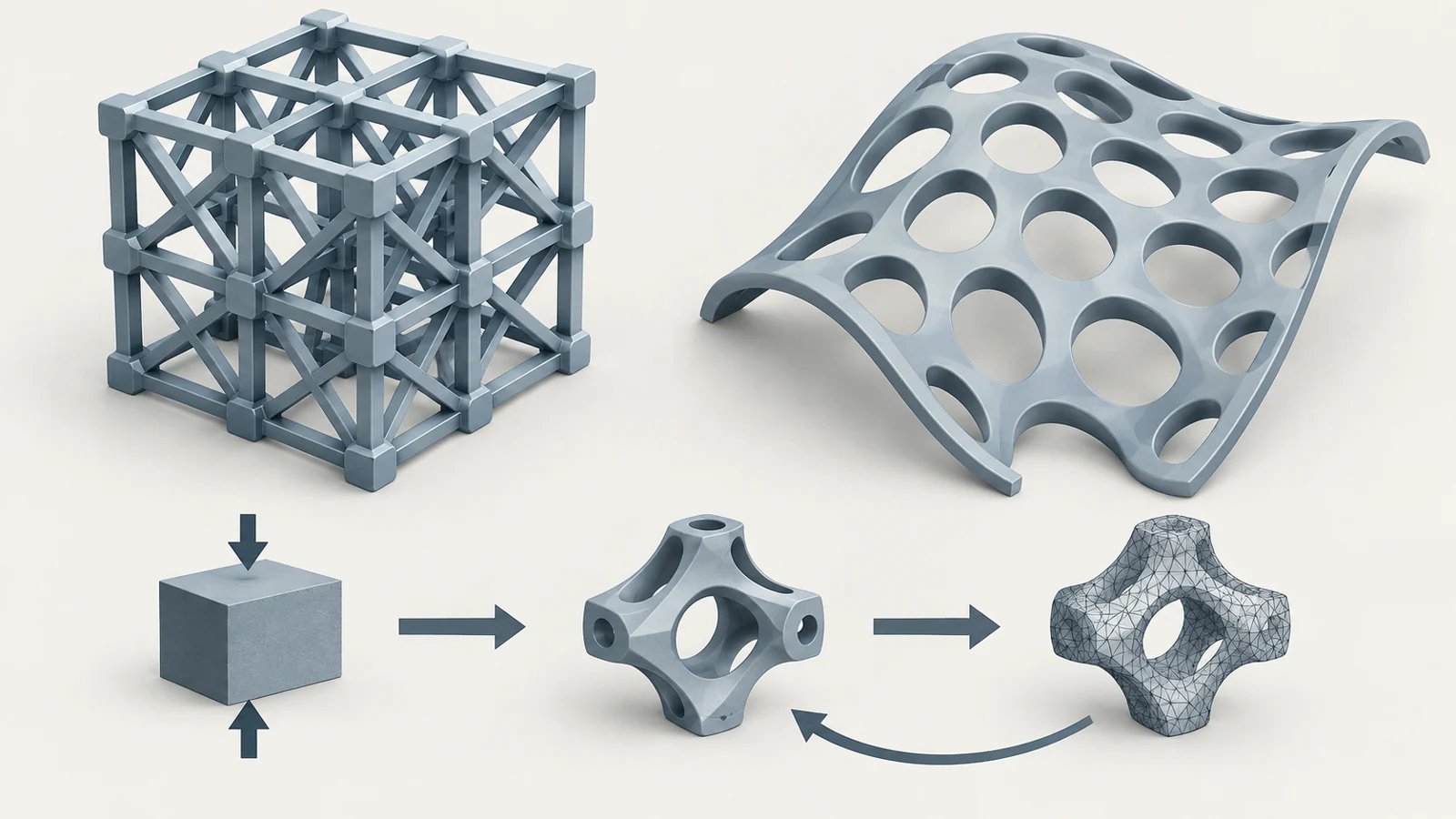
An open lattice made of struts has an intuitive representation. Its joints become nodes, and its struts become connections between them. A graph neural network can work directly with that network of connections, learning relationships between the lattice’s topology—how its parts are joined—and its mechanical response. This is a natural fit for a truss-like structure, but it becomes harder to use for complex, continuous surfaces.
Another option divides a three-dimensional shape into small grid cells called voxels, the spatial equivalent of pixels. A convolutional neural network can process this arrangement and learn spatial patterns. The grid accommodates a different range of shapes, but its resolution matters. Curved boundaries can acquire stair-step edges, and refining the grid to describe those curves more smoothly increases the amount of data to handle.
The review also considers meshes, which describe geometry using connected elements and are used in finite element simulations. They can preserve detailed shapes, with substantial demands on memory and computation. Smooth, repeating curved architectures, including triply periodic minimal surfaces, therefore pose different representation choices from a lattice that can be described through joints and struts.
This makes representation an engineering decision with consequences throughout the workflow. A convenient format may restrict geometric variety; a detailed one may make training and simulation more demanding. Model choice follows partly from that decision. Comparing neural networks without considering how their structures were encoded would miss a major reason for their different strengths.
Following one candidate through the calculation
Consider an illustrative search for an architecture with a requested energy-absorbing response, a target discussed in the review. The engineer supplies the design goal, and an inverse-design method proposes a geometry. A learned forward model may help screen that proposal or guide the search toward it.
The next substantial check is a finite element analysis. This divides the structure into small computational elements and calculates how they respond together under specified forces and constraints. It produces a more detailed numerical account of deformation and mechanical response than the fast learned estimate used during exploration.
Suppose that calculation shows the proposed shape misses the target. In the iterative workflow described by the review, the geometry and its newly calculated properties can be added to the training dataset. The model then has another example connecting a design to its simulated behavior. Further training or optimization can use that information to refine the search. A disappointing candidate still supplies useful data about the design space.
This loop puts expensive calculations where they can inform both the current candidate and subsequent proposals. Agreement with the simulation establishes performance under the assumptions of that numerical model. Physical fabrication and testing address a further question: how the manufactured structure behaves, including features that its idealized digital description may not capture. Simulation agreement alone does not establish the durability of a finished component.
A printed scaffold provides a concrete example
One study described in the review takes the sequence into physical fabrication. Researchers combined neural networks with a genetic algorithm to design a lattice scaffold tailored to a particular defect in a sheep mandible. The scaffold was functionally graded, meaning its architecture varied across the structure to provide different local characteristics.
The resulting design was 3D printed and assembled with a cadaveric sheep mandible for mechanical validation. That example connects a specific design requirement, computational search, fabrication, and a physical mechanical assessment. Its relevance here is that development sequence. Testing with a cadaveric mandible does not establish healing, outcomes in living animals, or clinical effectiveness.
Where the shortcuts become costly
The speed of a trained predictor can obscure the effort needed to create it. Training examples must come from somewhere, often demanding finite element simulations or physical experiments. The review identifies the cost and quality of these datasets as a central constraint. A model needs enough relevant examples to learn the relationships the engineer wants to use, including complex responses and differences between loading directions.
Training itself also consumes computing resources, particularly for more elaborate generative models. A fast answer after training therefore describes one stage of development. It does not imply that producing the dataset, training the model, fabricating candidates, and testing them all become faster by the same factor. The value of a surrogate depends partly on how much useful design work it can support after that initial investment.
There is also a boundary around what the model has learned. Strong predictions within one lattice family do not establish reliable performance on unfamiliar architectures. The review notes that many models are trained for narrow classes of structures or particular tasks, which can limit generalization. Its comparison tables collect models, datasets, tasks, and reported outcomes across studies; those varied settings do not establish a single best model for every mechanical design problem.
Manufacturing introduces another constraint. An intricate geometry that looks favorable in a simulation may exceed what an additive manufacturing process can reliably produce. The review argues for incorporating manufacturing constraints into design itself. Otherwise, the search can spend its effort optimizing shapes whose defining details cannot be faithfully made. This is where the geometry, the fabrication process, and the intended loading conditions have to be considered together.
What this could change
A longer-term direction in the review is to design architectures for several functions at once. Engineers could seek a cellular component that meets a stiffness target while also providing a chosen acoustic or thermal response. The benefit would be the ability to coordinate several requirements through one internal architecture, giving designers more control over how a component interacts with forces, sound, or heat.
Reaching that capability requires moving beyond a successful isolated cell. Neighboring cells must remain connected, and their combined behavior must work at the scale of the whole component. Machine-learning surrogates could help explore these larger arrangements, linking local geometry to structural design while optimization methods negotiate competing performance goals.
If those methods can accommodate manufacturing constraints and connect behavior across scales, engineers could design the cellular interior and overall shape of a component together. That would extend the design question from choosing how one small structure stretches to deciding how a complete part performs several jobs through its architecture.
Key Sources
- Primary source: A Review of Machine Learning Applications in Mechanical Metamaterial Design.
DOI or Journal Page · Review or Meta-Analysis · 2026-06-30
Keep exploring