
Research Signal – Source date 2026-01-12
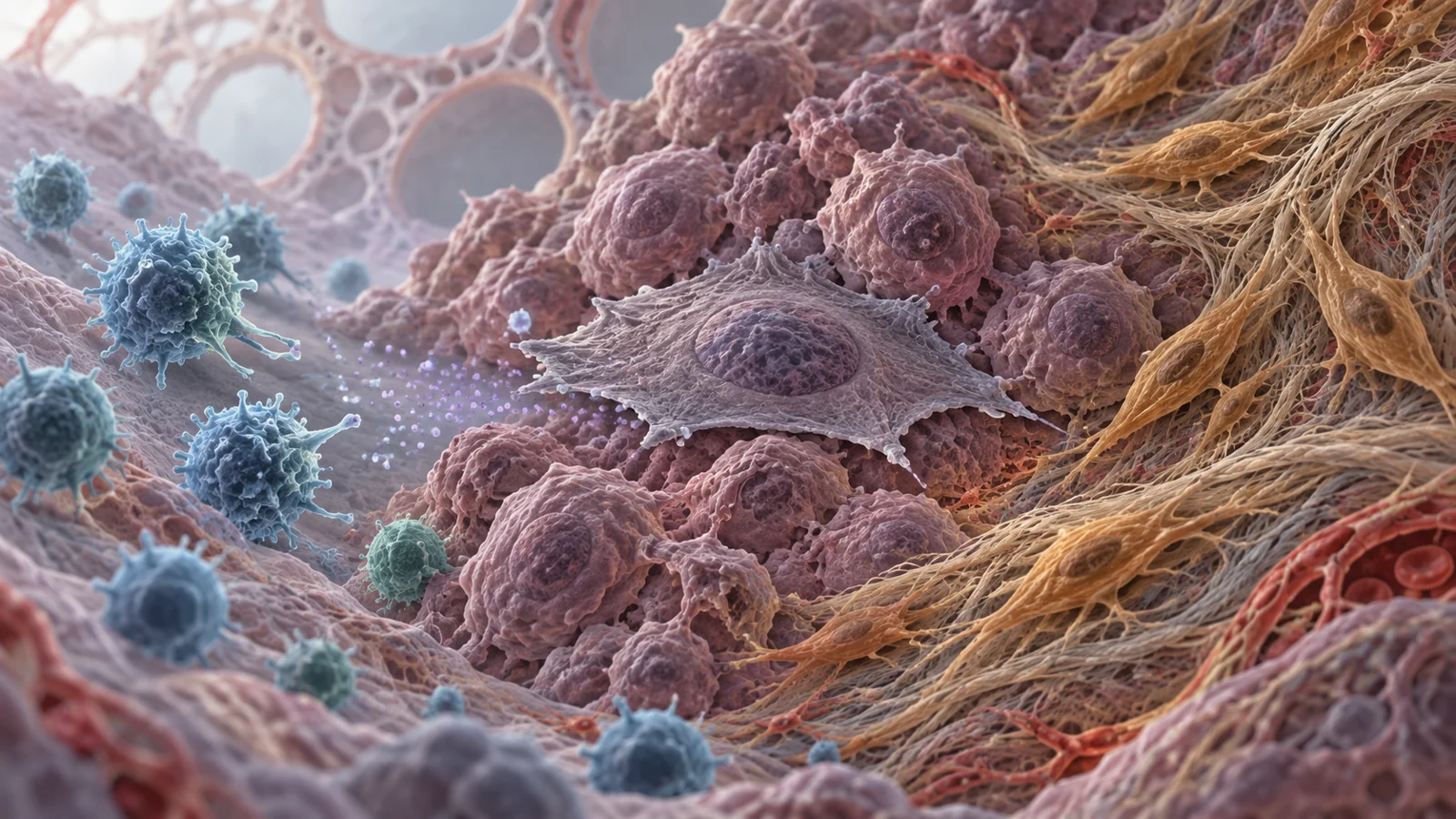
A cancer cell that stops dividing may sound like a problem solved. Cellular senescence is a lasting halt in cell division, and it can restrain tumor growth. Yet a senescent cell remains biologically active: it can release signals that change how nearby immune and support cells behave. If those signals persist, the arrested cell may still help shape conditions around a tumor.
A review published on January 12, 2026, brings together cell and animal experiments, patient-derived datasets, and early clinical studies on senescence in the lung cancer immune microenvironment. It describes a possible therapeutic sequence: use treatment to stop cancer cells from dividing, then selectively clear some senescent cells or alter their signals. The underlying biology gives researchers reasons to investigate that approach. It does not yet show that the sequence improves survival or prevents recurrence in people with lung cancer.
A cell can stop growing and keep sending signals
Chemotherapy and radiation can damage DNA and trigger a cell-cycle arrest. In lung cancer models, radiation-induced senescence has been associated with inflammatory molecules such as interleukin-1 alpha and interleukin-6, alongside changes in signaling within the cell. The mixture of substances senescent cells release is called the senescence-associated secretory phenotype, or SASP. It can include signaling proteins that recruit immune cells, alter neighboring tissue, or affect tumor behavior.
The SASP is not a fixed recipe. Its composition can vary with the cell that produces it, the treatment that induced senescence, and how long the state persists. A short-lived inflammatory response could help draw immune attention to abnormal cells. In lung cancer models, signals including CCL2 and interleukin-1 alpha have been linked to recruitment of macrophages, natural killer cells, and other immune responders.
Recruitment alone does not guarantee clearance. When senescent cells remain and signaling becomes prolonged, the surrounding response may change. The review describes lung cancer evidence connecting persistent SASP activity with suppressive myeloid cells, including myeloid-derived suppressor cells, and with changes that can weaken immune surveillance. In models, treatment-induced senescence has also been linked to increased PD-L1 on tumor cells, a feature associated with immune evasion.
This shifting environment helps explain why a growth arrest can have different consequences over time. The arrested cell may no longer multiply, but its continuing signals can affect neighboring cancer cells and the immune system. The reviewed studies suggest mechanisms for that possibility; they do not establish how often, or at what point, it drives treatment resistance in patients.
The cell’s identity changes the target
“Senescent cells” are not one uniform population. Tumor cells, macrophages, T cells, and fibroblasts can all show senescence-related features, but they occupy different roles in the tumor environment. A strategy aimed at removing every cell with such features could therefore have effects unlike one directed at a particular cell type.
A concrete example comes from a KRAS-driven mouse model of lung cancer. Targeted depletion of senescent macrophages reduced tumor burden and improved overall survival in those mice. The review also describes senescence-like macrophages in human lung pre-invasive lesions, while noting they were largely absent in established adenocarcinomas. The mouse result is evidence about that model; it does not show that clearing macrophages would benefit people with lung cancer.
Other cell types raise different concerns. Senescent fibroblasts can release factors associated in lung cancer models with tumor-cell growth and radioresistance. T cells with senescence-related or dysfunctional features may have reduced ability to attack tumors. These observations make cell identity and location central to the therapeutic question: removing a harmful source of signals could differ from removing an immune cell that might otherwise contribute to tumor control.
Clearing cells and quieting their signals are different strategies
Senolytics are intended to eliminate senescent cells. Senomorphics, sometimes called senostatics, aim to change their behavior or reduce harmful secretions while leaving the cells in place. The distinction matters because a cell’s growth arrest may still be useful even when some of its signals are not.
In lung cancer models, researchers have explored both approaches. A galacto-conjugated form of navitoclax, called Nav-Gal, was reported to target senescent cells after cisplatin treatment in experimental systems. Separately, blocking p38-MAPK signaling reduced interleukin-6-dominant secretions in senescent fibroblast models. These examples illustrate different aims: removing a cell versus altering a pathway involved in its secretory effects. They remain evidence from preclinical work, not established treatment choices for patients.
The proposed “induce, then edit or eliminate” sequence builds on these ideas. Treatment might first produce a growth arrest in tumor cells; a later intervention might then clear selected senescent cells or temper their signals. The order is a testable proposal, but the right timing, target cell population, and balance between clearance and reprogramming have not been established for clinical use.
Early clinical evidence speaks to feasibility and dose
The review highlights a phase 1b study combining osimertinib with navitoclax in people with EGFR-mutant non-small cell lung cancer. The study established a recommended phase 2 dose and reported manageable hematologic toxicity. This is useful early clinical information: it addresses whether the combination could be given at a dose suitable for further study and what blood-related toxicity was observed.
Those findings do not answer whether adding a senolytic improves long-term outcomes. Establishing a dose and describing tolerability are different questions from showing that the strategy delays recurrence, extends survival, or benefits a defined group of patients. The proposed sequence still requires clinical testing for those outcomes.
Choosing a treatment would require more than a senescence score
The review discusses gene-expression scoring models associated with prognosis and immune features in lung cancer datasets. Some higher-score groups were associated with more immunosuppressive cells and greater expression of immune checkpoint molecules. Such patterns can help researchers investigate how senescence-related biology aligns with tumor behavior and treatment response.
An association in a dataset is not yet a validated clinical guide. The review says these signatures need validation across independent patient groups and measurement platforms before they can direct care. A useful treatment decision would also need to identify which cells carry the relevant senescence features, determine when intervention is appropriate, and limit effects on normal tissues. The supplied evidence does not establish a clinically validated marker, treatment window, or delivery method for doing that.
Could controlling lingering senescent cells prolong lung cancer control?
If researchers can reliably identify the senescent cell populations that sustain harmful immune signals, and safely target them at the right point in treatment, senescence-directed therapies could help make lung cancer treatment effects more durable. That could mean pairing an effective growth-arresting treatment with selective clearance or signal reprogramming, while preserving useful immune activity. The route from experimental models and early dosing results to that patient benefit remains to be demonstrated.
Key Sources
- Primary source: Cellular senescence in lung cancer immune microenvironment and senotherapeutic opportunities.
DOI or Journal Page · Review or Meta-Analysis · 2026-01-12
Keep exploring