
Research Signal – Source date 2024-07-31
Testing a medicine or cosmetic for dexamethasone requires more than finding a faint chemical trace. The method must measure the drug despite other ingredients, give consistent answers and fit a workable laboratory routine. Established analytical techniques can deliver accurate results, but equipment costs, analysis time and sample preparation make simpler alternatives worth investigating.
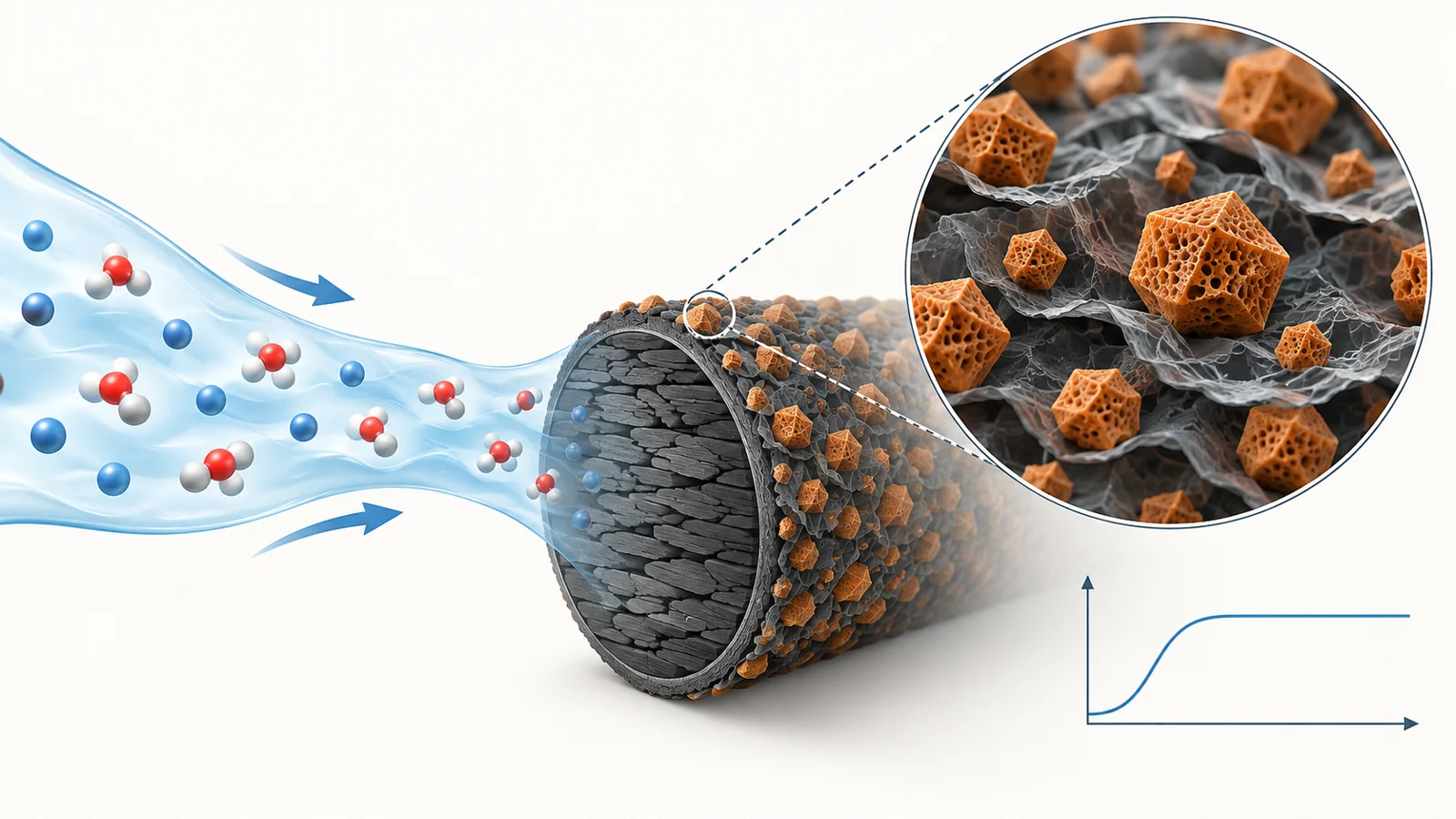
A 2024 study explored one such alternative using a coated pencil graphite electrode. The coating combined MIL-100(Fe), an iron-based metal-organic framework—a porous sensing material—with graphene oxide sheets. Connected to a system that carries injected samples past the electrode, it measured dexamethasone through changes in electrical current.
The useful advance was a combination of features: detection at a low applied potential, sensitivity to small concentrations and tests on prepared pharmaceutical and cosmetic samples. Understanding its practical reach means looking at how those features worked together, including what happened as the electrode was reused.
Turning dexamethasone into a current response
The pencil graphite electrode provides the underlying electrical contact. Its coating supplies the chemistry that makes dexamethasone measurable at a lower potential.
In the authors’ proposed mechanism, iron in MIL-100(Fe) cycles between two oxidation states, Fe(II) and Fe(III). The electrode oxidizes Fe(II) to Fe(III). Dexamethasone then participates in a reaction that reduces Fe(III) back to Fe(II), while the drug itself is oxidized. This process increases the measured oxidation current. With calibration against known concentrations, the current becomes a way to estimate how much dexamethasone is present.
Graphene oxide contributes a sheet-like support with surfaces that can adsorb molecules and accommodate the iron-based particles. The material measurements help explain why combining the two mattered. The composite had a measured specific surface area of about 669 square meters per gram, compared with about 303 for MIL-100(Fe) alone and 297 for graphene oxide alone. That measurement describes accessible surface within the material, not the visible size of the electrode.
Electrical testing also showed a useful compromise. The composite’s resistance to electron transfer was 5.15 kilohms, substantially below the 17.50 kilohms measured for the iron-framework coating alone. Graphene oxide alone had still lower resistance, at 1.15 kilohms. The composite therefore brought together the iron’s sensing chemistry and improved electron transfer relative to the iron-only coating; it did not simply maximize conductivity.
Why the low operating potential matters
In flow-injection amperometry, a sample enters a moving liquid stream and passes the electrode. The instrument holds the electrode at a chosen potential and records the resulting current peak. Peak height provides the analytical measurement.
The optimized sensor operated at +0.10 volts relative to a silver/silver chloride reference electrode. This is the working electrode’s detection potential, rather than a measure of the entire instrument’s power consumption. In separate electrochemical measurements, direct dexamethasone oxidation on bare graphite occurred around +0.62 volts. The iron-mediated response offered a way to detect the drug at a lower operating potential.
That choice can help distinguish dexamethasone from other electroactive ingredients. The paper identifies several possible cosmetic interferents whose oxidation occurs at higher potentials. Operating below those reactions can reduce their contribution to the measured current. The benefit concerns unwanted electrical responses from sample ingredients, rather than any change in the drug’s properties.
Getting that response required balancing the coating. A 1:1 ratio of MIL-100(Fe) to graphene oxide performed best. Increasing the iron-material proportion reduced the response, which the authors attributed to poorer conductivity. Too much graphene oxide could also hinder electron flow through overlapping sheets. The balance between the two coating components therefore mattered for the response.
The operating conditions mattered as well. The researchers optimized the flow system and used an acidic buffer at pH 2. The reported performance belongs to that controlled arrangement, where coating composition, solution chemistry and movement of the sample all influence the current.
What the analytical measurements show
The reported detection limit was 0.030 micromolar, or 30 nanomolar. It was calculated using three times the standard deviation divided by the calibration slope. This is an estimate of the concentration distinguishable from measurement variability; it should not be read as a guarantee of accurate quantification at that concentration.
The calibration results covered two separate concentration intervals:
| Measurement | Reported result |
|---|---|
| Lower linear range | 0.10–5.0 micromolar |
| Higher linear range | 0.010–5.0 millimolar, equivalent to 10–5,000 micromolar |
| Detection limit | 0.030 micromolar |
| Optimized detection potential | +0.10 volts versus silver/silver chloride |
The distinction between the intervals matters. They are two reported calibration ranges, with a gap between 5 and 10 micromolar, rather than evidence for one uninterrupted linear response across the entire span. Each tested concentration was measured in triplicate.
To examine consistency, the researchers prepared five electrodes together under the same conditions and another five at different times. At a dexamethasone concentration of 2.0 millimolar, they reported relative standard deviations of 0.6–5.1% for repeatability and 0.7–5.3% for reproducibility. These measurements describe variation in the response under the tested preparation conditions. Accuracy in actual products was assessed separately.
The interference tests challenged the system with selected salts, glucose, urea and cosmetic preservatives, including parabens and antioxidant additives. At five times the dexamethasone concentration, the tested substances produced no significant changes in the recorded response. That result supports selectivity against this particular set of ingredients; it does not establish that the electrode uniquely identifies dexamethasone in every mixture.
Repeated use revealed another practical distinction. During injections of 2.0 millimolar dexamethasone, the first 55 cycles averaged 90 ± 15% of the initial response. By injection 55, the response had fallen to about 80% and continued declining. The researchers consequently limited each electrode to 40 injections in subsequent experiments. The headline figure of 55 injections describes a durability test that included deterioration, while 40 was the more conservative working limit they adopted.
What happened in medicines and whitening creams
The application study used three pharmaceutical products and five whitening creams obtained from local shops. Samples were prepared in acidic buffer and analyzed using standard addition, in which known quantities of dexamethasone are added to help quantify the response within the sample mixture. These were laboratory measurements of prepared samples, not direct readings from an untouched tablet or cream.
For the pharmaceutical products, results from both the sensor and the comparison method, high-performance liquid chromatography with diode array detection, were within 8% of the labeled concentrations. Agreement with this separate analytical technique adds useful evidence that the electrical response could support measurements beyond simple standard solutions.
Neither method detected dexamethasone in the five whitening creams. That finding does not demonstrate complete absence. A concentration below the relevant method’s detection capability remains possible, so these creams did not provide a demonstration of detecting naturally present contamination.
Adding known dexamethasone quantities supplied a different test. The sensor method recovered 93–111% of the added amount, compared with 84–107% for the chromatography method. Recovery asks how much of a known addition the analysis measures back. Values above 100% reflect overestimation, rather than additional drug being present. These results support feasibility in the tested sample preparations without establishing equivalent performance across the much wider variety of cosmetic formulations.
The flow measurement took about 100 seconds per injection. That is a useful indication of measurement speed, but it is only one part of a workflow that also requires sample preparation, calibration and electrode handling. The low detection potential and graphite base alone cannot establish the cost or throughput of a complete routine testing service.
Taken together, the application results support a laboratory analytical method with a limited product test set. Extending that result to routine use would depend on performance across broader formulations, reproducible electrode fabrication and robustness during everyday operation. Repeated injections assess working lifetime during a run; they do not establish how stored electrodes would perform after longer periods.
What this could change
If the low-potential response holds across more formulations and electrodes can be made consistently, this approach could give laboratories a simpler way to screen prepared pharmaceutical and cosmetic samples for dexamethasone. The causal advantage is specific: the iron-based coating enables a measurable response at a potential that helps avoid reactions from some other ingredients, while flowing samples past the electrode permits repeated measurements.
Reliable fabrication and manageable electrode replacement would make that combination more useful in routine batches. Laboratories could gain an additional measurement option for checking product composition, with chromatographic confirmation used where appropriate. The 2024 result provides an experimental basis for that possibility through its low-potential chemistry, measured calibration behavior and small real-sample study. The downstream payoff would come from carrying those properties into dependable testing workflows.
Key Sources
- Primary source: Iron-based metal-organic framework/graphene oxide composite electrodes for efficient flow-injection amperometric detection of dexamethasone.
DOI or Journal Page · Peer-Reviewed Paper · 2024-07-31
Keep exploring