
Research Signal – Source date 2021-05-26
A treatment idea begins with a measurement question
A May 26, 2021 ClinicalTrials.gov entry proposed a way to investigate whether cellular senescence might contribute to Long-Hauler Syndrome, now commonly called long COVID. Its central question was not whether a drug already worked. It was whether senescent cells, together with the substances they release, were linked closely enough to persistent illness to justify a future trial of senolytic drugs—medicines intended to selectively eliminate senescent cells.
That sequence matters. Before testing a cell-clearing treatment, researchers would need evidence that the biological feature it targets is associated with the condition being studied. The registry described a pilot investigation built around blood and urine measurements from consenting patients, with those measurements related to symptoms and other clinical characteristics.
The proposal therefore connected a possible treatment idea to an earlier research step: looking for signs that senescence-associated processes are present in people with long COVID and relevant to their illness.
What the samples are meant to reveal
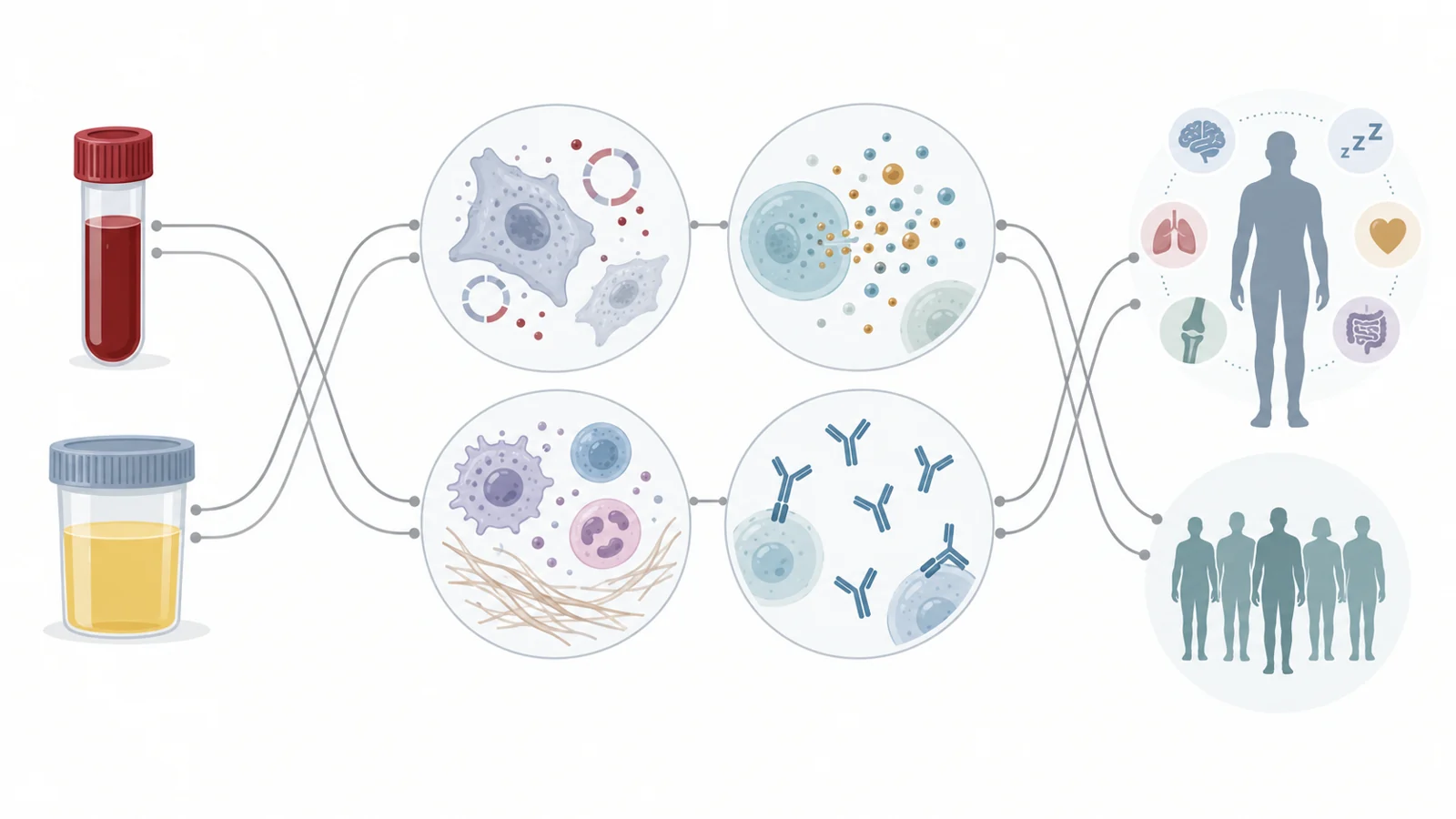
The planned assays were grouped around several kinds of biological signal. They included markers of cellular senescence and SASP factors, the senescence-associated secretory factors named in the registry. The study also planned to examine inflammatory mediators, pro-fibrotic factors and auto-antibodies in blood and urine.
These categories were not treatment readouts. They were measurements intended to test whether the proposed biology could be detected and related to the condition. A sample might provide information about several signal groups at once, allowing the researchers to ask whether senescence-associated measurements appeared alongside inflammatory, fibrosis-related or immune-related features.
The supplied study description does not establish that participants received a senolytic drug. The measurements came first because they could help determine whether a later intervention study had a sufficiently grounded rationale.
Putting molecular signals in patient context
A number in a blood or urine assay would be difficult to interpret on its own. The proposed analysis would relate the measurements to a person’s age, the timing and severity of their COVID-19 infection, current Long-Hauler Syndrome symptoms, physical examination findings, underlying conditions and laboratory data.
The registry described two related questions. One was whether features of long COVID were associated with markers of cellular senescence or SASP factors. The other was whether SASP factors were higher in patients seen in a long COVID clinic than in controls. The first question connects molecular measurements with differences between patients. The second asks whether a particular group of secreted factors distinguishes clinic patients from a comparison group.
Those comparisons could make the hypothesis more specific. They might show that certain measurements track with particular patient characteristics or differ between groups. But the prospective description does not establish that the comparisons found elevated markers or an association with symptoms. It also does not establish whether enrollment or sampling had occurred at the historical publication date.
A signal would still leave the treatment question open
Even a relationship between a senescence-associated measurement and persistent symptoms would have more than one possible interpretation. Senescent cells might contribute to symptoms. The measurements might reflect another process that accompanies long COVID. They might also vary with differences among patients, such as age, previous infection severity or underlying conditions.
Marker comparisons and treatment trials answer different questions. The proposed measurements could help investigate associations with long COVID features and whether SASP factors are higher in clinic patients than in controls. They could not, by themselves, show that senescent cells cause persistent symptoms, that removing them would improve health, or that such removal would be safe in this population.
That is why the registry framed the work as a possible basis for deciding whether to initiate a senolytic trial. A future intervention would need to test the consequences of treatment directly. The study description provided here establishes the proposed measurements and comparisons, not senolytic administration, clinical benefit, safety findings or a treatment recommendation.
What this could change
For people living with persistent symptoms, the potential benefit would be a treatment approach aimed at a biological contributor to their illness. Instead of moving directly from a molecular association to a prescription, the proposed path would require evidence that senescent cells genuinely contribute to symptoms and that selectively eliminating them can safely improve patient outcomes. If both conditions were eventually met, the blood and urine investigation could have helped turn a biological hypothesis into a testable therapeutic direction.
Key Sources
- Primary source: Cellular Senescence and COVID-19 Long-Hauler Syndrome
Government or Regulator · Clinical Trial · 2021-05-26
Keep exploring