
Research Signal – Source date 2024-08-30
The liver can repair itself remarkably well, but that ability has limits. Primary human hepatocytes, the cells that perform many of the liver’s essential functions, are difficult to make multiply outside the body. Inside the body, disease can damage the liver’s regenerative capacity just when replacement cells are most needed.
A review published on August 30, 2024, examines one way researchers are trying to address this shortage: lineage reprogramming. In plain language, the approach directs one kind of cell toward a liver-cell identity without first converting it into a pluripotent stem cell. The idea could create new sources of hepatocytes or hepatic progenitor-like cells, either for laboratory work or, eventually, for repair inside a diseased liver. The research summarized in the review remains largely experimental, with important questions still separating a changed cell identity from a reliable treatment.
Why researchers need another source of liver cells
A healthy liver can replace lost cells after some injuries. That natural response becomes less effective under chronic damage, fibrosis, cirrhosis, aging, or other pathological conditions. At the same time, primary human hepatocytes have limited ability to proliferate in vitro. Researchers therefore face a practical problem: the cells most useful for studying liver function or replacing damaged tissue are not easy to produce in large quantities.
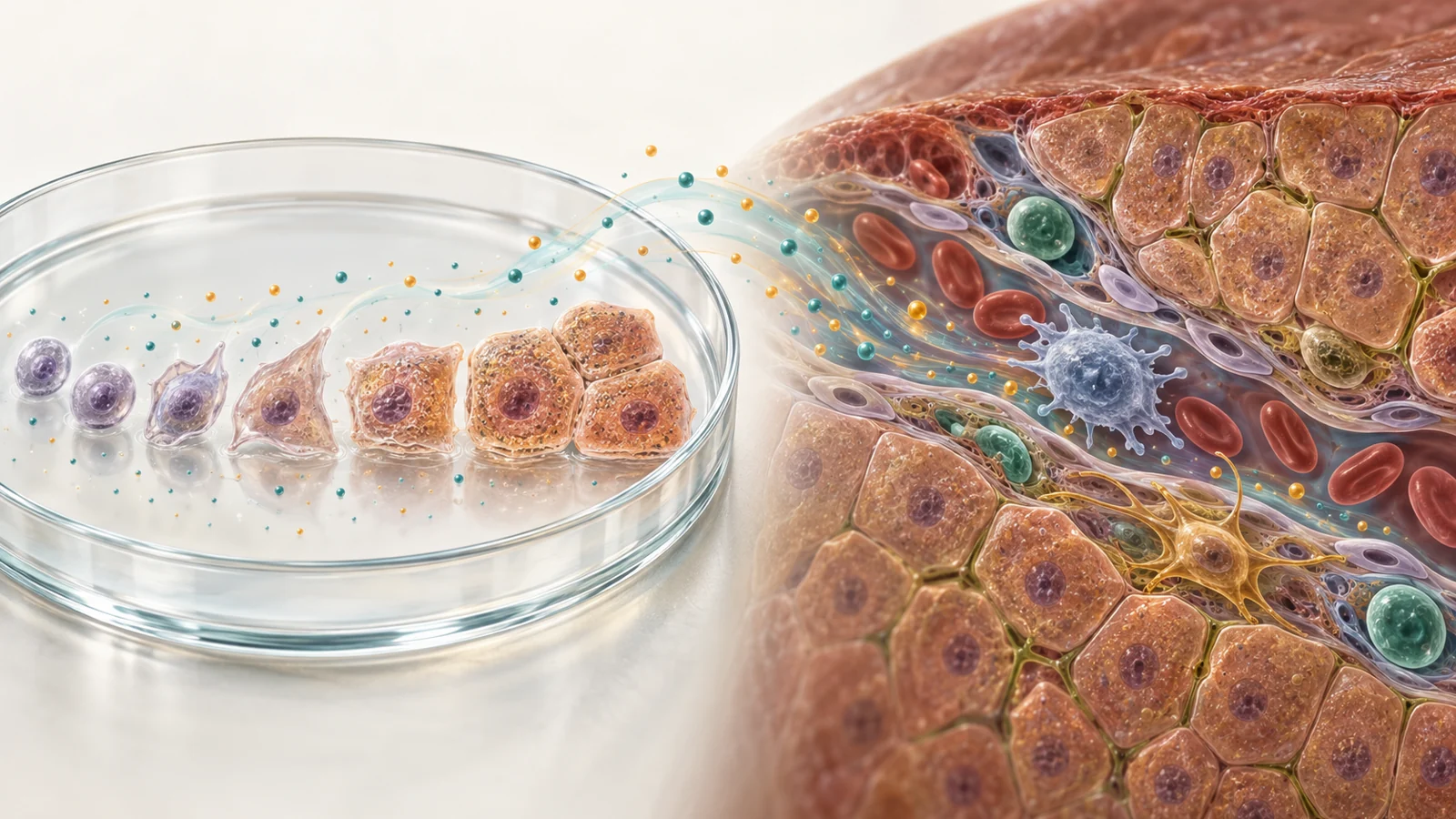
Lineage reprogramming is intended to work around that bottleneck by changing the identity of cells that are more available or more capable of expansion. The starting material might be fibroblasts, liver-associated cells, or other epithelial cells. Some strategies try to convert the starting cell directly into a hepatocyte-like cell. Others first create a more flexible, proliferative intermediate and then guide that intermediate toward a hepatic fate.
This route differs from classical reprogramming into induced pluripotent stem cells. Instead of passing through a pluripotent state and then adding developmental signals to make a liver cell, lineage reprogramming aims to establish the new identity more directly. Skipping that intermediate could theoretically reduce some risks associated with pluripotent cells after transplantation. It does not, however, make the resulting cells automatically mature, stable, safe, or suitable for patients.
How one cell identity can be redirected
Two broad tools appear repeatedly in the review’s discussion of in vitro work: transcription factors and chemical compounds. Transcription factors are proteins that help switch groups of genes on or off. By supplying combinations associated with liver identity, researchers try to push another cell toward a hepatocyte-like state.
Chemical reprogramming uses small-molecule combinations to alter the cell’s behavior without relying on the same kind of forced transcription-factor expression. The route can be direct, or it can pass through an intermediate state with greater plasticity. Which route is used depends on the starting cell and the desired endpoint.
The distinction matters because a cell that resembles a hepatocyte under a microscope is not necessarily equivalent to a mature liver cell. Researchers also need to know whether it performs the relevant metabolic functions, maintains its identity over time, and behaves predictably after being placed in a biological environment. The review describes progress toward those goals, but it also highlights how easily apparent conversion can conceal incomplete or unstable reprogramming.
Mouse results show a possibility, not a ready-made therapy
The review describes chemical approaches that converted mouse fibroblasts into mouse induced hepatocyte-like cells. In one more recent example discussed by the authors, the resulting cells showed metabolic activity comparable to primary hepatocytes in vitro and were able to repopulate mouse livers in vivo. Those findings make the basic concept more concrete: a cell that did not begin as a hepatocyte can acquire liver-like functions and participate in liver replacement in an animal model.
The same results also show why the human question cannot be answered by extending a mouse result in a straight line. The review identifies the conversion of human fibroblasts into human hepatocyte-like cells using small molecules as a major unresolved challenge. Other chemical strategies have started with human liver or gastrointestinal tissues, which may provide useful material but are limited by the availability of those tissues.
So the field is working on two linked problems. It needs a method that can generate enough cells, and it needs a starting material that is accessible enough for practical use. Success in one species or with one tissue source does not settle either question for human treatment.
The target cell changes with the disease
Lineage reprogramming does not have to mean making cells in a dish and transplanting them later. The review also discusses in vivo approaches, in which reprogramming agents are delivered into the liver and act on cells already present there.
The most useful target may depend on what has gone wrong. In fibrosis or cirrhosis, mesenchymal cells called myofibroblasts accumulate as part of the scarring process. They can contribute to fibrosis and impede hepatocyte regeneration. The review describes mouse studies that used liver-directed vectors to deliver liver-associated transcription factors to these cells, producing a low level of hepatic reprogramming.
A different problem appears in aging or disease states where hepatocytes remain present but have lost much of their ability to regenerate. In that setting, the proposed strategy is to restore or redirect damaged hepatocytes themselves rather than replace the surrounding mesenchymal population.
Delivery is therefore part of the biological strategy, not just a transport detail. Adeno-associated virus vectors and lipid nanoparticles are among the systems discussed for carrying transcription factors, messenger RNA, or gene-regulating tools into the liver. Their natural tendency to reach liver tissue is useful, but efficient and selective delivery remains difficult, especially when the intended target is a non-parenchymal cell rather than a hepatocyte.
The hardest step is proving that the new cell stays useful
A successful conversion needs more than a temporary change in gene activity. The review points to concerns about identity stability, maturation, purity, delivery efficiency, and the possibility of unsafe growth. One cited study found that mouse cells produced through transcription-factor-mediated reprogramming could drift back toward their original mesenchymal state after passages in culture. In an animal setting, the cells showed uncontrolled proliferation and produced both hepatic and ectopic mesenchymal derivatives. Those observations do not describe every reprogramming method, but they show why a liver-like appearance is not enough.
The method of delivery can add another layer of concern. Retroviral and lentiviral systems may insert introduced genetic material into the genome. Some reprogramming designs have also involved factors such as Myc or p19Arf, whose use requires careful consideration because of possible links to oncogenic transformation. Bypassing pluripotency may reduce one theoretical source of risk, but it does not remove the need to evaluate the converted cells themselves.
The review’s central evidence boundary is equally important. Its in vivo validation of reprogrammed hepatic-cell function is limited to animal models. Whether the same approaches can work effectively and safely in human bodies remains uncertain. The review also emphasizes that converted cells still need fuller functional maturation, high purity, stable identity, better targeting, and scalable production. These are connected requirements: an immature cell, an imprecisely delivered factor, or an unstable identity could undermine the intended repair even if the initial conversion appears successful.
What a larger supply of liver cells could make possible
A dependable way to generate mature, stable liver cells could expand the supply of hepatocytes for disease research, drug-related testing, and future regenerative strategies. It could also support approaches that act within an injured liver by redirecting selected resident cells instead of relying only on externally prepared cells.
That capability remains conditional on solving the problems identified in the review: human conversion, functional maturation, purity, stable behavior, safe and targeted delivery, and disease-specific performance. If those pieces can be made to work together, lineage reprogramming could give researchers more ways to replace or restore lost liver-cell function. The review supports the possibility and the research direction, not an established treatment for people.
Key Sources
- Primary source: The Progress and Promise of Lineage Reprogramming Strategies for Liver Regeneration.
DOI or Journal Page · Review or Meta-Analysis · 2024-08-30
Keep exploring